In a recent incident, Commonwealth Games medallist Narender Berwal left Prime Minister Narendra Modi in splits. Recalling a past bout against a Pakistani boxer, Berwal revealed his opponent admitted to hating the name “Narendra” because the Indian fighter, his coach, and the Prime Minister all shared it. The viral exchange put the classic Indian name back into the spotlight.
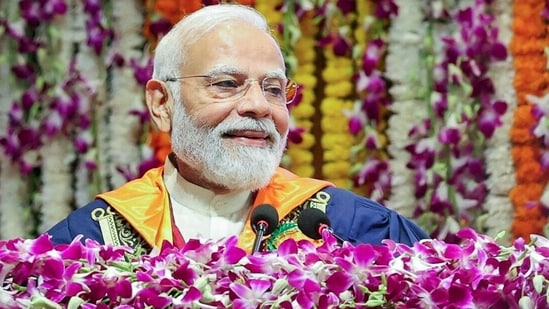
However, beyond modern headlines and viral sports moments, the name carries a rich legacy. From writers to mathematical geniuses, several influential figures named Narendra have left an indelible mark on India’s culture and history.
What does the name ‘Narendra’ mean?
According to ancestry.com, the name is derived from Sanskrit. It comes from two elements: one is “Nara,” which means “man,” and the other is “Indra,” the king of the Gods in Hindu mythology. The moniker is interpreted as "the king of men" or "leader of men.”
Famous people named Narendra:
1. Narendra Modi
Prime Minister Narendra Modi, born in 1950, rose from modest beginnings to become one of the most influential contemporary political leaders in India. He established his administrative reputation as the longest-serving Chief Minister of Gujarat from 2001 to 2014.
In 2014, he took the oath as India’s PM for the first time and became the first prime minister born after Independence. He was sworn in to the position for the third time in 2024. On June 10, 2026, he became the longest-serving elected Prime Minister of the country, surpassing the previous record held by Jawaharlal Nehru.
2. Narendra Hirwani
{{/usCountry}}In 2014, he took the oath as India’s PM for the first time and became the first prime minister born after Independence. He was sworn in to the position for the third time in 2024. On June 10, 2026, he became the longest-serving elected Prime Minister of the country, surpassing the previous record held by Jawaharlal Nehru.
2. Narendra Hirwani
{{/usCountry}}He was a leg-spinner who took the cricket world by surprise after bagging 16 wickets against the West Indies in a test match in Chennai in 1988. He was 19 at the time. Though his magical performance gave Team India a glorious victory, he couldn’t quite replicate it throughout his career.
He announced his retirement in 2006. At that time, he told the media, “No regrets on being dropped or not being picked as the team selection depends on the requirements of the team.”
According to a 2006 Hindustan Times report, Hirwani was employed by Air India. The Gorakhpur-born former cricketer was reportedly appointed to the national selection panel in 2008.
PTI, in a 2014 report, stated that he was appointed the chairman of the Madhya Pradesh Cricket Association's (MPCA) committee that selected players for the Ranji Trophy.
3. Narendra Karmarkar
Narendra Karmarkar is a mathematician known for developing an interior-point algorithm in 1984. According to the Indian Institute of Science (IISc), he “invented a polynomial algorithm for linear programming, also known as the interior point method. The algorithm is a cornerstone in the field of Linear Programming.” He published the result of his invention, the “Karmarkar’s Algorithm”, while working for the Bell Laboratories in New Jersey in 1984.
He is an IIT Bombay graduate and completed his B.Tech in electrical engineering from the prestigious institution in 1978. Following this, he went on to complete his MS at the California Institute of Technology and PhD in computer science at the University of California.
Over the years, he received numerous awards, including the Paris Kanellakis Award by The Association for Computing Machinery for “specific theoretical accomplishments that have had a significant and demonstrable effect on the practice of computing” in 2020. He also received the Distinguished Alumnus Award from IIT Bombay in 1996. Additionally, he is the recipient of the 1999 Srinivasa Ramanujan Birth Centenary Award and the Fulkerson Prize in Discrete Mathematics, awarded jointly by the American Mathematical Society & Mathematical Programming Society.
4. Colonel Narendra ‘Bull’ Kumar
Ace mountaineer Colonel Narendra Kumar played a crucial role in helping India secure the Siachen Glacier. Awarded Padma Shri, Arjun award and the Kirti Chakra, the retired colonel was fondly known as ‘Bull’. He passed away in 2021 at the age of 87 at the Army Research and Referral Hospital in New Delhi due to age-related illness.
Bipin Rawat, the Chief of Defence Staff of the Indian Armed Forces at the time, expressed his condolences on Kumar’s demise. “On the demise of Col Narendra ‘Bull’ Kumar, we convey our condolences. A soldier whose determination and yearning to scale high mountain peaks led to discoveries that helped the Army in occupying locations that helped us in strengthening our defensive posture,” he had said.
“Our strong posturing on the Saltoro Ridge and in other areas of Ladakh are a part of his adventurous travels. His name will forever remain etched in the rich history of our Army,” Rawat said at the time.
5. Dr Narendra Kohli
Dr Narendra Kohli was one of the most eminent and well-known Hindi writers. He was the first to write Ramayana as a series of novels. His novel Mahasamar, based on the Pandava-katha, was also extremely popular. Additionally, he was known for Todo, Kara Todo - a novel based on the life of Swami Vivekananda. His other well-known works include Sagar-Manthan, Ahalya, Abhigyan, Vasudev, Aatma Swikriti, Sharnam, and Varunputri.
He was awarded the Padma Shree. Apart from the fourth-highest civilian award, he was also awarded the Hindi Akademi award, Hindi Sansthaan award, Pandit Deen Dayal Upadhyay Samman, and Madhya Pradesh government and Bhopal’s Maithili Sharan Gupt Rashtriya Samman, among others.
He died in 2021 due to Covid-19-related complications.
6. Narendra Nath Mitra
Narendra Nath Mitra was a Bengali writer best known for his short stories. Born in 1916 in a village in Faridpur (now Bangladesh), he later relocated to Kolkata. After Independence, he chose to stay in India rather than return to his birthplace, which at the time was part of East Pakistan.
After completing his SSC level education, he completed his IA from Rajendra College. Later, he came to Kolkata and completed his BA from Bangabasi College.
He initially worked at the Dum Dum Ordnance Factory and later joined the Kolkata National Bank. Eventually, he became a journalist and remained with Anandabazar Patrika until his death in 1975.
Among his many short stories, one of the most famous is Abataranika, which was later adapted into the film Mahanagar by Satyajit Ray.
7. Swami Vivekananda (Narendranath Dutta)
One of the most significant mentions on the list is Narendranath Dutta, despite his name being a Bengali variant of “Narendra”. Swami Vivekananda, born Narendranath Dutta, was the son of an aristocratic Bengali family. He was fondly known as “Naren”.
From a young age, he displayed intense spiritual curiosity and intellectual brilliance. His life was transformed after becoming the chief disciple of Ramakrishna Paramahamsa. Later, he embraced monastic life and took the name Swami Vivekananda.
He became internationally renowned following his iconic 1893 address at the Parliament of the World's Religions in Chicago, where he introduced Hindu philosophy and the concept of universal tolerance to the West.
He passed away while meditating in his room at the Belur Math in West Bengal in 1902.