Every year, the Nobel Prizes recognise breakthroughs in fields ranging from physics and chemistry to medicine and literature. But there is one subject many people might expect to see on the list that is missing, mathematics. So, did Alfred Nobel deliberately leave mathematics out? And is there really a story involving a mathematician that explains the omission?
What did Alfred Nobel actually include?
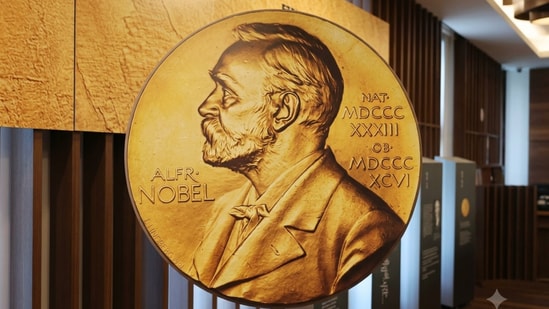
The answer begins with Nobel’s will. When Alfred Nobel wrote his final will in 1895, he directed that his fortune should fund prizes for people who had conferred the “greatest benefit to humankind”. He specified five fields, physics, chemistry, physiology or medicine, literature and peace.
Mathematics was not included.
The Nobel Prize’s official account of Alfred Nobel’s will confirms that these were the five original categories. The first Nobel Prizes were awarded in 1901.
There is also an important detail that often causes confusion. The economics prize was not part of Nobel’s original plan either. The Sveriges Riksbank Prize in Economic Sciences in Memory of Alfred Nobel was established in 1968, decades after his death.
(Also Read: Golden naked Trump statue at EU Parliament: 3 bizarre statues of the US president made by artists)
Why is there no Nobel Prize for mathematics?
{{/usCountry}}(Also Read: Golden naked Trump statue at EU Parliament: 3 bizarre statues of the US president made by artists)
Why is there no Nobel Prize for mathematics?
{{/usCountry}}One of the most persistent stories about the missing mathematics category involves Swedish mathematician Gösta Mittag-Leffler. A popular rumour claims that Alfred Nobel had a personal rivalry with Mittag-Leffler and that this was somehow linked to his decision not to create a mathematics prize.
The story has been repeated in different versions over the years, including claims about an alleged relationship involving a woman Nobel knew. But there is no reliable evidence that this was the reason mathematics was left out.
The MacTutor History of Mathematics discusses the rumour and notes that the alleged personal connection between Mittag-Leffler and Nobel’s mistress had no factual basis.
The Institute for Pure and Applied Mathematics (IMPA) also describes the rivalry and romance explanations as legends. It says the simplest answer is that Nobel could not create prizes for every area of knowledge and chose five fields that he considered closely connected to the progress of humanity.
What prize do mathematicians get instead?
Mathematics eventually got a major international prize of its own.
The Abel Prize was established by the Norwegian Government in 2002 and is awarded annually for outstanding achievements in mathematics. Its first recipient was French mathematician Jean-Pierre Serre in 2003.
The official history of the Abel Prize notes that the idea for a major mathematics prize had actually been discussed long before the modern Abel Prize was created, partly because Nobel’s original prizes did not include mathematics.
(Also Read: 61-year-old woman completes 5-hour plank, sets longest female abdominal plank record)
Mathematicians can also receive the Fields Medal, another highly prestigious honour that is awarded every four years.
So, the mystery has a rather simple ending. There was no Nobel Prize for mathematics because Alfred Nobel did not put mathematics in his original will. The rivalry story has been repeated for years, but there is no solid evidence behind it.