Most of us think mistakes can be undone. You delete a file, you fix it; you spill your coffee, you clean it. Nature doesn't always work like that. In a 2018 study published in Basic and Applied Ecology, Victoria Coffey and Rafael Otfinowski found that prairie land in Canada's Riding Mountain National Park that once held spruce plantations didn't come close to resembling untouched prairie 19 years after the trees were removed.
How a prairie ended up under spruce
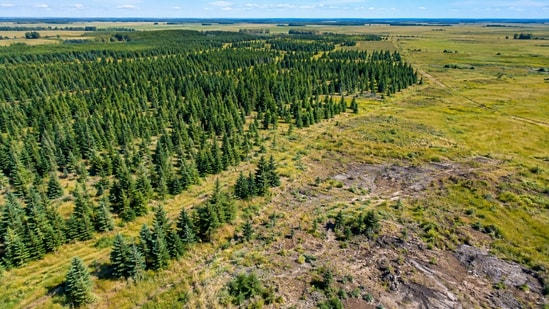
According to the research, various fescue prairies in the park in Manitoba were transformed into white spruce plantations between 1928 and 1950. It was an attempt to make up for trees that were logged before the park was created. Some trees were later taken out of some places to give the prairie space to regenerate itself. Fescue prairie is a rare type of land, and the researchers believe that nowadays it occupies less than 5 percent of its original habitat in North America.
In order to evaluate the regeneration potential of the land, the team compared untouched prairie with patches cleared at different times, giving them a window into up to 19 years of recovery to see how well the land bounced back. Researchers also studied seed banks, which are stores of seeds that are lying in the soil. If the seed bank is damaged, the prairie may struggle to restore itself. The authors acknowledge that the barriers to recovery may persist long after the trees are gone. They refer to these long-term effects as legacies.
What the scientists found above ground
A total of 131 plant species were recorded. However, none of the cleared plots resembled the undisturbed prairie plot, even after 19 years of clearing the trees. Weedy species increased following the removal of the trees. There was an increase in plant diversity followed by a decline over the 19 years studied. Native species decreased, whereas exotic and invasive species increased. Rough fescue, the defining grass of the prairie, was absent in all the cleared plots. The authors also found that the seed bank did not match the vegetation above ground, which made natural recovery difficult. In simple terms, the land did not simply revert to how it looked before the trees.
What changed below the surface
{{/usCountry}}A total of 131 plant species were recorded. However, none of the cleared plots resembled the undisturbed prairie plot, even after 19 years of clearing the trees. Weedy species increased following the removal of the trees. There was an increase in plant diversity followed by a decline over the 19 years studied. Native species decreased, whereas exotic and invasive species increased. Rough fescue, the defining grass of the prairie, was absent in all the cleared plots. The authors also found that the seed bank did not match the vegetation above ground, which made natural recovery difficult. In simple terms, the land did not simply revert to how it looked before the trees.
What changed below the surface
{{/usCountry}}The story has deeper roots. In her master's thesis at the University of Winnipeg, Coffey analyzed nematodes, very small worms living in the soil. She compared nematode communities in native prairie, remaining plantation, and areas cleared 2, 5, and 20 years before her sampling. The thesis found that the native prairie had the lowest nematode diversity, unlike the oldest cleared area. That means the cleared soil had moved away from the native prairie's community, not back toward it. Plant-feeding nematodes were the most abundant group in both the oldest cleared area and the native prairie. It also showed a strong association of the nematode community with the overlying plants. This suggests that the plants and soil life changed together.
What this means for restoration
The authors conclude that tree removal alone is not enough to restore northern fescue prairies. Low-variety plant communities can persist and block recovery without active management. Most people think of tree planting as an easy way to help the planet. The study isn’t saying tree planting is bad. It just shows that place matters because a grassland is a living system with its own plants, seeds, and soil life. This was only one site in one park, so the results may not apply everywhere. But the message is useful for anyone who cares about nature: fixing a landscape can take far more than undoing the original change.