
 E-Paper



Big Tech Companies Prepare to Skirt Trump’s $100,000 H-1B Fee
Some giant firms are discussing ways to avoid paying. Smaller ones have fewer options.


 Prefer HTon Google


WASHINGTON—The world’s biggest technology companies are looking to skirt President Trump’s $100,000 H-1B visa fee, potentially leaving the brunt of the new policy to hit smaller startups.
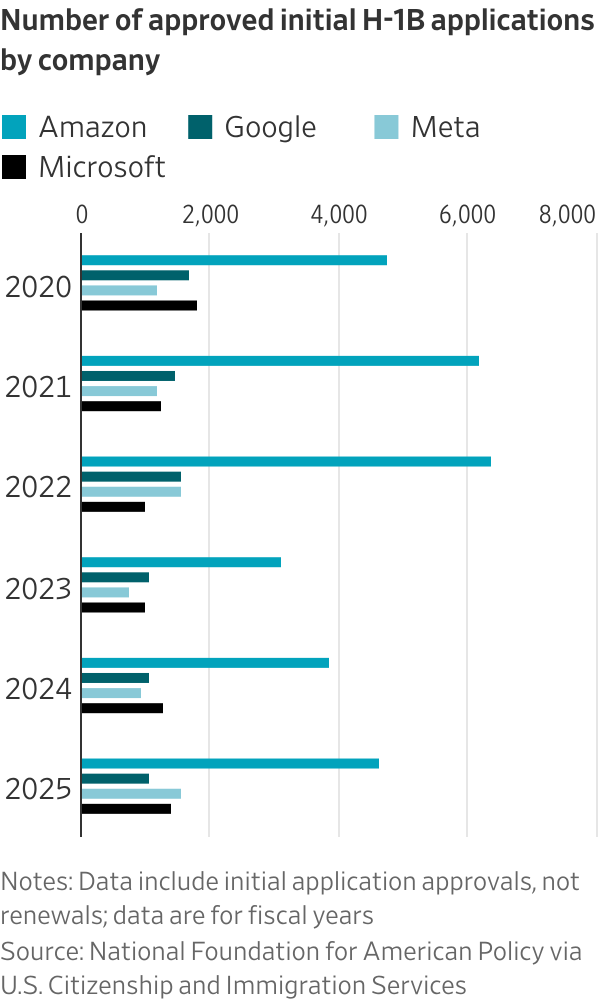
Drawing largely on playbooks they have relied on for years, Amazon.com, Microsoft, Alphabet’s Google and others generally plan to find workers in categories that don’t have to pay the fee, including existing H-1B visa holders, students and people on other types of visas, according to people familiar with the companies’ plans.
Some of the companies have been reducing their reliance on the H-1B program in recent years and are discussing ways to avoid using the system in certain cases, the people said.
But many smaller companies, including startups in specialized areas such as artificial intelligence and healthcare, can’t easily navigate the policy changes or invest in alternatives that are cheaper than the $100,000 fee but still more costly than the status quo.
“It’s the big guys who are OK and the small guys who are either choosing a different path or going in a different direction,” said Morgan Reed, president of ACT | the App Association, a trade group for smaller tech companies that is asking the administration to give small businesses relief from the fee. “That’s antithetical to what everyone is asking for.”
The administration in September announced its new fee for the H-1B visa, which is the main pathway to the U.S. for highly skilled foreign workers. Visa holders can eventually become eligible to apply for green cards, which would let them stay in the country indefinitely. The administration said in October that many people wouldn’t have to pay the fee, calming the panic that set in after Trump initially announced it.
Every March, the government conducts a lottery that decides who will receive the coveted 85,000 new visas available for the coming year. The administration recently changed the lottery to give workers who will be paid higher salaries better odds, another factor expected to favor the top tech companies. Companies file hundreds of thousands of petitions for the visas each year. Employees of universities and other nonprofits are generally exempt from the 85,000 cap.
One common program used by big tech companies is the Optional Practical Training program, or OPT, which gives foreign graduates at U.S. universities temporary employment after graduation, typically for a year. Those with STEM degrees in science, technology, engineering or math can get another two years of employment before transferring to the H-1B program. Those employees won’t have to pay the H-1B visa fee, making it easier for companies to seamlessly use the program.
The big tech companies are best positioned to take advantage because they can often offer higher salaries and increase their chances in the lottery, experts say. They can also often place workers in offices overseas, an option rarely available to startups.
“It just doesn’t seem like the same rules should apply,” said Jennifer Ide, chief administrative and legal officer at healthcare startup Rimidi, which has about 20 employees. The company lost one worker who jumped to another firm that had an overseas office rather than risk staying with Rimidi, which likely couldn’t have kept them on if they were forced to leave the country due to the policy change. Another could be forced to leave the firm if they don’t win the lottery. “It would be prohibitive for us to pay the $100,000 fee,” Ide said.
Immigration hard-liners and some in the tech industry have been calling for changes to the H-1B program for years, saying consulting firms and other companies use it to replace American workers with lower-paid foreigners. The companies say the workers often have different skill sets and are doing different jobs, but some have criticized tech companies for using the H-1B program while laying off thousands of U.S. workers.
That criticism is what Trump and Commerce Secretary Howard Lutnick said they were trying to address with the $100,000 fee.
“It’s a difficult balancing act with the technologists and immigration hard-liners within the president’s coalition,” said Neil Suri, a vice president at research and advisory firm Capstone who focuses on technology policy.
Several groups, including the Chamber of Commerce and states, have sued the administration over the policy.
White House spokeswoman Taylor Rogers defended the $100,000 fee. “It will discourage companies from spamming the system and provide certainty to employers who actually need to bring the top-tier talent from overseas,” Rogers said.
Atlanta-based Rimidi needs engineers who specialize in integrating different types of healthcare data, giving it a limited pool of employees to begin with, Ide said. The company hires from nearby Georgia Tech and plans to pursue some of the same strategies as bigger firms, but paying high salaries to improve the chances of employees in the lottery is another challenge.
Some experts said the administration’s desire to restrict hiring of skilled foreign workers is a continuing concern for companies.
“If this was a book, the H-1B fee of $100,000 is chapter one,” said Stuart Anderson, executive director of the National Foundation for American Policy, a research organization that supports the program. “By the time the story ends, we’re going to see fewer and fewer highly skilled individuals eligible to work in the United States.”
Write to Amrith Ramkumar at amrith.ramkumar@wsj.com


