A strong earthquake of magnitude 6.3 struck Afghanistan early Monday morning, with intense tremors felt across the region, including in parts of Pakistan. The initial earthquake was followed by aftershocks. Almost all the tremors were classified as shallow earthquakes that originate closer to Earth’s surface.
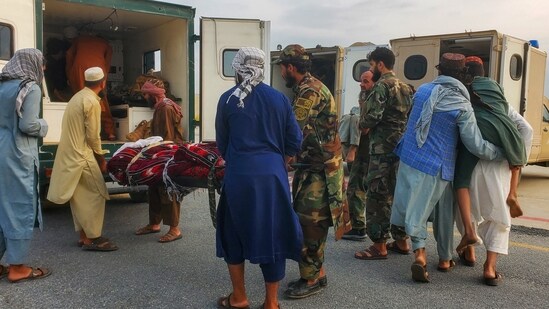
The quake's epicentre was near Jalalabad, Nangarhar province, the USGS said. The Kunar Disaster Management Authority said in a statement that at least 250 people were killed and 500 others injured in the districts of Nur Gul, Soki, Watpur, Manogi and Chapadare.
The shocks of this earthquake were felt across various regions in Afghanistan and in parts of Pakistan, including in Peshawar, Mansehra, Abbottabad & Swat.
According to the Indian National Centre for Seismology (NCS), the earthquake occurred at 11:47 pm local time on Sunday, at a depth of 160 km. This initial earthquake was followed by aftershocks with magnitudes ranging between 4 and 5.
After the 6.3 magnitude tremor, a 4.7 magnitude earthquake occurred at a depth of around 140 km, not far from the epicentre of the initial tremor.
{{/usCountry}}After the 6.3 magnitude tremor, a 4.7 magnitude earthquake occurred at a depth of around 140 km, not far from the epicentre of the initial tremor.
{{/usCountry}}"EQ of M: 4.7, On: 01/09/2025 , Lat: 34.62 N, Long: 70.92 E, Depth: 140 Km, Location: Afghanistan," NCS stated in a post on X.
This was followed by a 4.3 magnitude and a 5.0 magnitude tremor at 140 km and 40 km depth, respectively. The initial tremor and the aftershocks have been classified as shallow or intermediate earthquakes, depending on the depth.
As compared to deep earthquakes, shallow earthquakes originate from more to Earth’s surface and are generally more dangerous. This is because the seismic waves from Shallow earthquakes travel faster to travel due to a shorter distance, resulting in ground shaking and being more dangerous to structures.
Several videos also went viral on social media showing people panicking as the strong tremors shook the ground. The aftermath of it shows houses destroyed and covered in debris after the earthquake.
Afghanistan has a history of Powerful earthquakes, with the Hindu Kush Mountain region being more active, where quakes occur every year.
Earlier on August 19, an earthquake of magnitude 5.2 struck Afghanistan's Hindu Kush region.
Afghanistan sits on numerous fault lines between the Indian and the Eurasian tectonic plates, with a fault line also running directly through Herat.