London, 1888. Fear had taken hold of the East End. Five women had been brutally murdered, the killer remained at large, and the police had little to show for their investigation. With the killer still at large and Scotland Yard struggling to make progress, London's newspapers began shaping the story of a mysterious murderer who would become one of history's most infamous figures: Jack the Ripper.
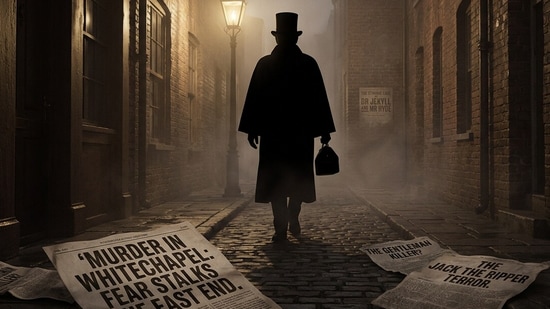
The Whitechapel murders gripped Victorian London, with reports of mutilated bodies, mysterious suspects and unanswered questions dominating newspapers. The story soon spread. A BBC retrospective, based on original Home Office files, later examined how sensational newspaper coverage fuelled myths that misled both the public and the police.
When fiction began to blur with reality
On November 9, 1888, Mary Jane Kelly, widely regarded as the fifth and final canonical victim of Jack the Ripper, was murdered in London's East End. At the time, the Lyceum Theatre was staging an American production of The Strange Case of Dr Jekyll and Mr Hyde. Its business manager was Bram Stoker, who would later write Dracula.
The theatrical production had already attracted attention for its portrayal of violence against women. The Pall Mall Gazette, reviewing the play, highlighted scenes in which Hyde attacked women. Within weeks, the newspaper was drawing comparisons between the fictional character and the mysterious killer stalking Whitechapel.
{{/usCountry}}The theatrical production had already attracted attention for its portrayal of violence against women. The Pall Mall Gazette, reviewing the play, highlighted scenes in which Hyde attacked women. Within weeks, the newspaper was drawing comparisons between the fictional character and the mysterious killer stalking Whitechapel.
{{/usCountry}}"It was almost prophetic," Christopher Frayling, a professor of cultural history at the Royal College of Art, told the BBC in 1988.
“The Gazette was writing of a Mr Hyde who stalked the East End. Jack the Ripper of Whitechapel and Dr Jekyll and Mr Hyde, Spring-heeled Jack – and all the merchants of menace who populated the Penny Dreadfuls and Victorian melodramas – had become inextricably intertwined.”
The similarities between fiction and the murders became so striking that Richard Mansfield, the American actor playing Jekyll and Hyde, was suspected of being the killer. A concerned theatregoer even wrote to the police suggesting that Mansfield could be Jack the Ripper.
“The murders were turned into fiction that very autumn, into a sort of morality play that still resonates,” Frayling told the BBC.
How newspapers may have created a monster
Newspaper coverage of the murders was not uniform. While Fleet Street publications such as The Daily Chronicle and The Times focused on the panic surrounding the murders and the idea of ‘outcast London’, local newspapers such as the East London Observer adopted a more sympathetic tone, as per HistoryToday.com.
After the murder of Polly Nichols, the Observer sent a reporter to view her body. While the Illustrated Police News sensationalised the killing, describing how Nichols’ ‘livid face was stained with blood and her throat cut from ear to ear’, the Observer offered a more restrained account: ‘The features were small and delicate, with the cheek-bones high, the eyes grey … The expression on the face was a deeply painful one.’
The Pall Mall Gazette, under editor WT Stead, was particularly influential.
Stead was experimenting with a sensational style of reporting that would later become associated with tabloid journalism. He also reportedly had a long-running grievance against Metropolitan Police Commissioner Sir Charles Warren, whom he blamed for what he considered a wrongful conviction and the excessive use of force against protesters.
The murders gave Stead an opportunity to criticise the police while drawing attention to prostitution, poverty and the exploitation of women.
Newspaper reports began suggesting that the killer could be a wealthy aristocrat. Others speculated that he was a doctor or an immigrant.
"There are a number of reasons why commentators [at that time]… imagine Jack the Ripper as a gentleman," Prof Judith Walkowitz, author of City of Dreadful Delight: Narratives of Sexual Danger in Late-Victorian London, told the BBC. “For at least 20 years, there had been agitation around the issue of prostitution, first coming from middle-class moral reformers and feminist agitators, and then heightened and elaborated in a newspaper expose of child prostitution by Stead, in which Stead documented how poor daughters of the people were snared for the sexual delectation of upper-class gentlemen.”
The victims were women living in poverty, many of whom had turned to prostitution to survive. Their murders became entangled with arguments about class inequality, sexual exploitation and morality in Victorian society.
Did sensational reporting influence the police?
The newspaper frenzy did more than shape public opinion. It also complicated the police investigation. As reports spread, the authorities received hundreds of letters from people claiming to have information about the killer. Many were signed using the name Jack the Ripper, which quickly became famous and appeared in several different spellings.
One particularly significant document was a memorandum written in 1894 by senior police officer Sir Melville Macnaghten. It named three possible suspects: Montague Druitt, a barrister whose body was found in the River Thames in December 1888; Aaron Kosminski, a Polish Jewish barber who lived in Whitechapel and later died in a mental asylum; and Michael Ostrog, a Russian doctor and former convict.
Frayling questioned whether these names represented the outcome of a thorough police investigation or simply repeated the theories circulating in the press. “Consider how they overlap with all those toffs and outsiders and doctors who were mentioned by the press in 1888 as part of their campaigns. Is this really the considered conclusion of a manhunt, or is it the gossip of the clubs?”
The legend of Jack the Ripper
The Whitechapel killings became an international story, but the killer was never identified. As the years passed, the lack of a definitive answer created room for more theories, books and investigations.
Jack the Ripper was variously imagined as an aristocrat, a doctor, an immigrant, an artist or a mentally ill man.