At the annual Diwali gala organised by the Canada-India Business Council (C-IBC) in Toronto in October, Canadian Prime Minister Justin Trudeau said: “One of the reasons we are such good friends, Canada and India, is that we are the two largest democracies in the world – one by population and one by size.”
Those words, he went on, were borrowed from a person with a facility for crafting lines – Vikas Swarup, author of the novel Q&A which became the basis for the multiple Academy Award-winning film Slumdog Millionaire. Swarup, of course, is also India’s high commissioner to Ottawa.
A formal announcement of Trudeau’s visit to India in February is not out yet, but Kasi Rao, president and CEO of C-IBC, said prime ministerial visits “bring a great sense of movement, both in terms of confluence and in convergence.”
In many ways, this has been a banner year for India-Canada relations. Over 100,000 Indians students are in Canada, contributing over $ 5 billion to the economy; Indian professionals, particularly technology workers, are benefiting from Canada’s Global Skills Strategy and an expedited permanent residency programme; and tourist arrivals are at a record high.
Swarup said:“I have seen a huge interest on the part of Canada in building deeper ties with India whether it is in pension funds wanting to upscale their investments in India, or Canadian universities wanting to forge stronger links with Indian institutions, or Canadian researchers and scientists wanting to explore partnerships with counterparts in India, and of course, the people-to-people level ties have always remained quite robust.”
{{/usCountry}}Swarup said:“I have seen a huge interest on the part of Canada in building deeper ties with India whether it is in pension funds wanting to upscale their investments in India, or Canadian universities wanting to forge stronger links with Indian institutions, or Canadian researchers and scientists wanting to explore partnerships with counterparts in India, and of course, the people-to-people level ties have always remained quite robust.”
{{/usCountry}}Nearly 1,000 Canadian companies now have operations in India. Rao said:“Clearly there’s a shift from the Atlantic to the Indo-Pacific so we need to make sure that we’re not left behind. At the practical level, given the uncertainty we see in Europe and in North America, India and Canada can focus with a renewed sense of attention on this.”
The Indian-origin population of over 1.75 million also acts as a “living bridge”, he noted, and is one factor in making India an ideal partner for Canada in Asia, as Ottawa looks at diversifying beyond the US.
But there remains the issue of resurgent pro-Khalistan groups and sentiment in Canada, one that New Delhi believes is due to the Liberal Party government being soft on the matter.
“We believe in addressing these issues through frank bilateral exchanges at the government level, not through the media. The two countries are working together in counterterrorism,” Swarup said.
The emergence of Jagmeet Singh as the leader of the New Democratic Party could prove another irritant since he has often focused on the 1984 anti-Sikh riots and has voiced support for self-determination in Punjab.
But that’s a challenge for the future, at least till the 2019 elections in Canada. For now, the ugliness over the passage of a “genocide” motion in the Ontario legislature and controversies surrounding defence minister Harjit Sajjan’s visit to India may have given way to a return to optimism.
The visit of three Canadian ministers to a technology summit in India in November has “led to a very positive momentum, we are on each other’s radars and the plan now is to take it to the next level,” Swarup said.
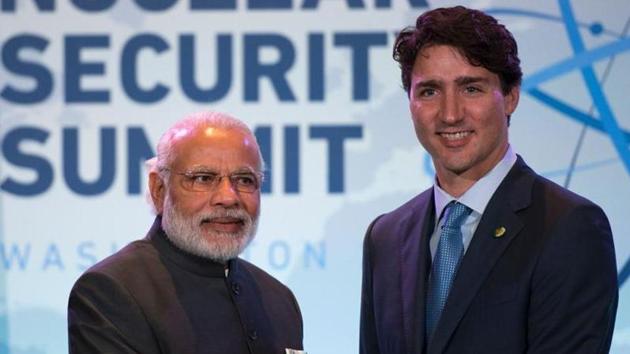
That, of course, is the Trudeau visit as the principals can then meet to turn burgeoning interest into tangible results.