Iran vs Israel military strength comparison: Israel launched strikes on Iranian military sites on Saturday, October 26, citing retaliation for Tehran's missile attack on Israel on October 1, marking another escalation in the conflict between the two Middle Eastern rivals.
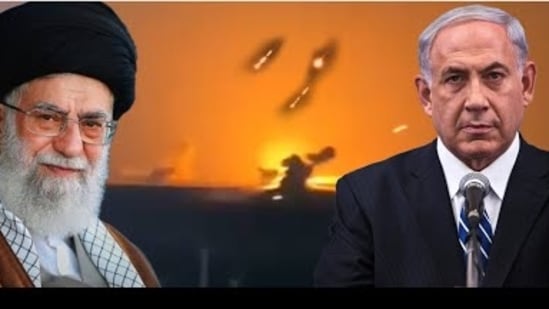
The Israeli military said it had completed its objectives and warned Iran against retaliation. Meanwhile, a semi-official Iranian news agency promised a "proportional response" to Israel's actions.
Follow Israel attacks Iran live updates
The outcome of a hypothetical conflict between Iran and Israel is uncertain, as both nations have considerable but distinct military strengths, strategies, and regional alliances that make a direct head-to-head difficult to predict.
Also Read | Iran says 2 soldiers killed in Israeli airstrikes: ‘Entitled to defend ourselves’
Below is a look at both countries' military power and aerial defence systems:
IRAN
Total military personnel: Iran’s total military personnel is estimated to be about 610,000, with around 350,000 active members (of which the regular army comprises 230,000, and the Islamic Revolutionary Guard Corps (IRGC) makes up the rest).
- However, decades of international sanctions have largely cut off Iran from the latest high-tech military equipment, news agency Reuters reported citing the International Institute for Strategic Studies in London (IISS).Also Read | Israel's strikes against Iran: How did Pakistan, Saudi and other nations react?
- The air force has only a few dozen working strike aircraft, including Russian jets and ageing US models acquired before the country's 1979 Islamic Revolution.
- Iran has cultivated a network of allied groups in the region, including Hezbollah in Lebanon, militias in Iraq, the Houthis in Yemen, and other aligned factions in Syria and Gaza. These groups can operate asymmetrically and put pressure on Israel from multiple fronts.
Total military personnel: Iran’s total military personnel is estimated to be about 610,000, with around 350,000 active members (of which the regular army comprises 230,000, and the Islamic Revolutionary Guard Corps (IRGC) makes up the rest).
- However, decades of international sanctions have largely cut off Iran from the latest high-tech military equipment, news agency Reuters reported citing the International Institute for Strategic Studies in London (IISS).Also Read | Israel's strikes against Iran: How did Pakistan, Saudi and other nations react?
- The air force has only a few dozen working strike aircraft, including Russian jets and ageing US models acquired before the country's 1979 Islamic Revolution.
- Iran has cultivated a network of allied groups in the region, including Hezbollah in Lebanon, militias in Iraq, the Houthis in Yemen, and other aligned factions in Syria and Gaza. These groups can operate asymmetrically and put pressure on Israel from multiple fronts.
Watch LIVE: Iran Air Defence Systems Intercept Israeli Missiles Amid Overnight Strikes | Iran Israel War
Ballistic missile arsenal: Iran has an extensive arsenal of ballistic missiles capable of reaching various parts of Israel, as well as cruise missiles and drones. While not as technologically advanced as Israel's arsenal, Iran's missile capabilities provide significant reach and threat. Iran has more than 3,500 surface-to-surface missiles, some of which carry half-ton warheads. The number capable of reaching Israel may be lower, however.
- Tehran also has the domestically produced Bavar-373 surface-to-air missile platform, as well as the Sayyad and Raad defence systems.
Fighter jets: Iran has a squadron of nine F-4 and F-5 fighter jets, one squadron of Russian-made Sukhoi-24 jets, and some MiG-29s, F7 and F14 aircraft, IISS said. Iran's air force commander said in April that the Sukhoi-24s were in their "best state of preparedness" to counter any potential Israeli attack. But Iran's dependence on Sukhoi-24s, first developed in the 1960s, underscores the relative weakness of its air force.
- Iran also has pilotless planes designed to fly into targets and explode. Analysts estimate its drone arsenal to be in the low thousands.
Tanks: Iran reportedly operates approximately 2,842 tanks, a mix of older Soviet-era models and locally upgraded versions, with a focus on numbers rather than cutting-edge technology.
Nuclear weapons: Iran does not currently possess nuclear weapons but has an extensive nuclear programme, initially focused on civilian energy purposes. However, concerns remain about its potential to develop nuclear weapons, given uranium enrichment and other capabilities.
ISRAEL
Total military personnel: Approximately 645,000, which includes about 169,500 active-duty members and around 465,000 reservists.
Fighter jets: Israel has an advanced, US-supplied air force with hundreds of F-15, F-16 and F-35 multipurpose jet fighters. These played a role in shooting down Iranian drones in April when Iran launched explosive drones and fired missiles at Israel in its first direct attack on Israeli territory.
- The air force lacks long-range bombers, though a smaller fleet of repurposed Boeing 707s serve as refuelling tankers that could enable its fighters to reach Iran for pinpoint sorties.
- The Israeli air force demonstrated its ability to hit long range targets in July when its fighter jets struck areas near Yemen's Hodeidah port in retaliation for a Houthi drone strike in Tel Aviv.
Drones: A pioneer in drone technology, Israel has Heron pilotless planes capable of flying for more than 30 hours, enough for far-flung operations. Its Delilah loitering munition has an estimated range of 250 km - far short of the Gulf region where Iran is, though the air force could close the gap by delivering one of the munitions closer to Iran's border.
Missiles: Israel is widely believed to have developed long-range surface-to-surface missiles, but neither confirms nor denies this.
- A multi-layer aerial defence system developed with U.S. help after the 1991 Gulf War provides Israel with several additional options for shooting down long-range Iranian drones and missiles.
- Israel's defence systems, including the Iron Dome, David’s Sling, and Arrow, are highly effective in intercepting incoming missiles, rockets, and drones. The Israeli systems are designed to be patched into counterpart US interceptors in the region for coalition-strength defences.
Tanks: Israel fields around 1,650 tanks, heavily emphasising quality. Most are Merkava models, renowned for advanced armor, firepower, and defensive systems tailored to combat in the Middle East.
Nuclear weapons: Estimates from organisations such as the Federation of American Scientists suggest Israel has around 80 to 90 nuclear warheads.