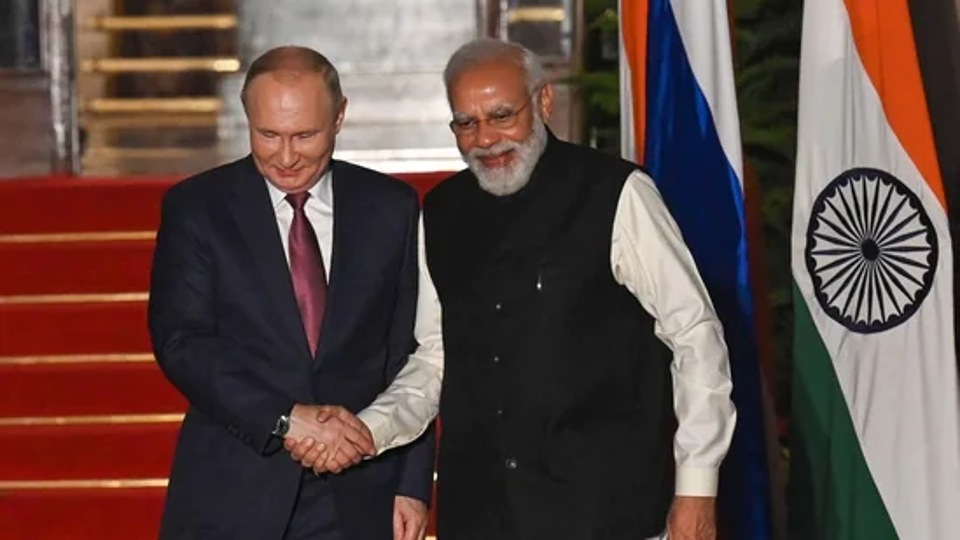
Russian President Vladimir Putin visited India on December 6 for a total of 250 minutes because of his personal relationship with Prime Minister Narendra Modi. That he chose to personally come to India, particularly at a time when the coronavirus pandemic was raging in Russia, speaks of his commitment to the bilateral relationship. He could, after all, have done a virtual summit with PM Modi, like he has done twice this year with his Chinese counterpart Xi Jinping.
This is
Russian President Vladimir Putin visited India on December 6 for a total of 250 minutes because of his personal relationship with Prime Minister Narendra Modi. That he chose to personally come to India, particularly at a time when the coronavirus pandemic was raging in Russia, speaks of his commitment to the bilateral relationship. He could, after all, have done a virtual summit with PM Modi, like he has done twice this year with his Chinese counterpart Xi Jinping.
This is especially relevant because HT learns that Putin reassured India that Russia’s relations with the country were still important (and warm) despite the growing closeness between his country and China.
Indeed, Russia is as close to China as India is to the US, and it is believed that both countries decided that they would only focus on the bilateral relationship and not let any third-party (read China and US) soil decades of steady and reliable friendship. And while Modi and Putin may have differing perceptions on global issues, they decided to put these aside and focus only on a stronger bilateral relationship.
Putin’s visit coincided with the start of the delivery of two S-400 air defence systems from Russia to India — much needed for India’s security, especially because the Chinese PLA has deployed the same systems on the western and eastern sectors of the Line of Actual Control. The acquisition of the S-400 system was the need of the hour given that PLA is militarising the entire LAC, and India has cited national interest as the rationale for its purchase — which has been seen in some quarters as a slight to the US and also runs the risk of being hit by CATSAA sanctions.
The fact is, Russia, over the past decades, has supplied the same systems to India as it has to China — be it Su-30 MKI aircraft or Sovremenny class destroyers. It is now willing to offer the under-development S-500 system to both countries. But although a large part of the Indian military is equipped with Russian equipment, the Modi government wants to diversify this relationship into energy and trade rather than remaining focused only on defence.
The thinking in New Delhi is that the era of hardware buyer-seller relations between India and Russia needs to be redefined and expanded so that bilateral trade goes up and Russia plays an important part in India’s energy security needs.
Prime Minister Narendra Modi has personally invested in relations with President Putin as he needs to correct the tilt that Moscow has towards Beijing due to US/western pressure on Russia. And with the US, Russia and China taking adversarial positions, India is looking at expanding political engagement with powers such as the UAE and Australia where there is a convergence on strategic interests.
With the rise of the Taliban in Afghanistan, both countries are on the same page on the threat of Islamic radicalisation and terrorism, especially because the Central Asian Republics are in the line of fire. Russia is comfortable with India reaching out to the Central Asian Republics, and the two countries can join hands to prevent the spread of ultra-conservative ideology to these liberal countries.
It helps that India-Russia relations are time-tested and not defined by which political party is in power on Raisina Hill.
One Subscription.
Get 360° coverage—from daily headlines
to 100 year archives.
Archives
HT App & Website