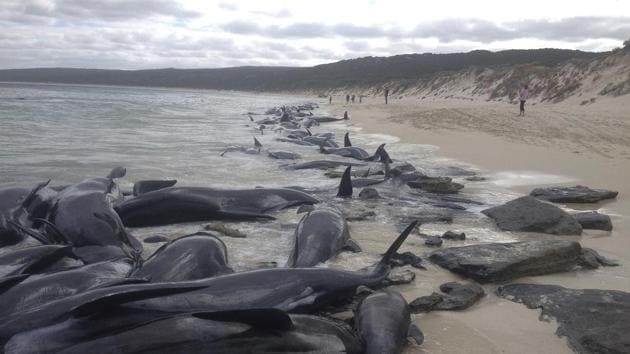
More than 150 whales have become stranded in Hamelin Bay in western Australia, and only 15 of them were still alive on Friday, authorities said.
Short-finned pilot whales who became beached at Hamelin Bay, in Western Australia's south, on Friday. (AP Photo)
The mammals are believed to be short-finned pilot whales.
{{^htLoading}} {{/htLoading}}
{{^usCountry}}{{/usCountry}}
The stranded animals were first spotted by a commercial fisherman early on Friday morning.
As of Friday afternoon, only 15 whales were alive. A rescue operation was underway to try and herd them back to sea. Authorities say palliative care will be administered where necessary.
Stranded whales on the beach at Hamelin Bay in this picture obtained from social media.
“I think it’s absolutely incredible, I have never seen anything like it, seen so many whales beached like this,” said Barrie Brickle, a tourist visiting the area.
{{^htLoading}} {{/htLoading}}
{{^usCountry}}
A shark alert has been issued by the fisheries department as the stranded whales might attract the ocean predators.
{{/usCountry}}
{{#usCountry}}
A shark alert has been issued by the fisheries department as the stranded whales might attract the ocean predators.
{{/usCountry}}
“Unfortunately, most of the whales beached themselves on dry land overnight and have not survived,” rescue team leader Jeremy Chick said. “Rescue operations will be hampered by deteriorating weather conditions and we need to ensure the safety of everyone involved before we move the whales.”
The carcasses were being removed from the beach, with Parks and Wildlife Service officers taking DNA samples in an attempt to collect clues about why whales strand.
In 2009, more than 80 whales and dolphins died on a beach in Hamelin Bay.
The biggest mass stranding of whales in Western Australia happened in 1996 in Dunsborough. That year, 320 long-finned pilot whales beached themselves.
Follow the latest breaking news, major developments and agenda-setting stories from India and around the world with the newsdesk at Hindustan Times. Operating round the clock, the desk brings together experienced editors, reporters and correspondents to deliver fast, accurate and contextual reporting across subjects that influence public policy, governance, business, society and international affairs. The HT News Desk covers politics, elections, government policies, the economy, business and markets, science and technology, the environment, law and order, infrastructure, education, climate issues and geopolitics, while closely tracking developments across states, institutions and global capitals. The team also leads coverage of major breaking news events, policy announcements, court proceedings, natural disasters, public emergencies and significant international developments. Reports published by the newsdesk are based on information gathered from reporters on the ground, official statements, government agencies, court records, regulatory filings, recognised institutions and other authoritative sources. Stories undergo editorial scrutiny and verification processes to ensure accuracy, fairness and relevance, and are updated as events evolve and additional information becomes available. Whether covering a key political decision in New Delhi, an economic policy shift affecting millions, a landmark court ruling or a major global event, the HT News Desk aims to provide readers with reliable, fact-based journalism that delivers not only the latest developments but also the context and analysis needed to understand their wider implications.
Get the latest World News, breaking headlines and global updates from the US, UK, Pakistan, Bangladesh, Russia and other countries. Follow major international events on Hindustan Times.
Get the latest World News, breaking headlines and global updates from the US, UK, Pakistan, Bangladesh, Russia and other countries. Follow major international events on Hindustan Times.