
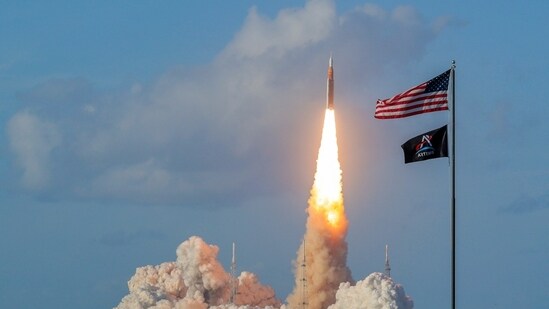
Five decades after the end of the Apollo program, NASA on Wednesday sent another crew of astronauts hurtling toward the moon. It’s about time. The Artemis II mission began a 10-day trip that includes a lunar flyby about 230,000 miles from Earth. The idea is to descend to the surface again on Artemis IV in 2028.
If successful, this would be a human triumph that two generations haven’t experienced. The plan for Artemis V, according to NASA, is to start
Five decades after the end of the Apollo program, NASA on Wednesday sent another crew of astronauts hurtling toward the moon. It’s about time. The Artemis II mission began a 10-day trip that includes a lunar flyby about 230,000 miles from Earth. The idea is to descend to the surface again on Artemis IV in 2028.
If successful, this would be a human triumph that two generations haven’t experienced. The plan for Artemis V, according to NASA, is to start construction on a moon base. This could provide useful experience, and perhaps a way station, for efforts someday to send human astronauts to explore Mars and beyond.
That’s if America’s politicians and public can keep their eyes on the stars, instead of turning inward as happened after the Apollo landings. In the historical glow, that program’s brevity is easy to miss. With six missions from 1969-72, the U.S. put 12 astronauts on lunar soil. Then, after beating the Soviets there, Americans lowered their aims. “Looking back on it,” Neil Armstrong said in 2001, “I find it fairly understandable in the light of conflicting requirements for resources.”
But the U.S. is wealthier than ever, and certainly richer than when Armstrong made one giant leap for mankind. It’s more a question of priorities. As the federal government’s ambitions for social and welfare spending steadily increased over the decades, NASA’s share of outlays floated down. In 2024 it was slightly above a third of a percentage point, or $25 billion. Total outlays were $6.75 trillion, with 65.8% classified as “payments for individuals. In 1969 those payments were 31.5%.
Private competition has also been a boon for spaceflight in recent years. To ferry astronauts to the International Space Station, the U.S. relies on Elon Musk’s SpaceX for commercial capsules and rockets. NASA is in a position to hedge its bets on Artemis lunar landers, since SpaceX has been working on a variant of its towering Starship for that purpose, while Jeff Bezos’s Blue Origin is under contract to build a more traditional design.
With China now planning to put astronauts on the moon by 2030, this is a moment to recapture the spirit of the old space race. It’s a shame the U.S. lost its ambition for human exploration after the Apollo program’s successes. But today there’s even less excuse, after 50 years of economic and technological progress, which has turned orbital launches from a feat into a business routine. Are Americans really going to let Beijing beat them to the first lunar base or landing on Mars?
One Subscription.
Get 360° coverage—from daily headlines
to 100 year archives.
Archives
HT App & Website