Near-Catastrophe on Flight 1073 Exposes Gaping Hole in Dubai’s Aviation Security
Security experts say an assailant with a plan and a knife, as alleged in Wednesday’s flight to Israel, shouldn’t have made it as far as the airport.
Published on: Oct 2, 2026, 14:00:09 IST
WSJ
Advertisement
The FlyDubai pilot who stabbed his captain and sent the plane diving toward the ground slipped through one of the world’s tightest aviation-security nets. The question is: How?
PREMIUM
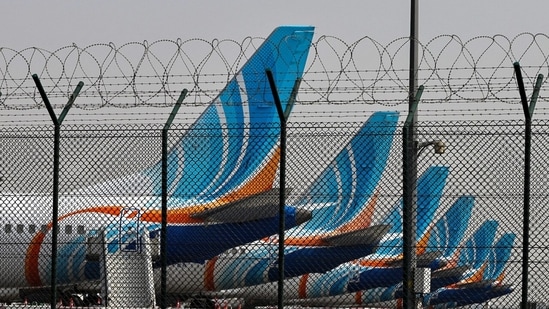
FlyDubai planes at Dubai International Airport. The airline has suspended its flights to Israel while the probe continues.
{{^htLoading}} {{/htLoading}}
The route connecting the United Arab Emirates and Israel is one of the world’s most sensitive. The Middle East has a long history of hijackings and other attacks on civilian airliners.
To counter attacks, both countries have some of the world’s most advanced surveillance technologies and capable spy networks. On top of
Deep Dive
How did the FlyDubai pilot manage to stab his captain onboard Flight 1073?
The pilot was able to conceal his intentions and gain access to a knife, leading to the incident where he stabbed the captain, initiating a severe in-flight emergency.
What are the implications of the FlyDubai incident for aviation security in the UAE?
This incident exposes significant gaps in aviation security in the UAE, prompting investigations and potential reassessments of security protocols, especially for flights to sensitive regions.
What actions are being taken to investigate the co-pilot's motives for the attack on Flight 1073?
Authorities are investigating whether the co-pilot acted alone or as part of a larger plan, examining potential terrorist links and the circumstances that allowed him to smuggle a blade onboard.
Powered ByAsk HT
And yet on Wednesday a pilot was able to conceal his intentions, gain access to a knife, and put a plane carrying around 170 people into a dive so steep it nearly tore it apart in midair.
“This is 100% a major security failure,” said Michael Horowitz, a security and geopolitical analyst who wrote a book about Israel’s future in the Middle East. “The question is how broad and how bad.”
{{^htLoading}} {{/htLoading}}
The answer will weigh on Israel’s air links to the world and the prospects of the U.A.E.’s core aviation and tourism businesses. FlyDubai suspended its flights to Israel while the investigation continued. A number of international airlines already had suspended flights to both the U.A.E. and Israel for months because of the risks associated with the Iran war.
Saudi officials initially assessed that the co-pilot tried to deliberately crash the plane after stabbing the pilot, people familiar with the matter said. They said they didn’t yet have a theory about why. The U.A.E. said Thursday it was investigating whether terrorism or some other motive played a role in the attack.
{{^htLoading}} {{/htLoading}}
If it does turn out to have been a terrorist act, “this would be the most significant terrorist plot involving a commercial passenger aircraft in recent years,” aviation security firm Osprey Flight Solutions said in a report.
FlyDubai didn’t respond to requests for comment.
Aviation experts consider Dubai International Airport to have high security standards. It was consistently the world’s busiest for international travel and connected fliers from risky countries such as Afghanistan and Iran. It uses facial recognition to identify passengers and scans carry-on luggage coming in and out of the country.
Pilots who have regularly flown from Dubai recounted strict searches through metal detectors that have led security staff to confiscate everything from selfie sticks to hair spray to cups of coffee. Air regulations ban all blades with sharp points and typically blunt knives longer than six centimeters.
{{^htLoading}} {{/htLoading}}
“Dubai is high-spec and a key global hub. It compares well to many of the top airports in the world,” Horowitz said. “But that doesn’t rule out insider jobs or a broader lapse in security.”
An Israeli official said the country has long pressed Dubai airport officials to strengthen security for flights heading its way. It stopped its own airlines from flying between Dubai and Tel Aviv for several months this year amid worries about security gaps and the risks posed by the war against Iran.
Israeli airlines typically follow stricter security protocols than foreign airlines flying the same routes.
Starting Friday, Israeli airlines will begin operating limited rescue flights to bring out Israelis stuck in Dubai after FlyDubai suspended service, according to Israel’s Ministry of Transportation. Israel’s flagship airline, El Al, said it wouldn’t allow passengers to bring checked or carry-on luggage at the instruction of security officials.
{{^htLoading}} {{/htLoading}}
Israel has also taken issue with security on foreign airlines. In May 2024, Israel’s comptroller published a classified report that found major problems with the security of flights to and from the country, including inadequate security at foreign airports, a person familiar with the matter said. It found that Israel’s Ministry of Transportation was focused on security on Israeli airlines and wasn’t investing enough to secure foreign airlines that carried Israeli passengers. The Israeli prime minister’s office didn’t return a request for comment on the report.
Dubai’s media office and airport didn’t respond to requests for comment.
The Sept. 11, 2001, attacks in which hijackers seized control of jets and flew them into the World Trade Center and the Pentagon reshaped the rules around international air travel. A key change was the introduction of reinforced doors to keep intruders out of the cockpit.
{{^htLoading}} {{/htLoading}}
The regulations mostly revolved around protecting aircraft from passengers, however, not pilots or crew who might present threats from within.
The 2015 Germanwings crash, in which a first officer took control of the cockpit after being left alone and intentionally flew the plane into the French Alps, killing everyone on board, led some regulators to require that two crew members be in the cockpit at all times. The pilot who crashed the plane had received psychotherapy for suicidal tendencies, and the industry has grappled with mental-health risks ever since.
A camera mounted on the closed cockpit door of an Airbus A380 aircraft.
Pilots typically are required to undergo a medical screening at least once a year but face suspension of their licenses if they receive certain mental-health diagnoses or are prescribed related medication. That has prompted concerns that aviators could hide symptoms and avoid seeking help.
{{^htLoading}} {{/htLoading}}
“We don’t know if it was a terrorist plot, if he intended to crash the plane, if it was just an altercation,” said Andy Blackwell, an analyst at aviation-security specialist ISARR and a former head of corporate security at Virgin Atlantic. “We don’t know their stresses. We don’t know their state of mind.”
FlyDubai has an in-house psychology division that vets first officers as they graduate to captain, according to a former pilot at the company and an active crew member at the sister carrier, Emirates. It wasn’t immediately clear whether the assailant would have undergone such a review.
A central question in the investigation is how the assailant was able to get the knife aboard. In addition to screening, airports take inventory of knives in restaurants located after security, and careful decisions guide what planes may carry.
The Wall Street Journal’s Deputy Middle East Bureau Chief Jon Gambrell explains how regional politics play a role in the investigation into the stabbing onboard a FlyDubai flight. Photo: Reuters
{{^htLoading}} {{/htLoading}}
It is possible the assailant smuggled his own knife on board or used a blade that was already post-security and accessible to the crew. He also could have had help.
“Not everything that needs to be detected is detected,” said Matthew Borie, chief intelligence officer and co-founder of Osprey Flight Solutions. “Insiders typically know how to breach the measures that are in place, because they’re part of the system.”
Screening is the last line in the security funnel. If a bad actor made it that far, there was already an intelligence failure in allowing a plot to go forward, security analysts said.
Dubai keeps close watch on its residents. When a Hamas militant turned up dead in a Dubai hotel room in early 2010, authorities combed through security-camera footage and electronic-payment receipts to quickly assemble images of the more than two dozen members of the hit team, even some that showed them donning disguises. The assailants had escaped, but it was a strong show of the city’s capabilities.
Borie said a significant plot shouldn’t have made it to the airport without being exposed.
“If this was really as what has been stated by the Israelis as a jihadist terror attack, the idea that this needed to be detected solely by the last level of screening before somebody boarded the aircraft—that’s the last layer of defense,” he said. “When insiders are involved, we’re putting an extensive amount of pressure on the lowest rung of the ladder to make the stop.”
The FlyDubai pilot who stabbed his captain and sent the plane diving toward the ground slipped through one of the world’s tightest aviation-security nets. The question is: How?
PREMIUM
FlyDubai planes at Dubai International Airport. The airline has suspended its flights to Israel while the probe continues.
The route connecting the United Arab Emirates and Israel is one of the world’s most sensitive. The Middle East has a long history of hijackings and other attacks on civilian airliners.
To counter attacks, both countries have some of the world’s most advanced surveillance technologies and capable spy networks. On top of that, air regulations have been repeatedly tightened following the Sept. 11, 2001, terrorist attacks on the U.S. and the Germanwings Flight 9525 intentional crash in the French Alps.
Deep Dive
How did the FlyDubai pilot manage to stab his captain onboard Flight 1073?
The pilot was able to conceal his intentions and gain access to a knife, leading to the incident where he stabbed the captain, initiating a severe in-flight emergency.
What are the implications of the FlyDubai incident for aviation security in the UAE?
This incident exposes significant gaps in aviation security in the UAE, prompting investigations and potential reassessments of security protocols, especially for flights to sensitive regions.
What actions are being taken to investigate the co-pilot's motives for the attack on Flight 1073?
Authorities are investigating whether the co-pilot acted alone or as part of a larger plan, examining potential terrorist links and the circumstances that allowed him to smuggle a blade onboard.
Powered ByAsk HT
And yet on Wednesday a pilot was able to conceal his intentions, gain access to a knife, and put a plane carrying around 170 people into a dive so steep it nearly tore it apart in midair.
{{^htLoading}} {{/htLoading}}
“This is 100% a major security failure,” said Michael Horowitz, a security and geopolitical analyst who wrote a book about Israel’s future in the Middle East. “The question is how broad and how bad.”
The answer will weigh on Israel’s air links to the world and the prospects of the U.A.E.’s core aviation and tourism businesses. FlyDubai suspended its flights to Israel while the investigation continued. A number of international airlines already had suspended flights to both the U.A.E. and Israel for months because of the risks associated with the Iran war.
{{^htLoading}} {{/htLoading}}
Saudi officials initially assessed that the co-pilot tried to deliberately crash the plane after stabbing the pilot, people familiar with the matter said. They said they didn’t yet have a theory about why. The U.A.E. said Thursday it was investigating whether terrorism or some other motive played a role in the attack.
If it does turn out to have been a terrorist act, “this would be the most significant terrorist plot involving a commercial passenger aircraft in recent years,” aviation security firm Osprey Flight Solutions said in a report.
FlyDubai didn’t respond to requests for comment.
Aviation experts consider Dubai International Airport to have high security standards. It was consistently the world’s busiest for international travel and connected fliers from risky countries such as Afghanistan and Iran. It uses facial recognition to identify passengers and scans carry-on luggage coming in and out of the country.
{{^htLoading}} {{/htLoading}}
Pilots who have regularly flown from Dubai recounted strict searches through metal detectors that have led security staff to confiscate everything from selfie sticks to hair spray to cups of coffee. Air regulations ban all blades with sharp points and typically blunt knives longer than six centimeters.
“Dubai is high-spec and a key global hub. It compares well to many of the top airports in the world,” Horowitz said. “But that doesn’t rule out insider jobs or a broader lapse in security.”
An Israeli official said the country has long pressed Dubai airport officials to strengthen security for flights heading its way. It stopped its own airlines from flying between Dubai and Tel Aviv for several months this year amid worries about security gaps and the risks posed by the war against Iran.
{{^htLoading}} {{/htLoading}}
Israeli airlines typically follow stricter security protocols than foreign airlines flying the same routes.
Starting Friday, Israeli airlines will begin operating limited rescue flights to bring out Israelis stuck in Dubai after FlyDubai suspended service, according to Israel’s Ministry of Transportation. Israel’s flagship airline, El Al, said it wouldn’t allow passengers to bring checked or carry-on luggage at the instruction of security officials.
Israel has also taken issue with security on foreign airlines. In May 2024, Israel’s comptroller published a classified report that found major problems with the security of flights to and from the country, including inadequate security at foreign airports, a person familiar with the matter said. It found that Israel’s Ministry of Transportation was focused on security on Israeli airlines and wasn’t investing enough to secure foreign airlines that carried Israeli passengers. The Israeli prime minister’s office didn’t return a request for comment on the report.
{{^htLoading}} {{/htLoading}}
Dubai’s media office and airport didn’t respond to requests for comment.
The Sept. 11, 2001, attacks in which hijackers seized control of jets and flew them into the World Trade Center and the Pentagon reshaped the rules around international air travel. A key change was the introduction of reinforced doors to keep intruders out of the cockpit.
The regulations mostly revolved around protecting aircraft from passengers, however, not pilots or crew who might present threats from within.
The 2015 Germanwings crash, in which a first officer took control of the cockpit after being left alone and intentionally flew the plane into the French Alps, killing everyone on board, led some regulators to require that two crew members be in the cockpit at all times. The pilot who crashed the plane had received psychotherapy for suicidal tendencies, and the industry has grappled with mental-health risks ever since.
{{^htLoading}} {{/htLoading}}
A camera mounted on the closed cockpit door of an Airbus A380 aircraft.
Pilots typically are required to undergo a medical screening at least once a year but face suspension of their licenses if they receive certain mental-health diagnoses or are prescribed related medication. That has prompted concerns that aviators could hide symptoms and avoid seeking help.
{{^htLoading}} {{/htLoading}}
“We don’t know if it was a terrorist plot, if he intended to crash the plane, if it was just an altercation,” said Andy Blackwell, an analyst at aviation-security specialist ISARR and a former head of corporate security at Virgin Atlantic. “We don’t know their stresses. We don’t know their state of mind.”
FlyDubai has an in-house psychology division that vets first officers as they graduate to captain, according to a former pilot at the company and an active crew member at the sister carrier, Emirates. It wasn’t immediately clear whether the assailant would have undergone such a review.
A central question in the investigation is how the assailant was able to get the knife aboard. In addition to screening, airports take inventory of knives in restaurants located after security, and careful decisions guide what planes may carry.
The Wall Street Journal’s Deputy Middle East Bureau Chief Jon Gambrell explains how regional politics play a role in the investigation into the stabbing onboard a FlyDubai flight. Photo: Reuters
It is possible the assailant smuggled his own knife on board or used a blade that was already post-security and accessible to the crew. He also could have had help.
“Not everything that needs to be detected is detected,” said Matthew Borie, chief intelligence officer and co-founder of Osprey Flight Solutions. “Insiders typically know how to breach the measures that are in place, because they’re part of the system.”
Screening is the last line in the security funnel. If a bad actor made it that far, there was already an intelligence failure in allowing a plot to go forward, security analysts said.
Dubai keeps close watch on its residents. When a Hamas militant turned up dead in a Dubai hotel room in early 2010, authorities combed through security-camera footage and electronic-payment receipts to quickly assemble images of the more than two dozen members of the hit team, even some that showed them donning disguises. The assailants had escaped, but it was a strong show of the city’s capabilities.
Borie said a significant plot shouldn’t have made it to the airport without being exposed.
“If this was really as what has been stated by the Israelis as a jihadist terror attack, the idea that this needed to be detected solely by the last level of screening before somebody boarded the aircraft—that’s the last layer of defense,” he said. “When insiders are involved, we’re putting an extensive amount of pressure on the lowest rung of the ladder to make the stop.”
Get the latest World News, breaking headlines and global updates from the US, UK, Pakistan, Bangladesh, Russia and other countries. Follow major international events on Hindustan Times.
Get the latest World News, breaking headlines and global updates from the US, UK, Pakistan, Bangladesh, Russia and other countries. Follow major international events on Hindustan Times.
Home/Near-Catastrophe on Flight 1073 Exposes Gaping Hole in Dubai’s Aviation Security
{{^htLoading}}
Advertisement
{{/htLoading}}
SHARE THIS ARTICLE ON
{{#usCountry}}{{/usCountry}}
Notifications
Get breaking alerts directly from the newsroom
Notifications are on!You'll be notified when news breaks