Astronomers have discovered a black hole in the Milky Way so huge that it challenges existing models of how stars evolve, researchers said Thursday.
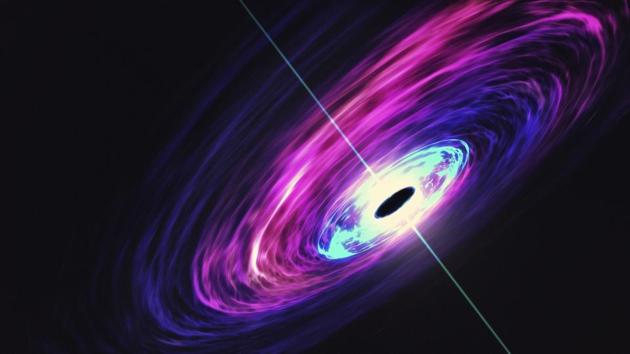
LB-1 is 15,000 light years from Earth and has a mass 70 times greater than the Sun, according to the journal Nature.
The Milky Way is estimated to contain 100 million stellar black holes but LB-1 is twice as massive as anything scientists thought possible, said Liu Jifeng, a National Astronomical Observatory of China professor who led the research.
“Black holes of such mass should not even exist in our galaxy, according to most of the current models of stellar evolution,” he added.
Scientists generally believe that there are two types of black holes.
The more common stellar black holes -- up to 20 times more massive than the Sun -- form when the centre of a very big star collapses in on itself.
Supermassive black holes are at least a million times bigger than the Sun and their origins are uncertain.
But researchers believed that typical stars in the Milky Way shed most of their gas through stellar winds, preventing the emergence of a black hole the size of LB-1, Liu said.
{{/usCountry}}But researchers believed that typical stars in the Milky Way shed most of their gas through stellar winds, preventing the emergence of a black hole the size of LB-1, Liu said.
{{/usCountry}}“Now theorists will have to take up the challenge of explaining its formation,” he said in a statement.
Astronomers are still only beginning to grasp “the abundance of black holes and the mechanisms by which they form,” David Reitze, a physicist at the California Institute of Technology who was not involved in the discovery, told AFP.
Stellar black holes are usually formed in the aftermath of supernova explosions, a phenomenon that occurs when extremely large stars burn out at the end of their lives.
“LB-1’s large mass falls into a range “known as the ‘pair instability gap’ where supernovae should not have produced it,” Reitze said.
“That means that this is a new kind a black hole, formed by another physical mechanism!” LB-1 was discovered by an international team of scientists using China’s sophisticated LAMOST telescope.
Additional images from two of the world’s largest optical telescopes -- Spain’s Gran Telescopio Canarias and the Keck I telescope in the United States -- confirmed that the size of LB-1, which the National Astronomical Observatory of China said was “nothing short of fantastic”.