Israelis are voting on Tuesday in a high-stakes parliamentary election that could determine the country's political future, shape its security policies and influence the ongoing conflict in West Asia.
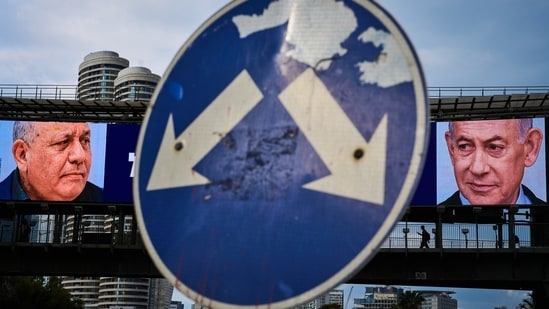
Prime Minister Benjamin Netanyahu, Israel's longest-serving leader, faces one of his toughest electoral battles as he seeks another term in office. The 77-year-old is trying to convince voters that he remains the best choice to protect the country, even as questions persist over the security failures surrounding the Hamas-led October 7, 2023, attack.
His biggest challenger is former military chief Gadi Eisenkot, who has emerged as a strong alternative by tapping into public dissatisfaction with Netanyahu's leadership. The two are running neck and neck in opinion polls, raising the possibility of a closely contested election.
Deep Dive
How do Benjamin Netanyahu and Gadi Eisenkot differ on Israel’s security policy?
Does Israel’s election directly elect the prime minister?
What happens if neither bloc wins a majority in Israel’s election?
Around 7.3 million Israelis are eligible to vote, including more than half a million first-time voters. Surveys suggest that a large majority of these young voters identify with centre-right or right-wing politics.
Who are the key candidates in Israel's election?
Benjamin Netanyahu: The embattled incumbent
Netanyahu is seeking to extend his record as Israel's longest-serving prime minister, but his campaign comes amid criticism over the October 7 attack and his handling of the subsequent wars.
{{/usCountry}}Netanyahu is seeking to extend his record as Israel's longest-serving prime minister, but his campaign comes amid criticism over the October 7 attack and his handling of the subsequent wars.
{{/usCountry}}The prime minister has maintained his opposition to Palestinian statehood and supports expanding Israeli settlements. He has also warned that Israel could resume military operations in Gaza if Hamas refuses to disarm.
Gadi Eisenkot: Netanyahu's main challenger
Former military chief Gadi Eisenkot, who leads the centrist Yashar party, has positioned himself as an alternative to Netanyahu.
Although relatively new to electoral politics, Eisenkot has gained support among voters dissatisfied with the incumbent. His more restrained public style also contrasts with Netanyahu's approach.
However, Eisenkot's security positions remain largely hawkish. He opposes Palestinian independence and supports settlements in principle, although he has promised to act against violence by Israeli settlers targeting Palestinians.
Naftali Bennett: Ex-PM seeking a comeback
Former prime minister Naftali Bennett is also in the race, leading Beyachad (Together), a joint electoral ticket with centrist politician Yair Lapid.
Like Netanyahu, Bennett opposes Palestinian independence and supports Israeli settlements in the occupied West Bank. However, he has repeatedly clashed with the prime minister over security matters and the country's legal system.
Itamar Ben-Gvir: Far-right leader seeking greater influence
National security minister Itamar Ben-Gvir, who heads the far-right Otzma Yehudit (Jewish Power) party, is another important figure in the election.
Ben-Gvir has advocated tougher measures against Palestinians, and opinion polls suggest his party could secure eight or nine seats in parliament.
While he is not considered a leading contender for prime minister, his party could play an important role in determining the next government, particularly if Netanyahu needs additional support to form a coalition.
What is at stake in Israel's election?
The election is taking place against the backdrop of a prolonged crisis in West Asia, which has disrupted regional stability and affected global energy markets and trade routes.
However, the biggest challenge for the winning candidate may be forming a government.
Pre-election surveys indicate that neither Netanyahu's political bloc nor the opposition is likely to secure enough seats to govern independently. This could leave smaller parties holding the balance of power and give them considerable influence over government policies.
Why India will be watching the election closely
India will also be closely following the outcome, given its longstanding strategic relationship with Israel, particularly in defence and technology.
The election comes at a time when the conflict in West Asia has raised concerns over energy supplies and maritime trade routes that are important to the Indian economy.
Any change in Israel's leadership or regional security policies could therefore have implications extending beyond the immediate conflict.
How do elections in Israel work?
Israel follows a system of proportional representation, under which voters choose political parties rather than directly electing a prime minister.
The country's parliament, known as the Knesset, has 120 seats, and a party or coalition needs at least 61 seats to secure a majority.
Parties must receive at least 3.25 per cent of the national vote to enter parliament. The seats are then distributed among qualifying parties according to their share of the vote.
Although parliamentary elections are normally held every four years, Israel has frequently gone to the polls early because of political disagreements and coalition breakdowns.
When will Israel election results be announced?
Voting begins at 7 am local time (9:30 am IST) on Tuesday and continues until 10 pm (12:30 am IST).
Israeli television channels will release exit polls as soon as voting ends, providing the first indications of which parties have performed well.
Official vote counting will follow, with the final tally expected by October 30. The results are scheduled to be formally published on November 4.
Once the final results are available, Israeli President Isaac Herzog will hold consultations with political party leaders to determine who has the strongest support to form the next government.
He will then nominate the candidate considered most likely to secure a parliamentary majority.
The nominated leader will have up to 42 days to assemble a governing coalition.
However, knowing which party has won the most seats may not immediately reveal who will become prime minister.
If neither political bloc secures a clear majority, negotiations between parties could continue for days or even weeks before a government takes shape.
(With agency inputs)