...
...
Next Story

Taliban lock Indian consulates for ‘security' in Kandahar, Herat: Sources

The owner of the Indian consulate premises in Herat received a call from the Taliban to come to the building with keys after the city fell to the insurgents.

Published on: Aug 14, 2021, 23:15:15 IST
By , Hindustan Times, New Delhi
Prefer HTon Google
Advertisement

As the Taliban offensive is escalating in Afghanistan with the insurgents reaching a few metres away from Kabul, sources said the rented premises housing the Indian consulates have been locked by the insurgents, claiming security reasons. “The Taliban, after taking over Kandahar city, put a lock on our rented Consulate premises there, claiming that it was being done as a security measure and will be opened when a responsible person (Indian) comes. Likewise, the owner of our consulate premises in Herat received a call from the Taliban to come to the building with keys,” a source said.
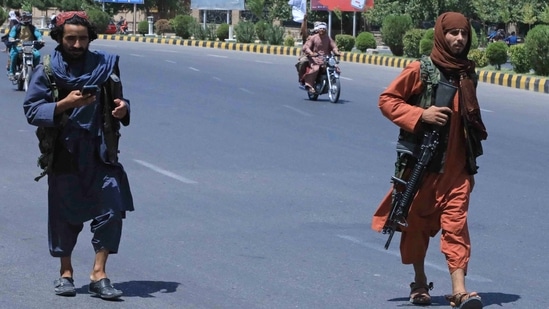
Taliban fighters patrol the streets in Herat on August 14 after they captured the city.  (AFP)

Also Read: Taliban set hard conditions for peace talks with Afghan govt

82 districts in the country are now under the Afghanistan government, while 252 are under the control of the Taliban and the status of 92 are disputed. The Afghan government has claimed that in the last 24 hours, in which the Taliban have taken over the Angoor Adda border crossing between Paktika Province and Khyber Pakhtunkhwa in Pakistan, 172 Taliban were killed and 107 wounded as a result of ANDSF operations in Nangarhar, Logar, Maidan Wardak, Kandahar and Balkh Provinces.

The Taliban captured Asadabad, the provincial capital of Kunar; Sharan, the provincial capital of Paktika; and Gardez, the provincial capital of Paktia, taking the number of Provincial capitals under its control to 20 out of 34. Taliban also captured Sarawazah district of Paktika and Shigal district of Kunar Province. Besides, the Taliban set free the prisoners after taking over Central prisons in Gardez, Sharan and Maimanah (Farhan).

On Saturday, President Ashraf Ghani addressed his countrymen and promised that the situation will not be allowed to escalate anymore as the Afghan leadership is in talks with world leaders to mobilise the army.

An Afghan leaders' delegation would leave for Islamabad on August 15, which will include Yunus Qanooni, Mohammad Karim Khalili, Ustaad Mohaqiq, Ahmad Zia Masoud, Khalid Noor, Latif Pedram, Syed Mansoor Naderi (all non-Pashtuns), and Kalimullah Naqibi, a Pashtun but affiliated to the Jamiat-e-Islami.

Another Afghan delegation under Abdullah Abdullah would visit Doha. Abdullah has an ‘important ‘ meeting in Kabul on Sunday and would, therefore, not leave for Doha tonight, as was earlier expected, sources said.

Leaders of Afghan refugees in Iran on Saturday issued a joint statement urging the international community to prevent human catastrophe due to internal displacement and called for a session of the UNSC to address the issue. Separately, the Iranian culture ministry has asked its media to refrain from using terms such as “brutality” (vahsigari) for the Taliban.

 
ABOUT THE AUTHOR
Shishir Gupta

Shishir Gupta is Executive Editor at Hindustan Times and one of India's top journalists covering national security, strategic affairs, foreign policy and geopolitics. Over the past three decades, he has extensively reported on India's military, diplomatic and security landscape, covering every major conflict and national security challenge, from the 1999 Kargil War and the 2020 East Ladakh standoff to Operation Sindoor in 2025. He has also covered major terror attacks, including the IC-814 hijacking, the 26/11 Mumbai attacks and the 2025 Pahalgam terror strike, along with numerous Pakistan-backed terrorist incidents in the Kashmir Valley and across India. He has reported on national and state elections for more than three decades. A recognised authority on strategic affairs, Gupta has covered India's nuclear programme since the Pokhran-II (Shakti series) tests in May 1998 and has written extensively on global nuclear issues, Indian diplomacy and the country's expanding global outreach. He has also reported widely on international conflicts and terrorism, with a special focus on the Indian subcontinent. Gupta has interviewed Prime Minister Narendra Modi more than four times, including Modi's first interview with the print media after becoming Prime Minister in May 2014. His other interviews include three with the Dalai Lama, as well as conversations with Benjamin Netanyahu, Amit Shah, Yogi Adityanath, S. Jaishankar, Nirmala Sitharaman and Piyush Goyal. He is the author of Indian Mujahideen: The Enemy Within (Hachette, 2011) and Himalayan Face-off: Chinese Assertion and Indian Riposte (Hachette, 2014). He was awarded the Chevening-Wolfson Joint Scholarship at Wolfson College, University of Cambridge, UK, in 1998 and participated in the International Visitor Leadership Program (IVLP) of the US State Department in 2006. He received the Ben Gurion Prize from Israel in 2011 and the K. Subrahmanyam Prize for Strategic Studies in 2015 from the Manohar Parrikar Institute for Defence Studies and Analyses (MP-IDSA). Since 2024, he has hosted Point Blank, Hindustan Times' weekly YouTube show on global geopolitics.

Get the latest World News, breaking headlines and global updates from the US, UK, Pakistan, Bangladesh, Russia and other countries. Follow major international events on Hindustan Times.
SHARE THIS ARTICLE ON
Hindustantimes wants to start sending you push notifications. Click allow to subscribe