California and Texas marked record spikes in new Covid-19 infections on Monday to cap a week that saw the highest-ever number of new infections reported in the United States.
Click here for full Covid-19 coverage
This new surge in cases in the southern and western parts of the country ended up being the second wave of infections in the US, undoing gains made by north-eastern states such as New York and New Jersey that finally controlled their outbreaks to a large extent.
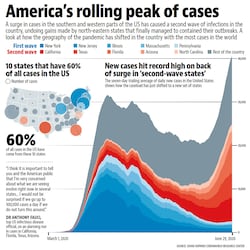
The state of New York (with NYC as the epicentre) led the ‘first-wave states’ that also included New Jersey, Illinois, Massachusetts and Pennsylvania when the coronavirus first swept through the country in March. By early April, 60% of all new cases in the US could be traced to just these five states. Since then, their contribution to new cases dropped to just 6% in the last seven days.
Cases in these ‘first-wave’ states peaked in early April, which resulted in a clear flattening of the new infection curve from April 10 (See chart).
{{/usCountry}}Cases in these ‘first-wave’ states peaked in early April, which resulted in a clear flattening of the new infection curve from April 10 (See chart).
{{/usCountry}}However, this drop was undone as the virus started spreading in the southeast and the west. California is among a number of US states including Florida, Texas Arizona and North Carolina, battling a new wave of infections as the nation emerges from weeks of clamp-downs. The ‘second-wave’ states were responsible for less than 3% of new cases reported in the final week of March. Since then, their contribution to the infections has grown to 30% in the last seven days.