The Iran war has emerged as a central issue in the 2026 US midterms Kansas Senate race. Democratic challenger Adam Hamilton attacked Republican Sen. Roger Marshall for voting against a congressional effort to curb President Donald Trump’s war powers, tying the conflict to rising fuel and farm costs in the state.
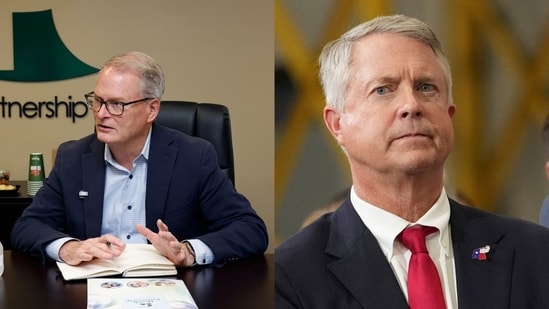
The Senate on September 24 rejected a resolution seeking to limit Trump’s authority to continue US military operations against Iran. The measure failed 49-50, with four Republicans, Susan Collins, Lisa Murkowski, Rand Paul and Thom Tillis, joining Democrats in supporting it. Marshall voted against the resolution.
Hamilton’s campaign quickly made Marshall’s vote a talking point ahead of the November 3 elections, arguing that Kansas families and farmers are bearing the economic consequences of the conflict.
“Roger Marshall once again voted against ending the war in Iran. Kansans are paying hundreds more at the pump as a result of this war,” Hamilton said, according to his campaign. He added that farmers were among those hit hardest by higher fuel and fertilizer costs.
Adam Hamilton targets Marshall over Iran vote
{{/usCountry}}Adam Hamilton targets Marshall over Iran vote
{{/usCountry}}Hamilton, a Democratic pastor and first-time Senate candidate, has increasingly made the war and its economic fallout part of his campaign against Marshall.
At a September 12 debate at the Kansas State Fair in Hutchinson, the candidates clashed over the Iran conflict, tariffs and agriculture. Hamilton criticized Marshall's support for Trump's approach to the war, while Marshall defended his position and his record on Kansas agriculture.
Marshall has described his position as supporting a strategy aimed at preventing Iran from obtaining nuclear weapons while avoiding a prolonged conflict. In June, he said the administration's approach should mean “no forever wars, no nukes” and argued that keeping shipping lanes open would help bring down energy and grocery costs.
Marshall also previously defended his vote against a War Powers Resolution, saying the U.S. military action against Iran was necessary to address what he described as threats from the Iranian regime.
Gas, diesel prices add pressure
Fuel prices have become a particularly potent issue for Kansas voters because of the state's large agricultural sector.
The U.S. Energy Information Administration reported that the national average price for regular gasoline reached $4.478 a gallon for the week ending September 21, up from $4.157 on September 7. Average on-highway diesel reached $6.529 a gallon, compared with $5.967 two weeks earlier. In the Midwest, diesel averaged $6.680 a gallon.
Hamilton's campaign cited higher fuel and fertilizer costs as evidence that the war is affecting Kansas households and farmers. It also claimed that 19 U.S. service members had died and that Kansas consumers had spent more than $860 million in additional gasoline costs since the conflict began. Those figures were presented by the Hamilton campaign and were not independently established in the campaign statement.
The Iran issue is unfolding as the Kansas Senate contest draws national attention. Marshall, a Republican incumbent, is seeking another term against Hamilton, who won the Democratic primary with 34.63% of the vote. Marshall won the Republican primary with 79.90%.
The candidates' confrontation over Iran now gives voters another clear dividing line in a race that is also being shaped by tariffs, agriculture, health care and the cost of living.