A busy bridge in Cedar Rapids, Iowa, became a recurring trouble spot for drivers, especially when rain or ice reduced the road surface's grip. In the years before 2012, more than 54 crashes were recorded at the location, prompting transportation officials to look for a solution that could improve safety without shutting down a major urban interstate.
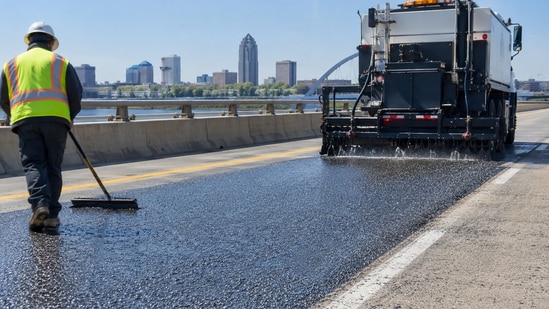
According to the Federal Highway Administration (FHWA), the Iowa Department of Transportation (IDOT) applied a high-friction surface treatment (HFST) to the bridge in June 2012, dramatically increasing the measured skid resistance. Within the following year, the site recorded only four crashes.
A bridge where wet pavement became a safety problem
The project was carried out on a five-in-one bridge complex spanning the Cedar River in Cedar Rapids, part of Interstate 380. The complex includes four bridge structures and a dam, while the section of interest is the six-lane urban highway crossing the river. It carries around 85,000 vehicles a day, including about 7,800 heavy trucks. Several features of the site called for special attention to traction control. Ramps leading to the bridge involved frequent lane changes, while vehicle speeds were high for the curve and the pavement's available friction.
Between spring 2008 and spring 2012, the location experienced more than 54 crashes, including 28 injury crashes. Eight involved semi-trailers. One particularly serious incident involved a truck that went over the bridge rail and caught fire below. A road safety audit found another warning sign: skid numbers on the existing pavement were in the 30s and 40s. That mattered because pavement friction helps tires maintain contact with the road during braking, turning, and other maneuvers. Research published in Accident Analysis & Prevention has found that wet-pavement crash rates tend to decline as skid resistance increases, highlighting the connection between pavement grip and traffic safety.
The treatment changed the bridge's friction almost immediately
{{/usCountry}}Between spring 2008 and spring 2012, the location experienced more than 54 crashes, including 28 injury crashes. Eight involved semi-trailers. One particularly serious incident involved a truck that went over the bridge rail and caught fire below. A road safety audit found another warning sign: skid numbers on the existing pavement were in the 30s and 40s. That mattered because pavement friction helps tires maintain contact with the road during braking, turning, and other maneuvers. Research published in Accident Analysis & Prevention has found that wet-pavement crash rates tend to decline as skid resistance increases, highlighting the connection between pavement grip and traffic safety.
The treatment changed the bridge's friction almost immediately
{{/usCountry}}HFST differs from the practice of resurfacing a road. It also involves using a polymer binder that bonds the high-quality aggregate with the road surface to create a surface that can offer a higher friction level. FHWA classifies the treatment as a safety intervention that addresses the problem of inadequate friction at sites where friction becomes insufficient due to wet weather, speed, or design of the roadways. For Iowa officials, the bridge was a test case because there were doubts about using HFST on an interstate bridge in a cold climate. The state was not sure how the treatment would behave with high traffic volume and heavy trucks, therefore IDOT first tested the treatment on its campus to evaluate how HFST would perform.
The change in friction was immediate. Measurements that had previously been in the 30s and 40s jumped into the 90s and low 100s immediately after installation. Those values remained at roughly the same level for several months afterward. More than a year afterward, measurements were still in the 80s to low 100s. The improvement was not just a short-lived result of roughening the surface. FHWA's case study showed that shot-blasting alone produced a temporary increase to around the mid-60s, while HFST provided a substantially higher and more persistent level of friction.
Four crashes in a year, compared with 54 before
The most visible change came in the crash record. In the year after the treatment, only four crashes were reported at the site, and just one involved an injury. In comparison, the bridge recorded more than 54 crashes during the roughly four years before HFST was installed. That marked reduction helped persuade IDOT that HFST could be useful beyond this bridge. Police officers reported fewer and less severe crashes, while maintenance staff later advocated using the treatment at other locations with similar safety problems.
The project cost about $494,000 and covered 1.8 lane miles, equivalent to 0.3 miles of roadway across the six lanes of the northbound and southbound I-380 bridge. FHWA estimated an expected treatment life of eight to 10 years and an approximate benefit-cost ratio of 3.8. Still, the Iowa experience does not mean every crash reduction after an HFST installation can automatically be attributed to the pavement treatment. A separate study of nine bridges published in the Journal of Performance of Constructed Facilities found an overall downward trend in crashes after high-friction overlays but cautioned that the reduction could not be completely attributed to the overlays.
For Iowa, the bridge became an early demonstration of how a focused pavement intervention could address a difficult safety problem without rebuilding the structure or changing the interstate's alignment.