All young creatures need a safe place to grow up, and baby salmon are no exception. One project in California’s Delta is using the tide to create that habitat. A 2024 paper published in San Francisco Estuary and Watershed Science notes that tidal wetland restoration for at-risk fish has gained momentum over the past decade. Dutch Slough, a site near Oakley, is one such effort.
The Delta's biggest tidal restoration
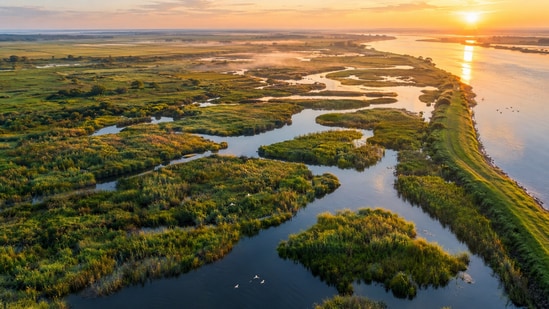
In 2018, the California Department of Water Resources (DWR) and its state and local partners celebrated the groundbreaking of Dutch Slough in Oakley, which DWR described as the Delta's largest tidal wetlands restoration project at the time. That title has since passed to the 3,400-acre Lookout Slough project in Solano County, which DWR said was completed in September 2024. It's a part of California EcoRestore. The effort, involving several agencies, was intended to advance at least 30,000 acres of habitat restoration in the Delta by 2020, and DWR's 2020 summary said it was on track to exceed that goal. At Dutch Slough, 1,187 acres of former dairy and grazing land are being converted to tidal marsh. The goal is to increase survival rates of endangered fish and wildlife.
How the tide does the work
Tidal marshes need land that slopes gently upward. So in May 2018, DWR began to move dirt from higher ground to lower ground. This allows water to flow in from the Delta channels and flow out with the daily tides. Grading of the first two parcels was finished in late 2019, and revegetation followed. The DWR planned to breach the levees in late fall 2021 to allow Delta waters to cycle through the new marsh depending on the establishment of the vegetation. The levees were breached in five places, and the final breach came in November 2021. That first phase opened about 700 of the site's 1,187 acres to the tides and to native fish and wildlife; the rest was still to be restored.
{{/usCountry}}Tidal marshes need land that slopes gently upward. So in May 2018, DWR began to move dirt from higher ground to lower ground. This allows water to flow in from the Delta channels and flow out with the daily tides. Grading of the first two parcels was finished in late 2019, and revegetation followed. The DWR planned to breach the levees in late fall 2021 to allow Delta waters to cycle through the new marsh depending on the establishment of the vegetation. The levees were breached in five places, and the final breach came in November 2021. That first phase opened about 700 of the site's 1,187 acres to the tides and to native fish and wildlife; the rest was still to be restored.
{{/usCountry}}Deep Dive
What is the Dutch Slough tidal wetland restoration project?
How does tidal water reach the restored marsh at Dutch Slough?
Has research confirmed that restored tidal marshes help juvenile salmon?
A safe neighborhood for young salmon
The site is on the western edge of the Delta, near the confluence of the Sacramento and San Joaquin rivers. It is also close to Suisun Marsh, where salt water and fresh water mix. The DWR says the mix provides a more diverse habitat than other marsh sites.
The goal is to turn retired farmland into tidal marsh that offers juvenile salmon and other species safer habitat. "It's essentially a safe neighborhood for fish," said Patty Finfrock, DWR's project manager for Dutch Slough at the time. Salmon spawn upstream and their young move downstream in search of food and shelter.
What the research says so far
The 2024 paper summarizes a fall 2023 symposium hosted by DWR and the State Water Contractors. It calls for more study of fish use of restored habitats. It also suggests better monitoring and adaptive management. A 2014 study in Transactions of the American Fisheries Society examined a similar project in Washington State. Tidal flow returned to 364 hectares (about 900 acres) of marsh at the delta of the Nisqually River. Restored and reference channels offered similar foraging and growth potential for juvenile Chinook salmon. However, densities of salmon were reduced in restored channels. The growth potential was more variable because the water was warmer and less stable. The authors concluded that some habitat features are recoverable quickly, but not all are.
More than a fish story
DWR Deputy Director Kristopher Tjernell said the project advances scientific knowledge. He said it also benefits fish and wildlife that have suffered for decades from land and levee development. Also, it improves water and air quality, and he called the site a living laboratory for studying future wetlands. DWR says it must plan for climate hazards while serving clean water to 27 million Californians.
In 1999, American Rivers' John Cain saw the site's potential. He persuaded local leaders that a marsh was the best way to save the Delta shoreline. It also lets people walk, boat, and fish safely. A 55-acre portion of the site is being developed by the City of Oakley into a community park, with a loop trail for hiking, biking and birdwatching, according to DWR. It could also help reduce flooding risk for surrounding housing as sea levels rise.