In 1862, President Abraham Lincoln appointed Thomas Hogg U.S. marshal to Japan, and over the following years, Hogg sent plants home to his brother James, who ran a nursery in the Yorkville section of Manhattan. One of them was Japanese knotweed. A 2017 paper in the Journal of the Torrey Botanical Society by Peter Del Tredici of Harvard University’s Arnold Arboretum pieced together how the plant reached North America.
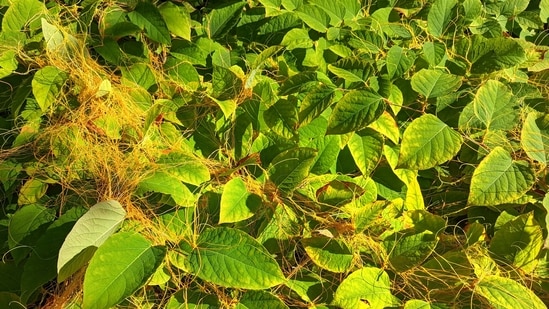
Del Tredici found articles from 1868, 1872, and 1875 that point to three separate introductions during the 1860s. Two came from Europe, and one arrived directly from Japan through the Hoggs. In his 1875 article, James Hogg said the plant had reached him seven or eight years earlier, placing its arrival around 1867 or 1868. He described a striking perennial that grew 5 to 7 feet tall and set rose-colored fruits in September. He also noted that shoots had recently served as an asparagus substitute in France. An 1868 piece by botanist George Thurber praised another plant’s graceful appearance but called its rapid spread its greatest fault. Del Tredici suggested the two descriptions most likely referred to different clones.
A specimen helps trace the plant’s spread
A dried specimen collected by M. Ruger of the Torrey Botanical Club in September 1873 from Hogg’s Yorkville garden offers a clue. Examining it under a dissecting microscope, Del Tredici found a female plant whose few anthers appeared sterile, with no sign of pollen. Because Hogg reported abundant fruit, a pollen-producing plant may have grown nearby. This suggests the shipment could have included at least one male and one female plant, although the specimen alone cannot establish the origin or viability of the fruit Hogg described.
{{/usCountry}}A dried specimen collected by M. Ruger of the Torrey Botanical Club in September 1873 from Hogg’s Yorkville garden offers a clue. Examining it under a dissecting microscope, Del Tredici found a female plant whose few anthers appeared sterile, with no sign of pollen. Because Hogg reported abundant fruit, a pollen-producing plant may have grown nearby. This suggests the shipment could have included at least one male and one female plant, although the specimen alone cannot establish the origin or viability of the fruit Hogg described.
{{/usCountry}}Deep Dive
How did Japanese knotweed first reach North America?
Why are Japanese knotweed populations in eastern North America more genetically diverse than those in Europe?
How does Japanese knotweed spread so quickly?
That possibility matters because much of Europe’s Japanese knotweed belongs to a single female clone that reproduces vegetatively and does not produce viable seeds on its own. Philipp von Siebold’s company sold this clone in 1848. If fertile plants introduced through Hogg’s garden produced seeds that subsequently spread across the Northeast, they could help explain why eastern North American populations are more genetically diverse than European ones. Del Tredici presented this as a possible explanation rather than a confirmed account of the plant’s spread.
From showpiece to nuisance
Von Siebold’s catalog described the plant as inextirpable, meaning difficult or impossible to eradicate. By 1893, horticulturist E.N. Plank had noted Japanese knotweed’s aggressive growth in New York’s Central Park. Del Tredici’s 2017 paper also documented few herbarium records before 1900, followed by a steady rise through the 1940s and a sharp increase in the 1950s and 1960s. Widespread ornamental and practical planting may have contributed to that increase, although the records alone do not establish the cause. Many European countries and U.S. states have since restricted or banned its propagation.
The U.S. Geological Survey describes Japanese knotweed as an upright perennial that grows 1 to 3 meters tall, with hollow, bamboo-like stems and underground rhizomes that can extend 7 to 20 meters laterally. Stem or rhizome fragments as small as 40 millimeters can regenerate, allowing the plant to spread through floodwater or discarded cutting debris. It also tolerates repeated mowing and cutting.
Japanese knotweed can form dense stands that shade out other vegetation. It is included on the International Union for Conservation of Nature’s list of the world’s worst invasive alien species. The USGS database records the plant in multiple states and Washington, D.C. Its earliest listed observation is from Connecticut in 1894, a database entry that does not supersede the earlier New York records described above. Some database records may reflect historical rather than current presence.
In Britain, the sap-feeding psyllid Aphalara itadori was released in 2010 to help control Japanese knotweed. Researchers have also assessed its suitability as a biological control agent in North America, according to the USGS and CABI. The plant’s rapid growth, once noted as a horticultural feature, has made it difficult to manage more than 150 years after its introduction.