US President Donald Trump on Friday called the Supreme Court’s decision to limit nationwide injunctions a “monumental victory”, saying such court orders had repeatedly blocked his policy agenda.The court delivered rulings in the last six cases on its summer docket, including emergency appeals tied to former President Donald Trump’s policies.
In a split decision, the court ruled that individual judges cannot issue nationwide injunctions. However, it left uncertain the outcome of Trump’s attempt to restrict birthright citizenship.
The court sided with Maryland parents who raised religious objections to school reading materials, upheld a key provision of the Obamacare coverage mandate, supported a law designed to prevent children from accessing online pornography, and maintained a fee that helps fund phone and internet services for schools, libraries, and rural communities.
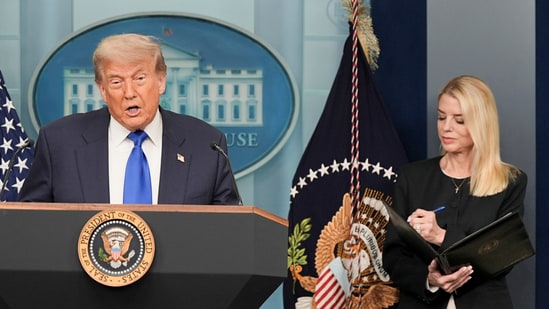
Speaking from the White House briefing room, Trump praised the US Supreme Court’s ruling on nationwide injunctions, calling it “amazing” and a “monumental victory for the Constitution,” as well as for “the separation of powers and the rule of law.”
Donald Trump to push birthright citizenship curb
Trump said he would now move forward with efforts to restrict birthright citizenship and other policies that had previously been blocked by lower courts.
{{/usCountry}}Trump said he would now move forward with efforts to restrict birthright citizenship and other policies that had previously been blocked by lower courts.
{{/usCountry}}Vice President JD Vance also welcomed the ruling, calling the system of nationwide injunctions a “ridiculous process” that had long been misused to obstruct executive action.
“Under our system, everyone has to follow the law—including judges!” the vice president wrote on the social platform X.
Skye Perryman, president and CEO of the nonprofit Democracy Forward, described the Supreme Court’s decision on birthright citizenship as “another obstacle” to safeguarding constitutional rights. However, she noted that “a number of pathways remain for individuals to obtain relief from the courts.”
Krish O’Mara Vignarajah, president and CEO of Global Refuge, called the decision “a deeply troubling moment not only for immigrant families, but for the legal uniformity that underpins our Constitution.”
“The ruling opens the door to a dangerous patchwork of rights in this country, where a child’s citizenship may now depend on the judicial district in which they’re born,” Vignarajah said in a statement.
He added that “birthright citizenship has been settled constitutional law for more than a century,” and warned that by preventing lower courts from enforcing it uniformly, “the Court has invited chaos, inequality, and fear.”
With AP inputs