The final day of voting for the 2026 US midterm elections is on November 3. The results will be declared after that, as counting wraps up across booths. Before that, here's a look at the numbers that matter in the 2026 midterm elections.
What's at stake in the US midterm elections?
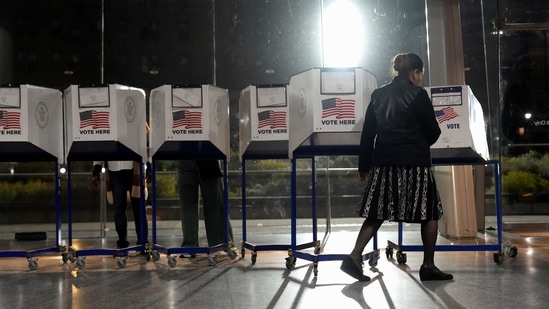
The US midterm elections will see changes at a federal and state level. Candidates are running not just for the US House of Representatives and Senate, but also for gubernatorial posts, and state government-level positions.
All 435 House seats are being contested, while 35 Senate seats are on the ballot as well. Of that, 33 are regular seats while Florida and Ohio are special seats. 36 gubernatorial elections are also taking place, along with three in US territories. Further, a staggering 6,139 State legislative seats will be decided in 88 out of 99 chambers across 46 states.
Deep Dive
How many House and Senate seats are being contested in the 2026 US midterm elections?
When will the 2026 US midterm election winners be declared?
Why can US midterm election results take days or weeks to finalize?
Also Read | Claire Valdez to Chris Rabb: Democratic Socialists likely on their way to Congress
{{/usCountry}}Also Read | Claire Valdez to Chris Rabb: Democratic Socialists likely on their way to Congress
{{/usCountry}}The two main chambers being contested on November 3 include the US House of Representatives and Senate, which makes up the US Congress.
US Congress: How it works
The US House of representatives is the lower house, akin to the Lok Sabha, for those familiar with Indian elections. The Senate is the upper house, which would be akin to India's Rajya Sabha.
Both the upper and lower houses have their distinct tasks and compositions.
US House of Representatives: Current composition
A total of 435 seats are up for contest from the US House of Representatives this midterm elections.
Currently Democrats hold 214 seats while Republicans have 218, the number needed for a majority. Two seats are vacant, and there's 1 Independent candidate. Kevin Kiley, who represents California's 3rd District, is the Independent after leaving the Republican Party in 2026. However, he still sits with the House Republicans.
Texas Republican Tony Gonzales and Florida Democrat Sheila Cherfilus-McCormick resigned, and both state governors declining to call special elections before the midterms, resulting in the two vacant seats.
US Senate: Current composition
At present, Republicans have the majority in the Senate with 53 seats while Democrats have 47 seats.
A total of 35 Senate seats are up for election. Of that, 22 are held by Republicans and 13 by Democrats. With a 51-seat count needed for majority, the Democrats have to win just four of the 35 seats in contention to wrest control for the GOP.
A look at the gubernatorial races
A total of 39 gubernatorial races are in the offing.
Of the total seats, 20 are held by Democrats, and 18 by Republicans. One is held by an Independent candidate. The gubernatorial seats include 36 states and three territories. The Democratic total includes Guam and the US Virgin Islands. Meanwhile, the Independent currently holds the Northern Mariana Islands seat.
Overall, while Republicans have 26 of the 50 state governorships, Democrats hold 24 of them.