
The White House is seeking answers over how the US Army handled a stockpile of unstable explosives at an Iowa munitions plant, after senior Trump administration officials were reportedly caught off guard by the risks and the preparations for a controlled detonation.
The administration is examining why information about the deteriorating chemicals was not elevated to senior officials sooner, even though the Army had known about the potential danger for months, CBS News reported on November 25, citing US officials familiar with the matter.
Suggested For You
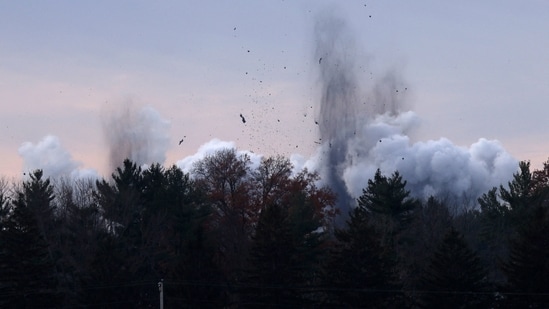
President Donald Trump and other administration officials praised the operation after the Army detonated about five tons of degraded lead azide at the Iowa Army Ammunition Plant in Middletown on Wednesday.
Deep Dive
Why did the Army use a controlled detonation to destroy the Iowa lead azide?
Did the EPA detect airborne lead after the Iowa detonation?
Why is the White House seeking answers about the Army's handling of the Iowa explosives?
Also Read: US judge bars Trump administration from enforcing revised birthright citizenship limits
Army officials accused of failing to escalate warnings
According to CBS News, several officials said then-Army Secretary Dan Driscoll did not alert Defence Secretary Pete Hegseth or other senior administration leaders after the Army identified the public and environmental risks in the spring.
{{/usCountry}}According to CBS News, several officials said then-Army Secretary Dan Driscoll did not alert Defence Secretary Pete Hegseth or other senior administration leaders after the Army identified the public and environmental risks in the spring.
{{/usCountry}}However, another source familiar with discussions about the ammunition told CBS News that the Army had notified Hegseth's office early on. Other officials said that notification did not reach Hegseth personally.
Acting Army Secretary Adam Telle was informed about the stored chemicals and their risks in September but did not brief his superiors, officials told the news outlet. The report said there had been discussions about moving Telle out of the acting role in the coming weeks.
The White House was reportedly taken by surprise when senior officials learnt the extent of the problem while returning from Trump's Asia trip. Chief of Staff Stephen Miller then coordinated a response involving around a dozen agencies and Cabinet members.
Also Read: IBM gives H-1B professionals three weeks to relocate or leave the US
68 barrels of unstable chemicals found in March
The Army notified the Environmental Protection Agency in March that 68 barrels of potentially unstable chemicals had been discovered during a routine inspection at the plant.
Vice President JD Vance said the administration had known for about six months that moving or neutralising the material could create significant danger for nearby residents. However, other officials told CBS News that the conclusion that controlled detonation was the only safe disposal option had been reached around two months ago.
A federal appeals court cleared the way for the operation on Monday after environmental groups and elected officials raised concerns about potential public-health risks.
EPA reports no airborne lead after blast
The Army carried out the controlled detonation on Wednesday, saying it had used barriers, aqueous foam and other measures to limit the spread of toxic dust.
The EPA reported that four monitoring stations detected no lead in the air 15 minutes after the blast. The readings remained unchanged two hours later, according to the agency.
Iowa governor-elect Rob Sand had criticised the chaotic lead-up to the operation and called for transparency. Trump accused Sand of delaying the process, although Sand did not have authority over the detonation.
Explore More
ABOUT THE AUTHOR
Asmi is a Senior Content Producer primarily covering stories related to NRIs, immigration, visas, citizenship and global mobility. She closely follows developments that affect Indians living, working and studying abroad, with a particular focus on translating complex policies and international developments into clear, accessible stories for readers. As part of the US Desk, Asmi also reports on a wide range of political, economic and social developments in the United States, exploring their relevance to Indian and global audiences. Her work spans breaking news, features, trends and explanatory stories, with an emphasis on accuracy, timely reporting and audience-focused storytelling. Asmi likes finding the human angle behind major developments and bringing context to stories that can often feel complicated or distant. She is especially interested in stories around immigration, life abroad, careers, education and the experiences of the Indian diaspora, while also exploring a wide range of topics that spark curiosity and conversation. Outside the newsroom, Asmi is an avid reader and loves travelling, discovering new places, experiencing different cultures and collecting stories along the way.