
 E-Paper



U.S. Sub Torpedoes Iranian Warship
The U.S. Navy shot down an Iranian missile aimed at Turkey as NATO allies are drawn in.


 Prefer HTon Google


A torpedo from an American submarine sank an Iranian warship in the Indian Ocean, Defense Secretary Pete Hegseth said, while the U.S. also shot down an Iranian missile that was heading toward a key Turkish military base.
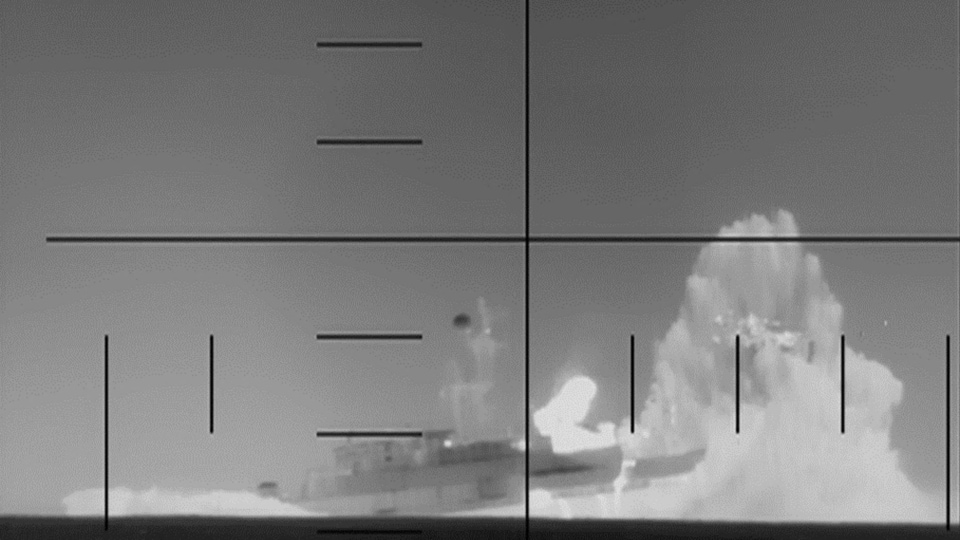
The dayslong Middle East conflict continued to expand well beyond Iran on Wednesday and risks pulling in America’s NATO allies. Hegseth in a news conference put a longer time frame on the war, saying it could last as long as eight weeks.
Hegseth said the attack on the Iranian vessel marked the first such sinking of an enemy ship by a torpedo since World War II. The operation reflects Washington’s determination to destroy Tehran’s navy and safeguard the flow of oil through the Persian Gulf. The torpedoed Iranian ship sank off the coast of Sri Lanka, killing at least 87 people, local authorities said.
The Iranian navy has been an important focus of U.S. strikes. Gen. Dan Caine, the chairman of the Joint Chiefs of Staff who appeared with Hegseth at the news conference, said that to date more than 20 Iranian naval vessels have been destroyed.
The Turkish base that was the target of the Iranian missile is in the south of the country. The U.S. Air Force has a hub at the base, called Incirlik, a facility it shares with the Turkish military.
The targeting of Turkey marks the crossing of another line in the rapidly expanding conflagration; Iran until Wednesday had refrained from attacking its neighbor. The North Atlantic Treaty Organization condemned the targeting of Turkey, a member of the military alliance.
The Turkish Defense Ministry said the Iranian missile was destroyed after passing through Iraqi and Syrian airspace on its way toward southern Turkey. The air defense ordnance fell in an open area in Turkey’s nearby Hatay province, causing no injuries or damage, it added.
A U.S. Navy destroyer in the eastern Mediterranean shot down the missile, a U.S. official and a regional official said.
The U.S. has long stationed nuclear weapons at the Turkish base. Among the weapons currently there are B-61 thermonuclear bombs, said Hans Kristensen, director of the nuclear information project at the Federation of American Scientists
The incoming Iranian missile was first identified by a NATO radar station at a different Turkish base, called Kurecik in southeastern Turkey, according to a regional official briefed on the attack.
Other NATO allies are deepening their involvement in the conflict. The U.K. recently granted the U.S. access to its military bases for strikes on Iranian missile capabilities, enabling the U.S. to increase the intensity of its bombing campaign. France said it is building a coalition to protect commercial ships from the threat of Iran and its proxy groups in the Strait of Hormuz, the Red Sea and Suez Canal.
The NATO charter says that an armed attack against one member “shall be considered an attack against all members, and triggers an obligation for each member to come to its assistance” according to the website of the alliance.
“We condemn Iran’s targeting” of Turkey, said NATO representative Allison Hart. “NATO stands firmly with all Allies,” she said in a short statement.
President Trump is discussing with his advisers the U.S.’s role in Iran after the military conflict ends, White House press secretary Karoline Leavitt said Wednesday. “Do we want to see Iran being led by a rogue terrorist regime? No, of course not,” she said. The president is “actively considering and discussing” America’s role with advisers and his national-security team, she added.
Leavitt read four objectives of Operation Epic Fury that didn’t explicitly include regime change. Trump hasn’t ruled out putting American troops on the ground, but they aren’t part of operational plans at this time, Leavitt said.
Meanwhile, U.S. markets on Wednesday appeared to set aside some of their fears over the conflict. Stocks advanced, after losses the previous day, while a recent run-up in oil prices paused. Still, oil prices are up about 15% this week, while natural-gas prices have soared in Europe and Asia.
Diesel-fuel prices, meanwhile, have surged this week. High diesel prices would be felt by consumers quickly: Grocery stores and other retailers pay truckers’ fuel surcharges and pass those costs on to consumers.
Several thousand ships remain stuck inside and outside the Persian Gulf, trapping roughly a fifth of the oil and liquefied natural gas the world consumes each day.
Since the conflict with Iran began, more than 17,500 American citizens have left the Middle East and returned to the U.S., according to State Department spokesman Dylan Johnson.
On Tuesday alone, more than 8,500 American citizens returned to the U.S., with many more leaving the Middle East for countries in Europe and Asia, he said in a statement. The State Department “will continue to actively assist” U.S. citizens who wish to leave the region, he said.
The widening conflict came as a body of conservative clerics in Iran was weighing who will replace the nation’s slain supreme leader, Ayatollah Ali Khamenei.
The clerics don’t have an exact timeline for the selection, according to a member of the body who was quoted by Iranian state news agency IRNA.
Khamenei’s son, Mojtaba Khamenei, 56, is considered a top contender and would likely opt for an even more hard-line direction as supreme leader, Iranian officials and analysts say.
Write to Jared Malsin at jared.malsin@wsj.com, Shelby Holliday at shelby.holliday@wsj.com and Lara Seligman at lara.seligman@wsj.com


