E-Paper



While Iran war rages, what's US military doing in this African nation? American ‘return’ to Nigeria, explained
In Nigeria, where a protracted insurgency strains state authority, the US has reinserted with a limited, strategic deployment of troops and surveillance drones.

 Prefer HTon Google


As the Iran conflict dominates global headlines, Washington is quietly recalibrating its military presence in West Africa too. In Nigeria, where a protracted insurgency continues to test state authority, the United States has reinserted itself through a limited but strategic deployment of troops and high-end surveillance drones, operating away from the battlefield’s frontlines.
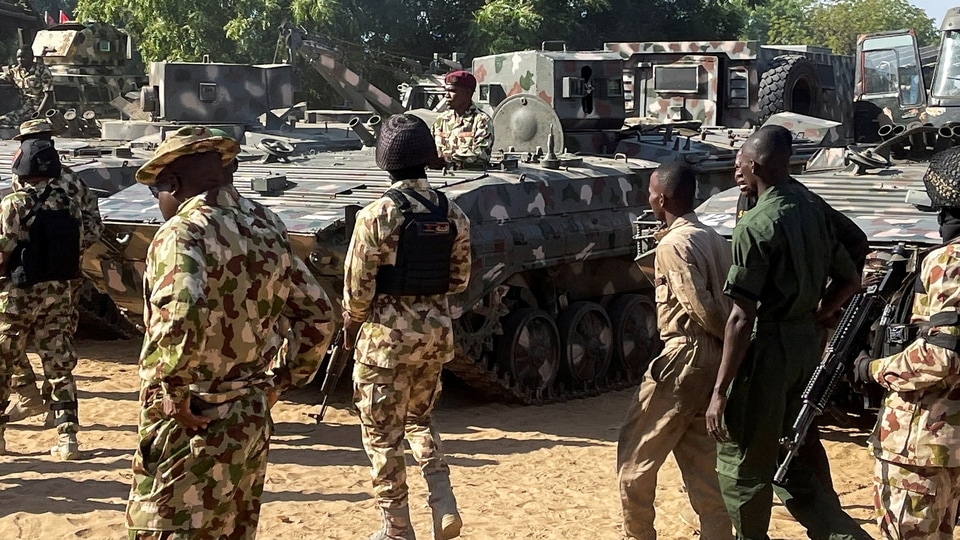
Around 200 US military personnel are currently stationed in Nigeria, working alongside multiple MQ-9 drones to provide training and intelligence support to the military, which is fighting Islamist militants across the north, US and Nigerian officials told news agency Reuters.
Also read | Nigerian troops kill 80 jihadists in northeast: military
A return, but with limits
This is not a combat deployment in the traditional sense. US troops are not embedded with Nigerian units in active battle zones. And the drones are not being used for airstrikes at least for now.
Instead, the focus is on surveillance and intelligence-sharing.
The move, however, signals a renewed American engagement in West Africa’s security challenges.
This comes after a period of reduced presence, particularly following the closure of a major US drone base in neighbouring Niger in 2024.
That facility, worth $100 million and once hosting about 1,000 troops, had been central to monitoring militant activity across the Sahel before Niger’s military leadership asked US forces to leave.
Why Nigeria matters now
Nigeria has been grappling with insurgency for nearly two decades. Groups like Boko Haram and ISWAP continue to pose a serious threat, adapting tactics and expanding their reach.
Also read | Suspected suicide attacks kill at least 23 in Nigeria's Maiduguri
Recent developments underline the urgency. A suicide bombing attack struck a garrison town in northeastern Nigeria this week, showing militants can still hit urban centres. In the northwest, violence linked to banditry is intensifying, raising fears it could evolve into another hub for Islamist operations, especially near borders with Benin and Niger.
Against this backdrop, US officials describe the threat as “shared”, and said the drones were deployed at Nigeria’s request to collect intelligence.
Intelligence over intervention
From the Bauchi airfield in northeastern Nigeria, US assets are feeding into a growing intelligence partnership between the two countries.
Nigerian authorities say this collaboration is already making a difference on the ground.
Major General Samaila Uba, director of information at Nigeria's Defence Headquarters, confirmed the arrangement and emphasised its non-combat nature.
"This support builds on the newly established US-Nigeria intelligence fusion cell, which continues to deliver actionable intelligence to our field commanders," he told Reuters.
"Our US partners remain in a strictly non-combat role, enabling operations led by Nigerian authorities," he added.
There is no fixed timeline for how long US troops and drones will remain in Nigeria. Officials from both countries say the duration will be decided jointly, depending on evolving security needs.
MQ-9 drones also known as Reapers are capable of staying airborne for over 27 hours and can be used for both surveillance and strikes. Their current role in Nigeria is restricted to intelligence-gathering, but their presence underscores the strategic flexibility of the deployment.
The bigger picture
Even before this latest move, US surveillance activity in the region had continued. Aircraft operating out of Ghana were reportedly conducting intelligence flights over Nigeria last year.
The US also carried out airstrikes in northwest Nigeria on Christmas Day, targeting militants it said were threatening Christian communities.
However, Nigerian authorities and conflict experts have pushed back against framing the violence as a purely religious campaign, calling it a far more complex crisis.
Persistent threat, shifting tactics
Despite years of military efforts, militant groups remain resilient. According to Nigerian officials, both Boko Haram and ISWAP continue to adapt, seeking high-impact attacks to maintain relevance.
"We continue to assess that these organisations will seek opportunistic targets and may attempt to demonstrate relevance through high-visibility attacks," Uba said.
While the Iran conflict dominates headlines, the US presence in Nigeria highlights another front in its global security strategy one where intelligence, not direct combat, is currently the primary weapon.
(With inputs from Reuters)