France is still nursing a grievance over Australia nullifying a USD 59 billion air independent propulsion (AIP) submarine deal and opting out for nuclear powered conventional weapon attack or SSNs submarines with US and UK under the September 15, 2021 AUKUS pact.
While Paris may have legitimate reasons for being upset with Australia for renegading on the submarine deal, the emerging picture in Indo-Pacific clearly shows that AIP submarines would have been a half-measure in containing a belligerent China under all powerful President Xi Jinping. Given the strategic environment in Indo-Pacific and South China Sea in particular, the Australian choice for an SSN is definitely a better option in tackling a rapidly growing PLA Navy and Chinese intermediate range ballistic missile arsenal.
The state of strategic play is such that India also has no choice but to go for long-range nuclear-powered submarines and delivery platforms as it is only a matter of time when the Chinese carrier force will be patrolling the Indian Ocean. With two nuclear submarines already operational and third one a work in progress, India also is building a leverage in case PLA decides strong arm tactics on the 3,488-km Line of Actual Control (LAC), like it did in May 2020.
If one overlooks the noise over Australia scuttling the French submarine deal, it is not very difficult to understand why Canberra decided the nuclear option as it is a deterrent to Chinese Taiwan ambitions. Today’s signing of security pact between Japan and Australia, once World War II adversaries, with the bottom line on convergence in Indo-Pacific is also a step in the direction to ask China to mend its aggression. Australian Prime Minister Scott Morrison described the agreement “will underpin greater and more complex practical engagement between the Australian Defence Force and the Japanese Self-Defence Forces.” Juxtapose the new security pact with AUKUS and Quad and the larger picture emerges on the Indo-Pacific with India having a logistics agreement with all the Quad partners.
{{/usCountry}}If one overlooks the noise over Australia scuttling the French submarine deal, it is not very difficult to understand why Canberra decided the nuclear option as it is a deterrent to Chinese Taiwan ambitions. Today’s signing of security pact between Japan and Australia, once World War II adversaries, with the bottom line on convergence in Indo-Pacific is also a step in the direction to ask China to mend its aggression. Australian Prime Minister Scott Morrison described the agreement “will underpin greater and more complex practical engagement between the Australian Defence Force and the Japanese Self-Defence Forces.” Juxtapose the new security pact with AUKUS and Quad and the larger picture emerges on the Indo-Pacific with India having a logistics agreement with all the Quad partners.
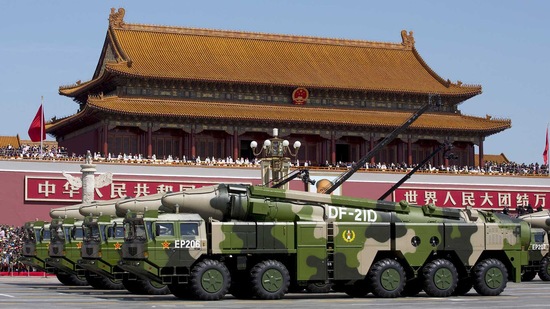
{{/usCountry}}Rather than viewing AUKUS from a French commercial perspective, the Australian nuclear powered conventional attack submarines will be an answer to the massive deployment of DF-21 and DF 26 series of ballistic missiles by the PLA on Chinese east coast to prevent US aircraft carrier enter the South China Sea in the worst case scenario over Taiwan. Given the range of these ballistic missiles, the US aircraft carrier force will have to operate outside the first chain of islands after China or else be on the cross-hairs of these PLA delivery platforms. While US and Russia were bound by the Intermediate Range Nuclear Forces Treaty since 1987 and before suspension in 2019, the PLA has built a massive intermediate range ballistic missile arsenal with its propaganda media nick-naming DF-21 and DF 26 as carrier killer and Guam killer weapons.
With the advent of Australian nuclear submarines, the Chinese missile sites on east coast will be threatened by the sub-surface attack platforms which can stay under water for months together in South China Sea or the Indo-Pacific. Fact is that AUKUS is a game-changer for Indo-Pacific as even the latest AIP diesel submarines must surface, in effect betraying their positions, in weeks for charging their batteries. Thus, from a strategic perspective, the Australian nuclear attack submarines with conventional ballistic missiles as deterrents will allow US aircraft carrier to operate between Chinese coast and first island chain and also enforce laws of the seas and freedom of navigation in South China Sea. As China is threatening Taiwan on a daily basis by breaching its air defence identification zone, it is for the US to speed up the SSN production for Australia as time is running out for Taipei and the security of Indo-Pacific.