
 E-Paper



Why Black Sea has become the Russia-Ukraine war's most crucial battleground
Bordered by Europe, Asia and West Asia, the Black Sea is a vital trade and security corridor.

 Prefer HTon Google


The Black Sea has been one of the most strategically important fronts in the Russia-Ukraine war. Both sides are stepping up attacks on ports, ships, oil infrastructure and logistics networks in the waterway.
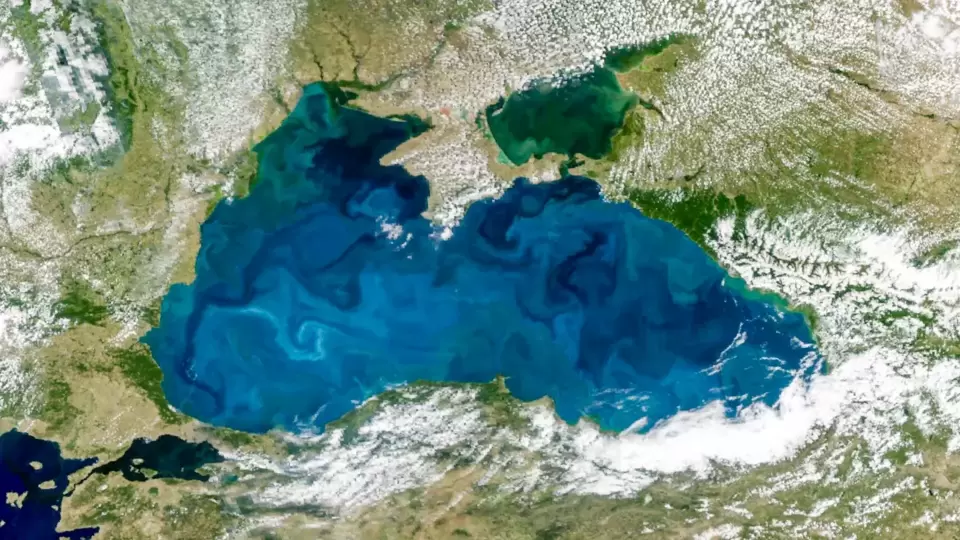
Beyond military operations on land, the battle for control of the sea is disrupting global grain and energy trade, damaging critical infrastructure and raising concerns over maritime security.
Why the Black Sea matters
Bordered by Europe, Asia and West Asia, the Black Sea is a vital trade and security corridor. It serves as a major route for the movement of grain, oil, gas and other commodities, while pipelines and fibre-optic cables running beneath its waters make it critical to global energy supplies and communications.
ALSO READ | Ukraine’s top general could be on the way out
For Ukraine, the Black Sea is the country's primary gateway for agricultural exports, which remain its largest source of foreign currency earnings. For Russia, it provides access to its key warm-water ports, making it central to military and commercial operations. The sea gained even greater strategic importance after Russia annexed Crimea in 2014, cementing its role in Moscow's long-term security objectives.
A key front in the war
The maritime theatre has seen a sharp escalation in recent months, with both sides targeting infrastructure that supports military and economic operations.
Between April and May, Ukraine struck Russian "shadow fleet" tankers, Kairos, Virat and Dashan, while drone attacks targeted the Tuapse refinery and the Tuapse oil terminal, one of Russia's major oil export hubs. The attacks triggered large fires, suspended operations and caused oil spills, toxic smoke and coastal pollution.
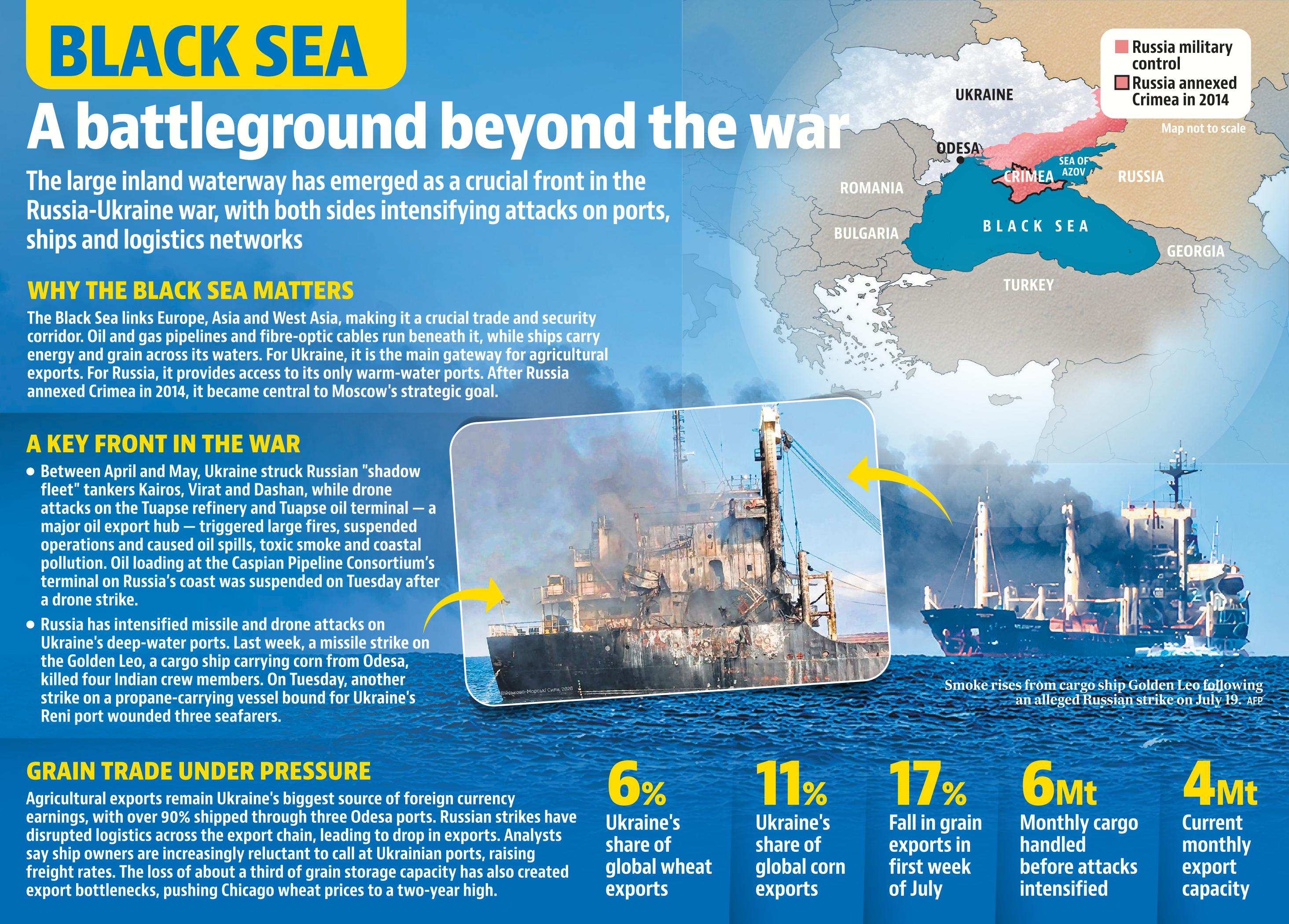
On Tuesday, oil loading at the Caspian Pipeline Consortium's export terminal on Russia's Black Sea coast was suspended following another drone strike.
Russia, meanwhile, has intensified missile and drone attacks on Ukraine's deep-water ports and merchant shipping.
ALSO READ | India summons Russian diplomat over death of four Indian seafarers in vessel attack off Ukraine coast
Last week, a missile strike on the Golden Leo, a cargo ship carrying corn from Odesa, killed four Indian crew members. On Tuesday, another Russian strike hit a propane-carrying vessel heading to Ukraine's Reni port, injuring three seafarers.
These repeated attacks have heightened risks for commercial shipping operating in the region and added to concerns over the safety of international trade routes.
Grain exports face growing pressure
The attacks are also putting Ukraine's grain trade under increasing strain. More than 90% of Ukraine's agricultural exports are shipped through its three ports in the Odesa region. As Russian strikes continue to disrupt port operations and logistics, exports have slowed.
Analysts say many ship owners are becoming increasingly reluctant to send vessels to Ukrainian ports because of security risks, driving up freight costs. At the same time, the destruction of roughly one-third of Ukraine's grain storage capacity has created bottlenecks in the export chain.
The disruptions have also had an impact on global food markets, with Chicago wheat prices rising to a two-year high amid concerns over supplies.
ALSO READ | Oleksandr Syrsky, Ukraine's under-fire commander-in-chief
Key figures
Ukraine accounts for around 6% of global wheat exports and 11% of global corn exports, underlining its importance to global food supplies. However, grain exports fell by 17% in the first week of July as attacks disrupted logistics.
Before the escalation in strikes, Ukraine's ports handled about 6 million tonnes of cargo every month, but current export capacity has dropped to around 4 million tonnes per month.
The Russia-Ukraine war
Russia launched its full-scale invasion of Ukraine on February 24, 2022. The war, however, traces its origins to 2014, when Russia annexed Crimea following the ouster of Ukraine's pro-Russian president, as per information by the UN and NATO. Ukraine's Donetsk and Luhansk regions also saw fighting continue for years.


