A tigress in her lifetime has multiple partners but the first right is always of the dominant tiger of the area, a study found, countering the earlier belief that they were polygynous.
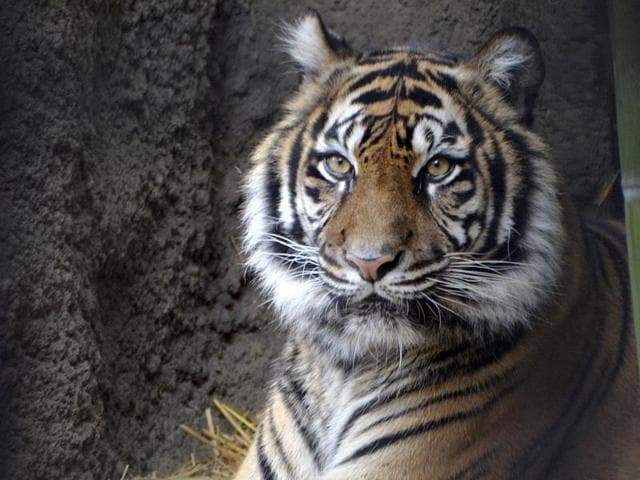
(Representative image) A tigress in her lifetime has multiple partners, a study found, countering the earlier belief that they were polygynous. (AP File Photo)
{{^htLoading}} {{/htLoading}}
The study is based on decade-long observation of tiger behaviour in Madhya Pradesh’s Panna Tiger Reserve.
{{^usCountry}}{{/usCountry}}
Camera trap evidence showed that tigers that were not territorial mated with the resident tigress. However, when the female conceived and was unable to move much, the dominant tigers provided her prey.
This is more prevalent in areas where their sex ratio is low. Almost half of India’s tiger reserves have poor sex ratio — three males for two females on average.
The authors of the study paper concluded that such polyandry might be a feature of an isolated population where the young males cannot find territories that offer them a chance to breed. Tigers are generally believed to be polygynous — a male will mate with several females.
{{^htLoading}} {{/htLoading}}
{{^usCountry}}
“This is good news for tiger conservation,” lead author Raghunandan Singh Chundawat said. “The study indicates that even a small number of tigresses can help in breeding of tigers.”
{{/usCountry}}
{{#usCountry}}
“This is good news for tiger conservation,” lead author Raghunandan Singh Chundawat said. “The study indicates that even a small number of tigresses can help in breeding of tigers.”
{{/usCountry}}
The authors suggested creating “stepping stones” — patches of forest within the larger landscape, where a few breeding females can be protected.
These smaller units can interconnect the reserve population and jointly create a larger, more viable tiger population. This will enhance the survival probability of tigers in the dry forest areas without having to increase the size of protected areas, Chundawat said.
The paper published in Biological Conversation journal highlighted that tigers in tropical dry forest areas are more vulnerable to extinction. Sariska and Panna Tiger Reserves, which lost their tigers in 2005 and 2009 respectively, fall in this category.
{{^htLoading}} {{/htLoading}}
The first comprehensive study with data on tiger movement over 10 years — the longest wildlife observation in the sub-continent — also found the ‘home range’ of tigers in Panna was three to four times their counterparts’ in bigger tropical tiger reserves such as Kanha in Madhya Pradesh and Nagarhole in Karnataka.
“The tigers were, therefore, more exposed to the threat of human-caused mortalities,” the authors said in a statement, terming this as a possible reason for a greater risk of extinction in dry tropical forests in smaller regions.
Chetan Chauhan is the National Affairs Editor looking into all aspects of news and features from across India. A Chevening scholar with over three decades of experience in reporting and news management, Chetan has extensively covered all important aspects of the social sector, political economy, environment and climate change nationally and internationally. He did a journalism course at the Reuters Institute of Journalism in Oxford and Digital Media training at Nanyang Technological University in Singapore. He started as a reporter with The Statesman in 1996 and joined the Hindustan Times in 2000 in the metro bureau covering environment, crime and Delhi politics. He covered hot local news, from the Jessica Lal murder case to the rebellion of Delhi Congress MLAs against then Chief Minister Sheila Dikshit, to the replacement of toxic vehicle fuel with cleaner compressed natural gas (CNG) in the national capital. Some of his stories on air pollution became part of the Supreme Court’s landmark MC Mehta versus Government of India case in the National Capital Region (NCR), forcing the government to take corrective measures. As part of the national political bureau since 2004, he covered important central sectors such as environment, education, social justice, labour, rural development, water resources, renewable energy, agriculture, broadcasting and the Planning Commission for more than a decade producing several exclusive and investigative breaking stories. His specialisation is the environment, having covered at least a dozen United Nations global conferences on climate change, biodiversity and wildlife including climate summits in Paris, Copenhagen and Bali. He also covered India’s two five-year plans ---11th and 12th and reported on drafting and execution of right based laws such as Right to Education, Right to Information and rural job guarantee law, MG-NREGA, now being introduced in new format as VG-RAM-G Act. He has in-depth knowledge of social sector issues. He was one of the first to report on tigers vanishing from Sariska and Panna wildlife reserves in 2004 and 2008, respectively, leading to the setting up of the National Tiger Conservation Authority (NTCA) and the introduction of stringent penal provisions for poaching. He has written extensively on the rising human-animal conflict in India and the degradation of India’s biodiversity hotspots because of mining and other activities. Since 2004, Chetan has covered Parliament comprehensively and participated in training on the nuanced coverage of Parliament proceedings. He has travelled extensively across India to cover national and provincial elections since 1998, especially in the Hindi heartland states, considered India’s road to power. He writes a regular column for Hindustan Times, Ecostani, on important national politics, economy, Himalayan ecology and environmental issues. His other responsibilities include providing inputs for edits and edit page articles for the publication, apart from managing news flow from across India.
Get the latest World News, breaking headlines and global updates from the US, UK, Pakistan, Bangladesh, Russia and other countries. Follow major international events on Hindustan Times.
Get the latest World News, breaking headlines and global updates from the US, UK, Pakistan, Bangladesh, Russia and other countries. Follow major international events on Hindustan Times.