
Sign in

Arsenic contamination on the rise: 1 lakh dead, 3 lakh suffering

Arsenic contamination is spreading fast in 12 states and beyond, with around one lakh people already dead and the chemical entering the food chain through farm products in the region, a committee of secretaries in a report to the government has said.

Updated on: Nov 26, 2015, 01:31:48 IST
Hindustan Times | By , New Delhi
Share
Share via
  • facebook
  • twitter
  • linkedin
  • whatsapp
Copy link
  • copy link

Arsenic contamination is spreading fast in 12 states and beyond, with around one lakh people already dead and the chemical entering the food chain through farm products in the region, a committee of secretaries in a report to the government has said.

About 7.04 crore people have been affected by arsenic-related diseases. (HT File Photo)

The committee has also estimated that 7.04 crore people have been affected, with around three lakh people having arsenic-related diseases in the country. Of them, the report said, around 30% are poor and malnourished and the money needed to deal with the problem is about Rs 9,700 crore.

More damning is the research done by the Indian Council of Agriculture Research (ICAR), showing that 90% of arsenic-laden water in affected areas was used for irrigation, with the study finding its traces in vegetables covering farm-rich states like Haryana and Punjab.

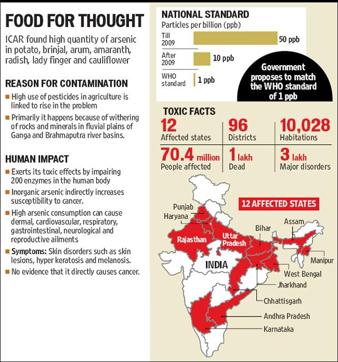
The council found high quantity of arsenic in potato, brinjal, arum, amaranth, radish, lady finger, and cauliflower, while a relatively low level of accumulation was found in beans, green chilli, tomato, bitter guard, lemon and turmeric.

Read | MP: State urged to oppose commercial cultivation of GM mustard

Major oil seeds and pulses are reported to contain high arsenic content, the report said, adding that high-yielding rice varieties have more arsenic accumulation than the local varieties.

“As people take contaminated water along with contaminated food, the chances of damage become greater. The food crops sold to inhabitants of uncontaminated regions lead to their consumption of arsenic contaminated food,” the committee said.
Article image

Arsenic groundwater contamination was first reported from West Bengal in 1983. By 2000, its spread was reported from the Ganges-Brahmaputra fluvial plains covering Jharkhand, Bihar, Uttar Pradesh, Assam, Chhattisgarh and Manipur. In the next 14 years, Haryana and Punjab were included in the list.

Now, 96 out of the 640 districts in India, including 13 in Haryana, have high concentration – more than 50 parts per billion (ppb) as against the national standard of 10 ppb – of arsenic.

The report says total number of deaths so far is one lakh people, with over three lakh suffering from arsenic-related diseases. The report, however, does not mention the time frame. Research has shown that consumption of arsenic content can indirectly cause cancer, apart from heart disorders.

The committee suggested a national action plan to address the issue. It has also recommended a national task force to overlook the arsenic contamination action plan and has sought more funds from the government.

Read | Unsafe food kills 2 million people worldwide every year, says WHO

  • Chetan Chauhan
    ABOUT THE AUTHOR
    Chetan Chauhan

    Chetan Chauhan is the National Affairs Editor looking into all aspects of news and features from across India. A Chevening scholar with over three decades of experience in reporting and news management, Chetan has extensively covered all important aspects of the social sector, political economy, environment and climate change nationally and internationally. He did a journalism course at the Reuters Institute of Journalism in Oxford and Digital Media training at Nanyang Technological University in Singapore. He started as a reporter with The Statesman in 1996 and joined the Hindustan Times in 2000 in the metro bureau covering environment, crime and Delhi politics. He covered hot local news, from the Jessica Lal murder case to the rebellion of Delhi Congress MLAs against then Chief Minister Sheila Dikshit, to the replacement of toxic vehicle fuel with cleaner compressed natural gas (CNG) in the national capital. Some of his stories on air pollution became part of the Supreme Court’s landmark MC Mehta versus Government of India case in the National Capital Region (NCR), forcing the government to take corrective measures. As part of the national political bureau since 2004, he covered important central sectors such as environment, education, social justice, labour, rural development, water resources, renewable energy, agriculture, broadcasting and the Planning Commission for more than a decade producing several exclusive and investigative breaking stories. His specialisation is the environment, having covered at least a dozen United Nations global conferences on climate change, biodiversity and wildlife including climate summits in Paris, Copenhagen and Bali. He also covered India’s two five-year plans ---11th and 12th and reported on drafting and execution of right based laws such as Right to Education, Right to Information and rural job guarantee law, MG-NREGA, now being introduced in new format as VG-RAM-G Act. He has in-depth knowledge of social sector issues. He was one of the first to report on tigers vanishing from Sariska and Panna wildlife reserves in 2004 and 2008, respectively, leading to the setting up of the National Tiger Conservation Authority (NTCA) and the introduction of stringent penal provisions for poaching. He has written extensively on the rising human-animal conflict in India and the degradation of India’s biodiversity hotspots because of mining and other activities. Since 2004, Chetan has covered Parliament comprehensively and participated in training on the nuanced coverage of Parliament proceedings. He has travelled extensively across India to cover national and provincial elections since 1998, especially in the Hindi heartland states, considered India’s road to power. He writes a regular column for Hindustan Times, Ecostani, on important national politics, economy, Himalayan ecology and environmental issues. His other responsibilities include providing inputs for edits and edit page articles for the publication, apart from managing news flow from across India.Read More