A century ago, a quiet scholarly breakthrough unfolded in then Mysore, when R Shamasastry, a pioneering epigraphist, unearthed and translated Kautilya’s Arthashastra, an ancient Indian Sanskrit treatise on statecraft, economic policy, and military strategy, with manuscripts preserved on fragile strips of dried palm-leaf. Shamasastry is the great-great-grandfather of Caltech computer scientist and professor Anima Anandkumar, who drew a link between her expertise – Artificial Intelligence – and the storied history of her family.
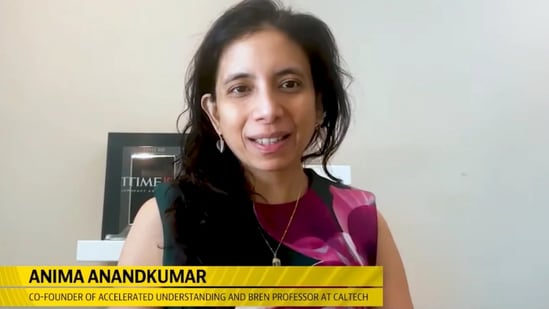
“UNESCO recognised Arthashastra, an ancient text, as one of the treasures from India. And I have a really interesting connection that my great-great-grandfather discovered Kautilya's Arthashastra more than a century ago. Using AI even to understand our rich history, our culture, and our local traditions, is important. We shouldn't just be focusing on one thing, but making investments across the board — invest in technical research, in humanities, and really grow that knowledge and make that first digitised, use AI, and then build AI,” said Anandkumar. speaking on the opening day of the 24th Hindustan Times Leadership Summit.
Anandkumar, the Bren Professor of Computing and Mathematical Sciences at the California Institute of Technology and a member of the United Nations Secretary-General’s Scientific Advisory Board, held two key pieces of advice. First, AI development, particularly when there is a sovereign angle involved for countries such as India, should be done in a holistic way. And secondly, language models are great, but they're not the only thing to invest in or focus on.
Anandkumar offered a sharp corrective to the industry’s obsession with frontier chatbots and autonomous agents. The core flaw in modern AI hype, she argued, was the assumption that language models can reason their way through the physical world simply by generating more text.
{{/usCountry}}Anandkumar offered a sharp corrective to the industry’s obsession with frontier chatbots and autonomous agents. The core flaw in modern AI hype, she argued, was the assumption that language models can reason their way through the physical world simply by generating more text.
{{/usCountry}}“So much of what those generative AI models do is try to mimic the world we see, we perceive," Anandkumar noted, adding, “On the other hand, scientific modelling is about going from microscopic to macroscopic, from atomic scales all the way to planetary scales, and maybe even cosmological scales much beyond our planet.”
Anandkumar’s mission is to build AI that can simulate and understand the physical world, and speed up discovery. She invented neural operators for learning multi-scale phenomena that frequently occur in nature, and later used those to train the first AI-based high-resolution weather model. A neural operator is a fundamentally different type of AI, which instead of needing supercomputers to break down the atmosphere into billions of tiny mesh blocks for calculations, relies on mathematical calculations to convert physical environments into frequencies. For instance, next-generation weather forecasting, which uses this technique, is projected to be a million times faster than traditional models.
“There are a lot of physical processes that are very difficult for us to grapple with. One example is the weather. Where a hurricane goes next, for example, is really hard to predict. We can't just eyeball it and say this is how it's going to move because it has a lot of really fine-scale interactions that are difficult for us humans to understand,” she said, adding that nuclear fusion was another example, where the plasma inside the reactor can behave in unexpected ways.
Her AI algorithms have enabled many other scientific advances such as modelling plasma evolution in nuclear fusion, enabling safer autonomous drone flights, and designing novel medical devices, drugs, and functional enzymes. Speed is only part of the story, Anandkumar insisted. “Speed also helps us create better risk assessment of extreme events like hurricanes, because instead of just making one prediction based on satellite data and other information, you could have hundreds or thousands of predictions based on statistical estimates of path, and other factors,” she explained.
The Fourier Neural Operator (FNO) framework that Anandkumar and her team developed forms the foundation of the Nvidia Earth-2 open source suite of AI models designed to forecast weather, climate and atmospheric physics. Anandkumar previously worked at Nvidia.
Anandkumar believed India’s engineering talent pool alongside investments in AI infrastructure and budding models gave the country a strong foundation. She warned that the country’s focus shouldn’t be limited but instead help advance the work of startups in space technology as well as batteries, for instance.
“AI can help with all those processes. But it is important to think in a broader way. Language models are great, but they’re not the only thing to invest in or focus on,” she said.
Anandkumar believed that with frontier language models, it was important to focus on the local language aspect as well for accessibility, something she said India uniquely could achieve.
Anandkumar is deeply sceptical of Silicon Valley’s latest buzzword — the autonomous AI scientist. Without rigorous grounding, she warned, such claims are little more than hallucinated "needles in a haystack" that shifts an impossible verification burden onto human researchers. In the next few years, Anandkumar expects a scientific breakthrough on the back of AI connecting multiple disciplines together, because the real world doesn’t fall into a specific physics solver or a specific knowledge. “The magic that we will see is all kinds of unexpected connections being made and which accelerate everything. Chip manufacturing, for instance, where bottlenecks are removed and it is all much cheaper to do”.