From home minister Amit Shah’s defence of the divisive Citizenship (Amendment) Bill 2019 (CAB) in both Houses of Parliament, it has become clear that the case for the proposed law is infirm, both constitutionally and morally. He struggled as he oscillated from Partition to an incomplete reading of Article 14 to justify the government’s case for a law which reduces citizenship to a religious test. Upon closer examination, four pillars emerge on which his case rests.
First, the home minister states that this bill is an antidote to the fallout of Partition seven decades ago. He draws a tenuous link between the bill and Partition, by blaming the Congress. This has absolutely nothing to do with the bill. It is nothing more than an attempt to inflame the Bharatiya Janata Party (BJP) support base. It was Shah’s ideological predecessors whom history records as having actively fomented the two-nation theory. Ram Manohar Lohia put it best: “Those who have shouted loudest about Akhand Bharat, the present Jana Sangh and its predecessors of the curiously unHindu spirit of Hinduism, have helped Britain and the Muslim League Partition the country.” The BJP’s ideological lodestar, VD Savarkar, repeatedly professed his support for the two-nation theory. It makes for perverse political sense to justify a divisive law which serves only to reopen old wounds.
Second, Amit Shah claims that Article 14 of the Constitution is not violated since a “rational distinction” of protecting minorities in these three countries has been carved out. Other eminent legal supporters of the government suggest that a bill that addresses one evil need not address all evils. Thus, individuals fleeing persecution will first be administered a religious test that dismisses the actual persecution they fled from as a secondary factor. This is exactly why such legislation is expressly barred by Article 14. Article 14 is attracted when the law is based on arbitrariness (such as when it incorrectly conflates persecution and religion), is discriminatory (penalises the adherents of one religion), or simply doesn’t satisfy its own objective (protecting Hindus and others since it leaves out the same from other bordering countries like China, Nepal, Sri Lanka and Myanmar). Such apologists should also note the Joint Parliamentary Committee report on CAB 2016, which records the warnings of unnamed “constitutional experts” that the bill directly violates the Constitution. Frankly, one does not even need to be a constitutional expert to identify the discrimination in the bill.
{{/usCountry}}Second, Amit Shah claims that Article 14 of the Constitution is not violated since a “rational distinction” of protecting minorities in these three countries has been carved out. Other eminent legal supporters of the government suggest that a bill that addresses one evil need not address all evils. Thus, individuals fleeing persecution will first be administered a religious test that dismisses the actual persecution they fled from as a secondary factor. This is exactly why such legislation is expressly barred by Article 14. Article 14 is attracted when the law is based on arbitrariness (such as when it incorrectly conflates persecution and religion), is discriminatory (penalises the adherents of one religion), or simply doesn’t satisfy its own objective (protecting Hindus and others since it leaves out the same from other bordering countries like China, Nepal, Sri Lanka and Myanmar). Such apologists should also note the Joint Parliamentary Committee report on CAB 2016, which records the warnings of unnamed “constitutional experts” that the bill directly violates the Constitution. Frankly, one does not even need to be a constitutional expert to identify the discrimination in the bill.
{{/usCountry}}Third, Shah claims no international agreements have been violated. Actually, the bill is an act of religious exclusion, masquerading as an exercise in sovereignty. It violates the principle of non-refoulement or “no-return” which states that no nation can turn away refugees fleeing persecution or threats to their lives in their home country. While India is not a signatory to the Refugee Convention, as Shah rightly pointed out, it is a signatory to the Convention Against Torture, which also contains the same principle. India would anyway be bound by that principle as it has acquired the status of a “jus cogens” ie, is a part of customary international law that all nations must abide by. The unanimous 2012 judgment of the European Court of Human Rights in Hirsi Jamaa vs Italy says: “[T]he prohibition of refoulement is a principle of customary international law, binding on all States, even those not parties to the United Nations Convention relating to the Status of Refugees or any other treaty for the protection of refugees. In addition, it is a rule of jus cogens, on account of the fact that no derogation is permitted from its peremptory nature, since no reservations to it are admitted.”
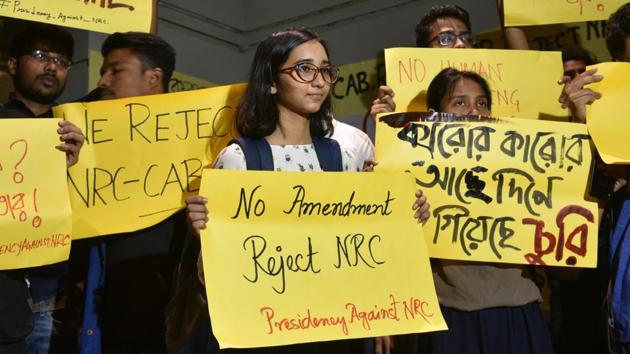
Fourth, Shah claims that this law has nothing to do with Indian Muslims or other Indian citizens. Oddly, in the same speech in the Lok Sabha, he promises a nationwide National Register of Citizens (NRC) and then attempts to defend the CAB in isolation of that announcement. This attempted dehyphenation is both audacious and dishonest. The law is a perfect example of the maxim, post hoc ergo propter hoc (after it, therefore, because of it). The CAB follows an Assam NRC which backfired and was denounced by the BJP’s own state leadership. The government is yet to publish the religion-wise breakdown of those 1.9 million excluded, but the CAB (Section 6B) seeks to abate proceedings against the Hindus in that list (singling out only Muslims as migrants). The CAB is, thus, a twisted solution to a botched NRC in Assam, and also a pre-emptive precursor to the nationwide NRC, which Shah has declared to be an inevitability. If this nationwide NRC is as badly conducted as the Assam NRC (whose first list identified over four million as immigrants), it will have an error rate of over 50%. The CAB is, therefore, a pre-emptive remedy to save all (but the Muslims) who are left out, something deliberately ignored by this government.
The government has embarked on this exercise as a distraction from its economic and social failures. The CAB is destined to be added to that list.