The thrashing of four Dalit men by alleged cow vigilantes in Gujarat has triggered a fresh round of tug-of-war between political parties to claim the lucrative vote bank ahead of crucial state polls next year.
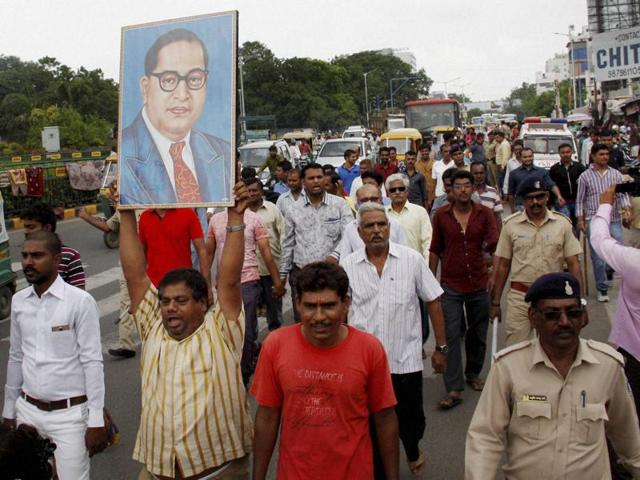
Opposition parties have jumped in to blame the Bharatiya Janata Party (BJP)-ruled governments at the Centre and state, outrage over the attacks has already forced adjournments in the Rajya Sabha and the issue is set to dominate the electoral landscape for the next few months.
But for the Dalit community, this political uproar is a bitter déjà vu. For the past two decades, India’s scheduled castes, which form a little less than a fifth of the population, have witnessed numerous massacres and atrocities.
From Khairlanji in Maharashtra in 2006 and Mirchpur in Haryana in 2010 to Laxmanpur Bathe in 1997 and Dangawas in Rajasthan last year, atrocities against Dalits have occurred under almost every single party’s rule in India.
In most cases, an inquiry committee is set up, the government makes conciliatory noises and compensation is announced. All this has already happened in Gujarat.
But as the memory of the atrocity fades from public memory, pressure to take action on the perpetrators lessens on the government.
{{/usCountry}}But as the memory of the atrocity fades from public memory, pressure to take action on the perpetrators lessens on the government.
{{/usCountry}}Such action also has fallout — the perpetrators often come from influential communities, such as the cow vigilante outfits in Gujarat who are said to have the backing of Hindu groups. It is often easier for parties to hold out sops — naming a new construction after BR Ambedkar or announce a package — than press for conviction.
In case after case of Dalit violence, the want of evidence leads to acquittals, and this phenomenon cuts across party lines.
In Congress-ruled Haryana, no one was convicted of murder after a 70-year-old Dalit man and his disabled daughter were charred to death, and 18 Dalit houses torched in 2010 in Mirchpur.
In Bihar, ruled by the Rashtriya Janata Dal and later by Janata Dal (United)-BJP, every suspect accused in the 1997 Laxmanpur Bathe massacre of 58 Dalit villagers was acquitted.
In AIADMK-ruled Tamil Nadu, no one has been convicted for setting 200 Dalit houses ablaze in Dharmapuri in 2012 after an inter-caste marriage incensed dominant castes.
The massacres are part of a broader pattern of impunity in cases of crimes against the Dalit people. Data from the National Crime Records Bureau show crimes against scheduled castes form almost a quarter of all crimes recorded in India but the acquittal rate is almost 80%.
More than 100,000 cases are still before courts with a pendency rate of 85%. No political party has come forward to change this statistic.
The mounting crimes and poor conviction rates reflect the social exclusion of the community because of how caste influences public life in India. Dalits are almost never in influential positions in the media, writing or private sector, and excuses for the rank casteism range from “lack-of-merit” to unavailability of suitable SC candidates.
Despite constitutional safeguards, the government sometimes fares equally poorly. A government survey last year found Dalits made up just 7% of all teachers in higher-education institutions in India. In Gujarat, this stood at 5%.
The only two categories where scheduled castes are represented commensurate with their population appear to be ‘safai karmacharis’ – a profession that India’s caste system has traditionally forced on Dalits — and prisoners.
India’s Dalit community carries with it a memory of trauma and oppression at the hands of the caste system that dictates who gets to go to school, get educated, escape poverty, become a leader or be remembered in death.
This continues to fester despite our claims of modernity and digital age. Massive public rallies by Dalit people never show up on national television channels, our literature is kept out of upmarket bookstores and our cultures are co-opted or erased. The only time a Dalit person makes the news is when they are thrashed or dead.
This has to change and the brave fightback from Dalit communities across Gujarat is one of many resistance movements across India.
In striking work, calling for shutdowns and leaving cow carcasses outside government offices, Dalit people are challenging caste oppressors, who force menial jobs on scheduled castes while simultaneously condemning them.
The BJP has been at the receiving end of Dalit ire in the past two years, be it the suicide of Rohith Vemula or the murder of Dalit children in Haryana. But there is little difference between them and most other political parties, which have a poor record of joining anti-caste fights. Other than the Bahujan Samaj Party, none have Dalit leaders at the helm.
If parties want the resurgent community to vote for them, mere words are not enough. Ensure timely prosecution of atrocities, crack down on caste in regions under your administration and ensure more Dalit representation in all spheres of public life. Promises and rallies will achieve little when Dalits are beginning to fight for their own right.