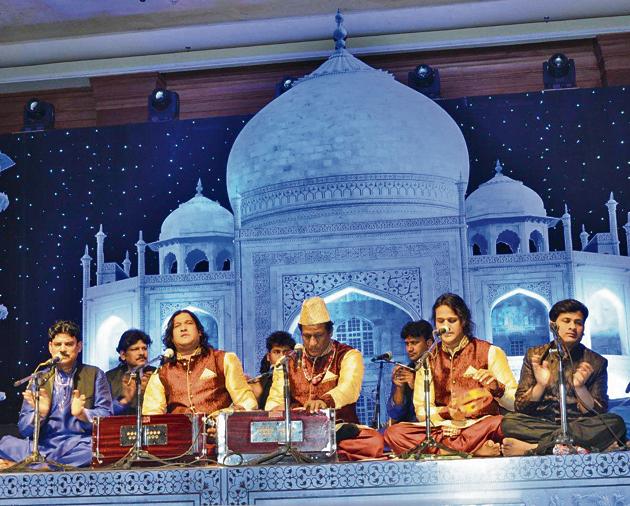
Listening to qawwalis at a dargah or khankah (place for spiritual retreat) is a divine experience. Visitors often find themselves in a trance, grooving to the tunes of the qawwal who is interacting with the maula.
The best qawwals from Delhi try to recreate the experience through a month-long Jashn-e-Qawwali festival during which one troupe performs every weekend.
Jashn-e-Qawwali is one of two elements of Rang, the annual arts festival of The Films and Theatre Society, a Delhi-based group of performing artists. “The first edition of the annual festival was in 2011. Every year, we promote different art forms. Four years ago, we included qawwali and got an overwhelming response. It has been an integral part of the festival since,” said Atul Satya Koushik, director of the festival.
Nizami Bandhu, the Qutbi Brothers and Sufi Hayat Brothers will be performing over the next three weekends.
“Not many people know that qawwali played an important role in tableegh (spreading of faith) in India during the phase when Sufism was at its peak here,” said Mohd Idris Qutbi of Qutbi Brothers, whose family has been traditionally performing devotional music at the shrine of Qutub Sahib, the popular name of Sufi saint Bakhtiyar Kaki.
They will sing ‘Dama Dam Mast Qalandar’, ‘Jugni’ and ‘Mera Piya Ghar Aaya’ at the festival.
{{/usCountry}}They will sing ‘Dama Dam Mast Qalandar’, ‘Jugni’ and ‘Mera Piya Ghar Aaya’ at the festival.
{{/usCountry}}“A lot of the compositions are in Persian. We recite those only at the dargah. For events such as Jashn-e- Qawwali, we mostly present qawwalis that most of the people in the audience can understand,” said Mohd Idris.
Although qawwali is associated with Sufism, it has gained immense popularity among people from various communities in India and neighbouring countries.
The word ‘qawwali’ comes from the Arabic word ‘qaul’ (to say). Qawwali is sung but the composition is such that the singer appears to be conversing with his peer or spiritual guide.
“The qawwal can feel the connection with Almighty. Such is the experience,” said Chand Nizami of Nizami Bandhu, who shot to fame with Kun Faya Kun from the movie Rockstar.
He performs at the shrine of Nizamuddin Auliya, along with his nephews Shadab and Sohrab.
“Our job is to serve the revered saint. We know nothing else. If this service gives us some recognition, what more can we ask for?” said Nizami.