It’s a tale that has, through the centuries, survived in its various re-tellings. The Ramayana has been retold for — and by — the rich and the poor; the privileged and the disenchanted; the artist and the peasant. If rural women in Bengal have reclaimed the story of Sita to critique patriarchy, many among the erstwhile royals have used the story to leave their indelible mark on history.
Read:How different would a feminist Ramayana be? A dance production finds out
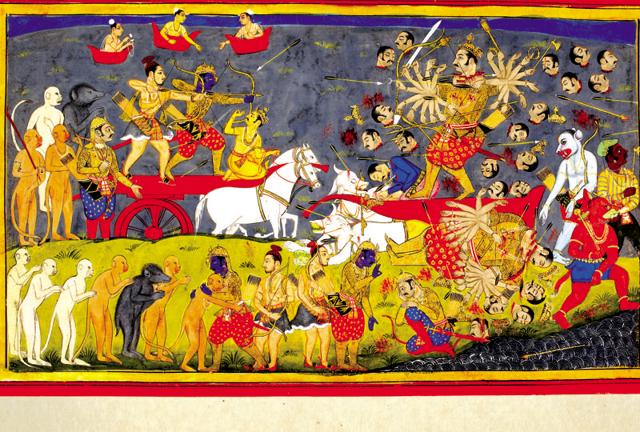
Of the latter, one was the Rajput king Rana Jagat Singh of Mewar, who saw himself as an inheritor of the mantle of Ram. In 1649, Jagat Singh commissioned the illustrated manuscript, with over 400 paintings, to a team of artists and a scribe, who would put together the mammoth project.
The work that they produced is now the “finest surviving” illustrated manuscript of the epic; about 250 paintings are now preserved at the British Library in London, and a few others are with museums in Mumbai and Jodhpur, as well as in private collections. Around sixty facsimiles of these paintings are now on display at the Bikaner House, timed with the launch of the book, ‘Illustrated Manuscripts of the Mewar Ramayana’ by Roli Books.
The paintings, spread over seven volumes, have been influenced by three different styles of contemporary Mewar paintings: that of artist Sahib Din, Manohar and a few others from the Deccan, says JP Losty, co-author of the book, and retired head of visual arts at the British Library, where he worked for over three decades. Losty, who has done much work on the subject since 1971, says that while there have been other versions of the Ramayana, the Mewar one was the most elaborate. It displayed an advanced narrative technique where episodes were broken down into several scenes in a single painting, he says.
{{/usCountry}}The paintings, spread over seven volumes, have been influenced by three different styles of contemporary Mewar paintings: that of artist Sahib Din, Manohar and a few others from the Deccan, says JP Losty, co-author of the book, and retired head of visual arts at the British Library, where he worked for over three decades. Losty, who has done much work on the subject since 1971, says that while there have been other versions of the Ramayana, the Mewar one was the most elaborate. It displayed an advanced narrative technique where episodes were broken down into several scenes in a single painting, he says.
{{/usCountry}}Read:My 30-year obsession with the Ramayana
Losty points to one of the exhibits at the Bikaner House — a scene in which Ram receives the news of the death of his father, to make his point. The entire episode has been broken down into smaller scenes — Ram’s fainting upon receiving the news, the mourning, the prayers — with great sequential clarity. In the set of paintings depicting the battle between Ram and Ravana, Losty says that the artists were extremely consistent and precise, paying attention to minute details such as the position of the battle leader and his troops in each of their works. They also took small liberties by adding a scene or two to emphasise a certain emotion, or humanise their characters.
It is the strength of these characters, says Sumedha V Ojha, co-author of the book, that has made Ramayana stand the test of time. Ojha, who has retold the tale in its abridged version for the book, insists that contrary to popular perception, the characters in Valmiki’s Ramayana, cannot be cast in “black and white”. “If one reads the original, the characters are not perfect. Ram is struggling to fulfil his duty as a ruler; the submission to people’s will and banishing Sita to the forest causes him much sorrow. Sita is also not a pushover, as many would like to believe. She questions her husband when he keeps weapons in the forest. And it is she, who chooses to accompany him to the forest, much against Ram’s and his family’s wishes,” says Ojha.
Read:Religion is not a sensitive topic: Devdutt Pattanaik
Even as Ojha concedes that certain versions of the Ramayana such as the one by Kalidas (Raghuvansham) have portrayed Sita as a much more powerful character, feminist scholars such as Nabaneeta Dev Sen have written about alternative interpretations of Sita’s character by rural women in Bengal. Sen writes about the Bengali poetess Chandrabati, in whose work, Sita is the story’s protagonist. In her story, it is Sita — not Ram — who has been born to destroy Ravana. “Ultimately it’s about people projecting their own sorrows, their dilemmas and their struggles on to the epic and its characters,” feels Ojha.
And therein, lies the charm of the timeless tale of Ramayana.