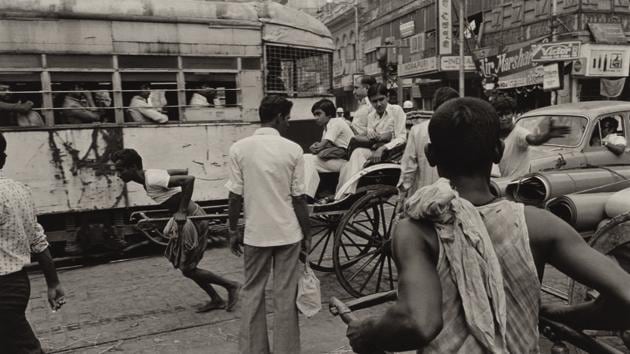
A black-and-white image depicts a chaotic street in erstwhile Calcutta with hand-pulled rickshaws and a tram passing by. In contrast, there are images of Varanasi at night, shot without flash: people sleeping on the street, a stray bullock sitting next to a temple that has a prominent sculpture of the Nandi bull.
The images have the touch of an insider, someone who lived unobtrusively, and was familiar with life on the streets of India. They celebrate the marginalised — the rickshaw puller, the street photographer, the local wrestler — and the interactions between people.
Read: A new coffee table book traces the cultural impact of the typewriter
Gallery: The best of William Gedney’s photographs of India
The man who shot them was William Gedney (1932 to 1989), a New York-based street photographer. Gedney visited India in two stints. He first spent time in Varanasi (from 1969 to 1971, on a Fulbright Fellowship), and then, a decade later in Calcutta.
Now, a selection of 48 images shot by Gedney in India will be on display at the Jehangir Nicholson gallery, Kala Ghoda. The images are sourced from the Duke University libraries (North Carolina, USA), where Gedney’s archives are preserved. The show is curated by Shanay Jhaveri, assistant curator of South Asian Art at Metropolitan Museum of Art, New York; art historian and curator Devika Singh; and writer and curator Margaret Sartor, who edited the only monograph on Gedney — What Was True (2000).
{{/usCountry}}Now, a selection of 48 images shot by Gedney in India will be on display at the Jehangir Nicholson gallery, Kala Ghoda. The images are sourced from the Duke University libraries (North Carolina, USA), where Gedney’s archives are preserved. The show is curated by Shanay Jhaveri, assistant curator of South Asian Art at Metropolitan Museum of Art, New York; art historian and curator Devika Singh; and writer and curator Margaret Sartor, who edited the only monograph on Gedney — What Was True (2000).
{{/usCountry}}“With foreign photographers, the focus was often on eye-catching subjects: poverty or stark contrasts. But Gedney wasn’t sensational. He shared the lives of ordinary people,” says Singh.
Gedney had never expected to spend 14 months in Varanasi. He was actually on a train to Calcutta, but was so enthralled by the city that he spent his entire first stay there. To fully immerse himself in the life of the city, he took a room with a middle-class Indian family. “Gedney came to India after already having done a fair amount of research and having read many books, which included those of RK Narayan, and writings on Indian miniature paintings. He had seen [some of] the films by Satyajit Ray. He also familiarised himself with the Ramayana and Mahabharata,” says Jhaveri.
Gedney was underappreciated in his lifetime, and had only one major solo show (1968, Museum of Modern Art, New York). Yet, his work now resonates with photographers across the world.
Apart from his India images, his noteworthy photographs include a series on a coal-mining town in Kentucky (USA, 1964). After receiving a Guggenheim Fellowship, Gedney took a cross-country trip to California (1966-67) where he shot the drifters (people who moved from place to place) of the Haight-Ashbury district of San Francisco.
William Gedney in India will be on display from March 9 to June 30 At Jehangir Nicholson Gallery, CSMVS, FortCall 2202 9613