Why do you curate? What do you hope to achieve through the act of curation?
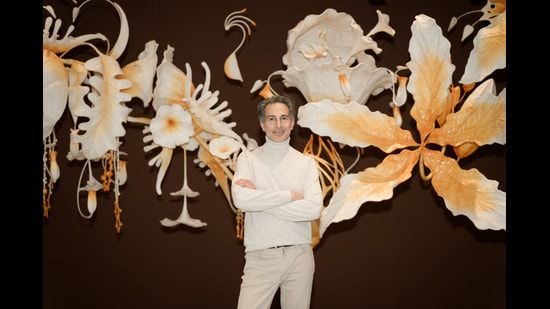
For me, curation is fundamentally about creating connections: between objects, ideas, artists, histories and, ultimately, audiences. A curator brings together objects that might not ordinarily be seen next to one another, and which, through their juxtaposition creates the possibility of a new understanding or an emotional response. I have always been interested in cultural exchange and in the way that objects can reveal histories beyond
Why do you curate? What do you hope to achieve through the act of curation?
For me, curation is fundamentally about creating connections: between objects, ideas, artists, histories and, ultimately, audiences. A curator brings together objects that might not ordinarily be seen next to one another, and which, through their juxtaposition creates the possibility of a new understanding or an emotional response. I have always been interested in cultural exchange and in the way that objects can reveal histories beyond our own expectations or understanding. For me a successful exhibition is one that encourages visitors to reconsider their received understanding of a subject.
Your curation of the India Pavilion at the current edition of the Venice Biennale focuses on the idea of home. How did you arrive at this concept? Why is home central to your thought?
Home and identity have interested me since the beginning of my academic career, undoubtedly because of my own circumstances: I am Indian, but was born in Rwanda to a family that had lived outside India for generations. The immediate catalyst for the Pavilion was Sumakshi Singh’s extraordinary reconstruction in thread of her demolished family house in Delhi, which made tangible something I had thought about for many years: whether home is fundamentally a physical place or an emotional condition sustained through memory and ritual. That question feels particularly pertinent in India today, where rapid economic and technological change is transforming the physical environments in which people live, while Indians are also increasingly mobile within the country and around the world.
You have selected artists who represent very different practices. What did that process involve?
The differences were important. A country as culturally diverse as India cannot be easily represented through a single geography, generation or artistic language, so I wanted five distinctive voices whose works could form a coherent whole. Sumakshi was the starting point, but I began to think more broadly about what constitutes home: Alwar Balasubramaniam brings the earth beneath our feet; Ranjani Shettar evokes nature and the garden; Skarma Sonam Tashi moves from the individual dwelling to questions of community and traditional architecture; and Asim Waqif’s bamboo scaffolding introduces change and the promise of what comes next. The selection therefore involved materiality, geography, visual compatibility and, above all, the ability of each artist to contribute something distinct to the same narrative.
Sumakshi Singh’s installation is made from threads, Asim Waqif uses his characteristic bamboo, Alwar Balasubramaniam uses soil – were you subconsciously thinking about Indian craft traditions and heritage too?
It was actually very conscious. In responding to In Minor Keys, I wanted to avoid materials that involved complex technological or industrial processes in favour of organic materials shaped by the human hand. Thread, terracotta, bamboo and papier-mâché have been part of Indian civilisation for centuries, embedded in domestic life, architecture, craft and ritual. What interests me is that none of these artists uses tradition nostalgically: they take materials with extraordinarily long histories and employ them to articulate entirely contemporary ideas. The materiality may be rooted in India’s past, but the artistic language belongs emphatically to the present.
How do these installations at the India Pavilion reflect contemporary India?
They reflect a country navigating tradition and rapid change simultaneously. India is deeply rooted in traditions and forms of knowledge that have endured for centuries, while its cities, technologies, economies and ways of living are being transformed at tremendous speed. Visitors experience both conditions in the Pavilion: the earth, thread, flowers and traditional dwellings evoke continuity and memory, while Asim’s scaffolding introduces construction, adaptation and the inevitability of change. I did not want to present a fixed image of India, but rather this tension between what we carry with us and what we are continually becoming.
I understand that there’s great interest in South Asian Contemporary Art in the West but are there certain expectations/biases too about the art and artists?
There are inevitably expectations when art from any particular geography is encountered internationally. But contemporary Indian art is too diverse to conform to a single visual identity, and Indian artists today are already very integrated into international institutional and artistic conversations. With the Pavilion, I was interested in resisting an illustrative idea of India. The materials have deep connections to Indian civilisation, but the artists use them with great originality to address questions of ecology, memory, urbanisation, loss and change that are both specifically Indian and completely universal.
What are your thoughts on biennales? How do we view works displayed at biennales? Do you necessarily think of them as public art?
What fascinates me about a biennale is its temporality: enormous intellectual, creative and logistical effort goes into something that exists for only a relatively short period. That intensity gives them a particular capacity to bring artists, objects and ideas together and provoke conversations that might not otherwise occur. I would not necessarily describe everything shown at a biennale as having been conceived as public art; rather, I think of a biennale as a public platform for art. In Venice, particularly, visitors move between different artists, nations and perspectives, and the experience is cumulative. The viewer becomes an active participant in making connections between them.
READ MORE: Report: Venice Biennale 2026
If I may ask, where do you feel at home?
That is perhaps the question at the heart of the Pavilion. I was born in Rwanda, I am of Gujarati origin, and I have lived in Britain and spent periods of my life in India, North America and elsewhere; so, I have never understood home as only one geographical address. I feel profoundly connected to India, but I think home for me is ultimately created through relationships, language, food, music, rituals and familiar objects – those things through which we identify ourselves. Home to me is something portable: we carry it with us, even as the places around us change. Today, I would say that I feel particularly at home in Venice, a port-city that has been a centre of cultural encounter across centuries and which remains a place for international exchange.
Kunal Ray writes about art & culture. He teaches at FLAME University, Pune.
One Subscription.
Get 360° coverage—from daily headlines
to 100 year archives.
Archives
HT App & Website