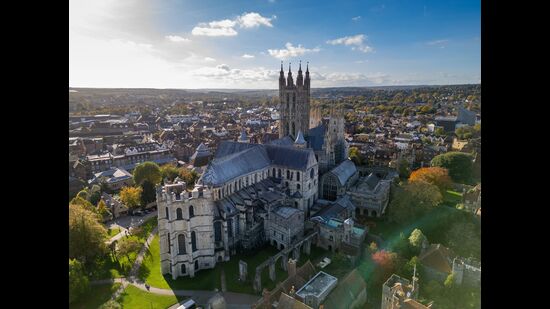
On a damp spring morning, I found myself walking through the cobbled streets of Canterbury, the ancient cathedral’s spires peeking out from behind half-timbered houses. Nestled in southeastern England, the town is best known as the setting for The Canterbury Tales, Geoffrey Chaucer’s 14th-century masterpiece, one of the most influential works in English literature. In it, a group of pilgrims travels from Southwark to Canterbury Cathedral, each telling a tale to pass the time.
I began my journey at
On a damp spring morning, I found myself walking through the cobbled streets of Canterbury, the ancient cathedral’s spires peeking out from behind half-timbered houses. Nestled in southeastern England, the town is best known as the setting for The Canterbury Tales, Geoffrey Chaucer’s 14th-century masterpiece, one of the most influential works in English literature. In it, a group of pilgrims travels from Southwark to Canterbury Cathedral, each telling a tale to pass the time.
I began my journey at the gates of the magnificent Canterbury Cathedral, a UNESCO World Heritage Site and the destination of the pilgrims in Chaucer’s book. The tomb of Saint Thomas Becket remains one of Canterbury’s greatest draws, attracting both pilgrims and literary visitors. Inside the cathedral, hushed interiors, radiant stained glass, and intricate medieval carvings still convey the same grandeur and mystery that stirred Chaucer’s imagination more than 600 years ago.
Outside the cathedral, there are many plaques and statues referencing The Canterbury Tales. The tales are also immortalised in walking tours and the spirit of the streets themselves. Geoffrey Chaucer’s bronze statue located outside the cathedral’s precincts greets visitors with the quiet authority of a man who gave the city its enduring literary fame. Erected in 2016 to mark the 400th anniversary of the publication of The Canterbury Tales in modern English, the sculpture shows the author in the act of storytelling, hand raised as if addressing his pilgrim band.
Canterbury’s literary history doesn’t end with Chaucer. It only begins there.
Canterbury was the birthplace of Christopher Marlowe, Shakespeare’s brilliant, rebellious contemporary. A poet and playwright whose works like Doctor Faustus and Tamburlaine helped shape the English Renaissance, Marlowe’s short life (he died in a mysterious stabbing at 29) reads like a spy thriller. His statue stands just outside the Marlowe Theatre, a modern venue named in his honour, where performances of classic and contemporary works keep his legacy alive.
Not far from Marlowe’s world, the 17th-century poet Richard Lovelace, known for lines like “Stone walls do not a prison make,” was born and buried in Canterbury. Written during his imprisonment for supporting the Royalists, his verses are rich with enduring themes of liberty and loyalty.
The most fascinating voice from Canterbury’s past, however, is Aphra Behn, widely regarded as the first professional woman writer in English. Born near Canterbury in the 1640s, she was a spy, playwright, poet, and novelist, and her work blazed a trail for generations of female authors.
But Behn’s name faded from public memory until recent years, when feminist scholars and artists began reclaiming her legacy. That resurgence has reached a new peak: in 2024, Canterbury unveiled a striking bronze statue of her outside the Beanie. The monument marks a long-overdue tribute to a woman who defied expectations and carved a space for female authorship in English letters.
As I look at the statue, the work of Christine Charlesworth, I recall Virginia Woolf’s lines: “All women together ought to let flowers fall upon the tomb of Aphra Behn... for it was she who earned them the right to speak their minds.”
Canterbury’s literary richness isn’t confined to the early modern period. Charles Dickens, who lived and worked nearby, set scenes from David Copperfield in the city in the county of Kent. Readers will recognise references to local landmarks like The Sun Hotel, which dates to 1480, and the King’s School, one of the oldest schools in England.
Kent’s coastline also features in Ian Fleming’s James Bond novels. Fleming had a holiday home in St Margaret’s Bay and drew on the region for inspiration that helped shape his spy novels. Local lore even credits Kent with giving him Bond’s famous code name — the number 007, said to be borrowed from the London-to-Dover coach route.
“In the early 1930s, Fleming discovered the Royal St George’s Golf Club in Sandwich. He immortalised its manicured fairways and storied history in Goldfinger,” says Jenny Miller, at Café No 35, a small independent restaurant cafe in the heart of the city.
Where the past meets the present
Modern Canterbury remains a vibrant hub for literature lovers. Independent bookshops are dotted across the city — chief among them The Chaucer Bookshop, a labyrinth of rare, second-hand, and antiquarian books. It’s the kind of place where you might lose an hour (or more) flipping through a vintage book or a signed first edition.
The Lilford Gallery Bookshop is a sleek, contemporary space with curated titles and regular exhibitions that connect visual and literary art. For those looking for a fresh poetry fix or niche publications, the Crooked House Bookshop is worth a visit.
The Canterbury Festival, held every autumn – this year’s edition was held from October 17 to November 1 – is Kent’s leading art festival and showcases literature alongside music, dance, and visual art. The city-wide celebration of creativity draws authors and readers into conversation, in the back rooms of cosy pubs or in tents pitched on university greens.
The University of Kent, on the city’s outskirts, further bolsters Canterbury’s literary life with public lectures, readings, and conferences.
A literary pilgrimage
One of the best ways to explore Canterbury’s literary soul is on foot. The Canterbury Literary Walk (either self-guided or organised via local tours) takes you past key sites: from the King’s School, where Marlowe studied, to Eastbridge Hospital, where Chaucer’s fictional pilgrims may have rested.
Don’t miss St Martin’s Church, the oldest church in continuous use in the English-speaking world, where early Christian scribes once illuminated manuscripts. Its moss-covered gravestones and ancient yew trees feel straight out of an old English novel.
And for those interested in the city’s Roman past. the Canterbury Roman Museum offers a fascinating detour into the storytelling potential of archaeology. Roman Canterbury, or Durovernum Cantiacorum, lies literally beneath your feet.
If you’re planning a bookish escape, Canterbury offers charming accommodations in converted coach houses, boutique hotels, and centuries-old inns. The House of Agnes, which found mention in David Copperfield, is now a cosy guesthouse with themed rooms and a library nook. For a stay that blends contemporary comfort with a dash of literary character, The Falstaff Hotel, just beyond the Westgate Towers, is a charming choice. Alternatively, Hampton by Hilton places you right in the heart of the action — surrounded by shops and cafés and only a five-minute stroll from the cathedral.
On my final day, I boarded a punt on the River Stour, gliding past weeping willows and beneath stone-arched bridges. Along the banks, students sketched crooked medieval façades, locals lingered in timber-framed cafés, and visitors paused to take in the city’s layered beauty.
Chaucer may have put Canterbury on the literary map, but the city’s story has never been just his. From Marlowe and Dickens to Behn and Lovelace, Canterbury remains a place where words and ideas stream as freely as the river that flows through it.
Companion reading list
The Canterbury Tales by Geoffrey Chaucer
The city’s most famous literary work. Read it in modern English (Nevill Coghill’s Penguin translation is excellent) for bawdy, brilliant tales that capture medieval life in all its complexity.
Doctor Faustus by Christopher Marlowe
The most iconic play by Canterbury’s fiery son. A chilling tale of ambition, damnation, and the search for knowledge — still electrifying centuries after it was written.
Oroonoko by Aphra Behn
Part travel narrative, part abolitionist critique, this 1688 novella by one of England’s first professional women writers is a surprising and powerful read.
The Poems of Richard Lovelace
Romantic, rebellious, and deeply lyrical. Look for the poems “To Althea, from Prison” and “To Lucasta” for a taste of Cavalier-era swagger.
David Copperfield by Charles Dickens
Canterbury plays a quiet but notable role in this classic bildungsroman. Dickens used the city’s streets, schools, and inns as backdrops for some of David’s formative moments.
Rupert Bear: The Daily Express Annuals
For a dose of gentle nostalgia, seek out collections of Rupert Bear strips created by Mary Tourtel, who was born in Canterbury. Perfect for younger readers or the young at heart.
Teja Lele is an independent editor and writes on books, travel and lifestyle.
One Subscription.
Get 360° coverage—from daily headlines
to 100 year archives.
Archives
HT App & Website