India is rich in textile and craft traditions. The sheer variety of techniques and skills is staggering. Over the years, however, with the move to mass production, much has been forgotten. But it is still possible to find samples of work in the archives of the 40-year-old Mumbai atelier, Chanakya International. Founded by Vinod Shah, for years, it has supplied embroidery and other hand embellishments to global couture houses such as Versace, Christian Dior, Prada and others.
The atelier, which
India is rich in textile and craft traditions. The sheer variety of techniques and skills is staggering. Over the years, however, with the move to mass production, much has been forgotten. But it is still possible to find samples of work in the archives of the 40-year-old Mumbai atelier, Chanakya International. Founded by Vinod Shah, for years, it has supplied embroidery and other hand embellishments to global couture houses such as Versace, Christian Dior, Prada and others.
The atelier, which celebrates its 40th anniversary this year, even has 15th generation craftsmen working for it so its archives, unsurprisingly, are a treasure trove. Its Byculla office has several rows of samples, accounting for more than a lakh swatches of different varieties: reticella is a delicate Italian lacework, which Swali reinvented with Indian stitch techniques; chand jaal is fine embroidery with real silver wire. Swali says the technique was extinct when she found a rare swatch with some Delhi rafugars. She revived it and made it contemporary. “We are no longer making it for the queens who sat in one place the whole day,” she says adding that it was lightened so it could work for occasions like the Oscars and on the red carpet.
The collection also includes clothes from real kings and queens – like the rare, 18th-Century imperial Chinese cape originally gifted to an emperor of the Ming Dynasty. Then there are 19th-century Victorian dresses and military uniforms featuring intricate metalwork and structural gold thread embroidery or zardozi. Other amazing finds include a collection of 20th-century silk Ikat robes with complex resist-dyed geometric patterns, heavily mirrored and embroidered bodices from Kutch, and a very old Phulkari from Punjab.
One section is dedicated to Chanakya’s own fabric innovations including some unassuming materials that have been converted into high fashion surfaces. For instance, pieces made from woven date palm raffia, usually used to create baskets, that were reengineered into couture textiles by Chanakya’s artisans. These made it to Christian Dior’s Spring/Summer 2023 collection. The next one is this writer’s favourite -- flattened cola cans, old radio parts, DVDs and silicone mouldings that together make up a reflective embroidered surface. Interlaced seed and glass bead panels fused with organic cotton threads made beautiful tapestries that were shown at the India Art Fair in Delhi earlier this year.
Some of these inventions, materials and artistry are also being used in the three ongoing exhibitions across Mumbai that celebrate Chanakya’s 40th anniversary and the tenth year of the Chanakya School of Craft. The school provides crafts and textile education to women from under-served communities.
The first of these, En Route (on until October 20) at Dr Bhaudaji Lad Museum, traces the forgotten journeys of six formidable solo travellers from the 1870s. The show was first presented at the Vatican Apostolic Library last year. The next exhibition, Garden of Gestures (on until September 30) at Chanakya Ateliers explores ancient Indian garden and grove traditions. And finally, Belong at Experimenter in Colaba (on until October 10) showcases the versatility of textiles, fibres and crafts technique with monumental works.
At the museum, larger-than-life fabric maps and world globes honour some early female globetrotters. Among them is American journalist Nellie Bly who travelled the world in 72 days. Elizabeth Bisland, another American journalist and author, raced Bly in 1889, traveling around the globe in the opposite direction. Annie Londonderry was the first woman to bicycle around the world (1894–1895). Challenging Victorian diktats on suitable clothing, she wore pants and proved that women have the strength and the ability to ride a cycle. English writer, political officer and archaeologist Gertrude Bell mapped the Middle East while Scottish scholar Agnes Smith Lewis travelled through Sinai and discovered some of the oldest Syriac gospel manuscripts. Her twin Margaret Dunlop Gibson also travelled with her. “This was during a time when women even leaving their homes alone was frowned upon,” says Swali. She and her team have also created a couple of site-specific installations including a monumental old map of Mumbai when it was just seven disjointed islands, and a tapestry of the Elephanta caves.
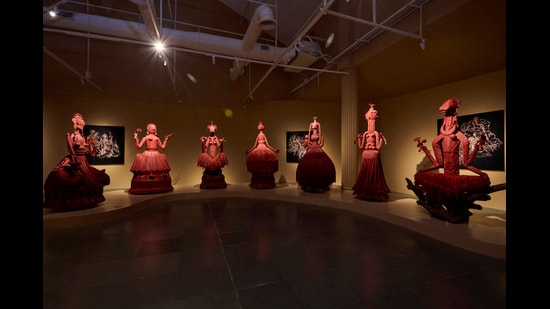
Garden of Gestures draws on ideas of Upvan, Tapovan and Kunj, ancient Indian garden and grove traditions associated with learning and contemplation. The upvan or forest brought close is a cultivated space where learning begins through observation, repetition and shared practice, Within the space marked for Tapovan stand seven large-scale fabric sculptures of the Saptamatrikas or the Seven Mothers. Crafted by the Chanakya School from bamboo, raffia and cotton, the sculptures revere feminine energy and honour women through whom knowledge is inherited, mastered and passed on. Within the Tapovan is the Kunj, the most intimate of the sacred groves, where the branches of trees bend downwards to form natural canopies through which light filters.
The exhibition at Experimenter marks four decades of an artistic practice grounded in the many possibilities of textile, says Swali. The elaborate and expansive works and monumental sculptural forms make the viewer think about belonging as an ongoing negotiation between body, ecology, memory and inherited systems of knowledge.
Together, these beautiful events highlight the dynamism of Indian textiles and techniques and show that they can definitely be elevated to the stature of fine art. “That has been my endeavour all along,” says Swali.
Riddhi Doshi is an independent journalist.
One Subscription.
Get 360° coverage—from daily headlines
to 100 year archives.
Archives
HT App & Website