“Why do I write on caste? What else can you write on? Can you write about life and ignore social realities? That will be a made-up story. That will be ridiculous,” said noted Hindi author Ajay Navaria. He and Rajathani writer Hari Ram Meena pushed the audience to think beyond token representations of the marginalised on day two of the Jaipur Literature Festival as they talked about the power of resisting oppression and the importance of imagining beauty.
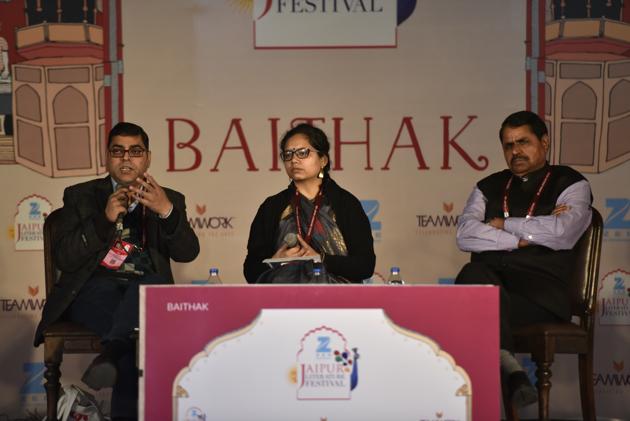
Navaria said that when he started writing two decades ago, he understood that the first time a marginalized person starts writing – whether it’s a woman, a tribal, or a Dalit – he or she expresses themselves through anger.
“But the Dalit aesthetic is not rage. And our characters aren’t unilayer victims because Dalit individuals in real life are so complex,” he said. The 44-year-old experienced tremendous success with his 2008 novel Udhar ke log. His recent collection of short stories, Unclaimed terrain, that exquisitely weaves together caste experiences in the everyday has also been well received.
But he says Dalit literature needs to move away from rage and think of solving the caste problem. “How long can we live in anger? Can’t we imagine a society where people live in love?”
Meena guffaws and disagrees, saying that when people aren’t given a space to talk about their lives, resistance is a fine tool. “My writing is often called the literature of revenge,” he said.
{{/usCountry}}Meena guffaws and disagrees, saying that when people aren’t given a space to talk about their lives, resistance is a fine tool. “My writing is often called the literature of revenge,” he said.
{{/usCountry}}Meena has written travelogues that span India’s tribal-dominated regions. “The places might be separated by distance but had a common thread in culture and mindset – living together, in harmony with the nature, without individual competiton.”
Navaria nods his head but points out that the stature of Dalits had changed in the past three decades. “When Om Prakash Valmiki started writing, the situation was different. We have to ask for representation but be compassionate,” he said.
“Babasaheb and Gandhi are complementary to each other in my mind, not as opposites.”
The moderator, Anu Singh Choudhary, asked if financial position was creating a new caste system. Navaria looked hesitant and mumbled that economic progress hadn’t negated caste or uplifted Dalits in that sense.
Meena agreed, adding that it was important to see that majoritarianism meant that India was never for everyone, especially tribals and Dalits. “I welcome anger. I want to ask whether the oppressors – the ones responsible for making us angry – have they written on their cruelty?”
Click here for our full coverage of the Jaipur Literature Festival 2017
Follow @htlifeandstyle for more