Was your novel On the Banks of Mayyazhi (translated from the original Malayalam by Gita Krishnakutty) informed by your experience as the cultural attaché at the French embassy in Delhi?
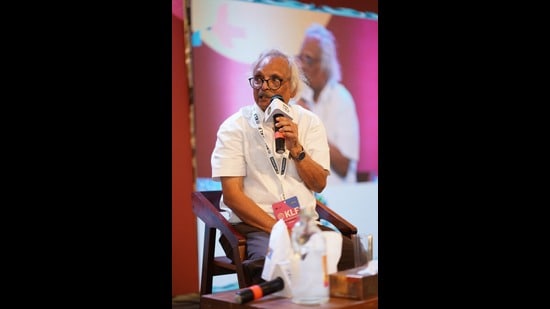
The novel is about my home town, Mahé (Mayyazhi), which used to be under French rule. Then, the nationalist wave started gaining prominence, and people in Mahé got involved in the independence struggle; it was a period of great historical turmoil. I witnessed all that, but I was inspired to
Was your novel On the Banks of Mayyazhi (translated from the original Malayalam by Gita Krishnakutty) informed by your experience as the cultural attaché at the French embassy in Delhi?
The novel is about my home town, Mahé (Mayyazhi), which used to be under French rule. Then, the nationalist wave started gaining prominence, and people in Mahé got involved in the independence struggle; it was a period of great historical turmoil. I witnessed all that, but I was inspired to write about my home town because it’s a unique place — it’s very small and covers only about 10 square kilometres. There’s a river on two sides and on one side, you have the sea. What’s interesting is that there’s a bridge over the Mayyazhi river. Half of it was in India, and the other half, [in the pre-independence era] was in France. So, every day, when I’d go to the other side, I’d say, I’m travelling to France, and on my way back, I’d come to India. Imagine that — no passport, no visa, nothing. [Laughs.] One day, I heard another story: when the ruler of Mahé, who used to live in an old bungalow, invited distinguished visitors from France, he’d stand by the French window, and say, pointing to the other side of the river, ‘Look, that’s India’. That’s writing material, isn’t it? I didn’t even have to research; everything was there, my material was handy, and all I had to do was put all this in my writing, that’s how the novel was born.
In an interview, historian Romila Thapar noted that different parts of India experienced colonialism differently. What was the case in Mahé?
When this novel was first published, it attracted criticism that it’s a “pro-colonial novel”. Although the independence struggle was gaining momentum in my home town, there was no violence before and after. Mahé is such a small place, and the French didn’t have anything against the local people; in fact, they maintained a very good relationship with them. My elder sister had a French classmate who would come to our house, and these two would talk in French. So, Mahé people were close with the French.
What happens in this novel, which invited this criticism, is that, at the time, Gandhi’s ‘Quit India’ movement had started, so people started telling the French to go away. This old lady, a grandmother, the protagonist of my novel, can’t grasp it. She gets angry, asking people, “Why are you telling them [the French] to leave?” Because I wrote from her point of view, people said you’re justifying colonialism. Of course, I’m not. There can be several perspectives on colonialism, and it’s her perspective. I feel fiction tells you the entire story, so in telling it, I used both myth and history and local stories.
The myth aspect related to my home town is Velliyamkallu. Velli means silver. And the word actually means the silver rock of Mayyazhi. The story goes that this cluster of rocks is where your soul goes when you die, and when you’re reborn, you come back to Mayyazhi. I used this cyclicity in my novel, and of course, there’s a history to my home town, too, so I combined them both.
When I was 21, I left for Delhi, and I worked at the French embassy. They are nice people, the French. And, of course, they didn’t do any harm to us, the people in Mayyazhi, but by that I didn’t mean to say they didn’t do anything to Algeria. They tortured Algerians, so their colonial legacy wasn’t as smooth as it was in Mahé, and there are several novels on French imperialism.
I recall Claire Messud’s latest, This Strange Eventful History.
Yes, yes. There are lots. Even in French, there’s this famous novel Voyage au Bout de la Nuit (Journey to the End of the Night, 1932) by Louis-Ferdinand Céline. It’s very popular novel in which Céline talks about French cruelties, so I didn’t mean to say [with On the Banks…] that the French were very nice people, but that in this small place that they had occupied – they didn’t disturb it because they were always at war with the English, and, as a result, they needed a foothold, which is why they came to this beautiful place called Mahé – unlike the British who plundered everything, they didn’t exploit its people.
Like in several Malayalam novels, migration features frequently in your novels, too. This is true also of the JCB Prize-winning Delhi: A Soliloquy.
I’ll tell you something, during the French rule, there were so many people who migrated abroad. There weren’t aeroplanes back then, so these people left probably by ship. Many of them were recruited in the French army. Several of them fought for the French. Migrants from Mahé and Pondicherry were sent to the most difficult places in Africa, most of which were under French rule. I don’t know what happened to these migrants who, on the French command, had to suppress the poor people in Africa.
I’m planning to write something on all those migrants from Mahé and Pondicherry; over a hundred years ago, what happened, how did they leave, where did they go, and what did they do? So, yes, migration interests me. Even today, politically, it’s a very relevant theme. Look at what’s happening in America.
But there isn’t enough material on the migrations I’m interested in. People say that you can search anything on AI, but I rely on fiction rather than on history or AI. If you want to know about French imperialism, you won’t find it in history books. As a writer, I feel I find the truth in fiction or from people themselves.
For example, there was this migrant soldier from Mahé, in Africa, who told me a story that they were sent to such an unimaginably hot place that if you’d drink a bottle of beer and throw it somewhere, in half an hour, you’ll find the bottle completely bent. Yes, bent! That’s because of the heat; the glass would fold. Can you get this information from any of the history books?
You’re one of the few authors who has worked with a variety of translators -- Nandakumar K and Fathima EV for Delhi, Gita Krishnankutty for On the Banks…, Prema Jayakumar for God’s Mischief, and AJ Thomas for Kesavan’s Lamentations. Please talk about your relationship with your translators.
I’ve worked with many, yes, but I didn’t choose any. For Mayyazhi, there was a publisher in Chennai, at the time, who contacted Gita, and I said, “Okay, let’s do it.”
Initially, when you’re new to things, people coming to you is a risky thing because you don’t know them, but as you get familiar with everything, you tend to know them. Now, I know that I work with the best translators, who can render Malayalam into English.
There were so many good novels being published in Malayalam. We have intense writing in Malayalam, but we had a lot of difficulty in getting published, because we’re marginalised with this ‘regional language’ and ‘regional writer’ tags.
When I received a Crossword Award, a newspaper wrote, “M Mukundan, Indian writer” (laughs). For the first time, somebody had called me an Indian writer! It surprises me -- if you don’t write in English then you’re regional, not Indian. As soon as my work was available in English translation, I seemed to have transcended the barriers of language and become an ‘Indian writer’. That’s a colonial legacy; this hangover of the English language has to change.
Please talk about your conversations with translators.
Whenever I receive the first draft, I go through it, and very often, naturally, we have to quarrel because translating fiction is markedly different from translating history or essays. Fiction translation is a specialisation.
For example, in Malayalam, I’d written something about a man who boarded a train and travelled without a ticket. One translator put that down as “He boarded a train of thieves” (because of a misunderstanding about a specific Malayalam word)! These subtleties have to be taken care of when you translate. I’ve been very lucky because I’ve worked with very good editors and publishers, who’ve been so wonderful throughout. They go through the text, then they consult me, make suggestions, even for a change in a comma, and send the material with changes marked. It’s a good practice.
I had once written that my protagonist takes the bus number 520 from the INA market in Delhi to go to Delhi University. The guy who translated it informed me that it’s wrong because number 520 doesn’t go to the university; it goes somewhere else. I wrote this so many years ago, so I told him, “You say he boarded the bus from the INA market, got off somewhere where it terminated, and went to the university,” problem solved. Then he said, but that’s not what you had written. To convince him, I had to say, “You don’t go looking for such details.” Of course, we quarrelled (laughs). These sorts of things come up when you work with good translators and editors. I learn a lot from them.
You’re considered a torchbearer of modern Malayalam writing. How does your work interact with contemporary readers? Which authors have informed your writerly life?
I don’t know about that, but I must tell you when I went to Delhi, it was a different place, a different India. Nehru was alive then, and he would go in his ambassador car, without any escort, to the house of this famous cartoonist, K Shankar Pillai, who had started Shankar’s Weekly. They were friends, but Nehru was the PM. Imagine how safe Delhi was.
We’d sleep outside in peak summer, without locking our doors. There was this communal harmony, everybody, from the Sikhs to the Muslims to the Christians, all of us lived in peace. It’s horrible what Delhi has become. I didn’t want to leave Delhi, but you know, I was there, I had witnessed what happened in the Jama Masjid area when Sanjay Gandhi started this sterilisation campaign, which was followed by the demolition with a bulldozer. I witnessed all of that. People, young and old, and children were run over. Then, of course, 1984!
I was born in Mahé, but I’m a product of Delhi, so I left Delhi with intense pain. I had written all my major works sitting in Delhi. But there was no other way; I couldn’t live there anymore.
When I came back to Kerala, I realised that the whole of India is now like Delhi. Now, should I run away from here, too? Where will I go? Where will all of us go? It’s a tragedy. India is such a beautiful country, but you feel like there’s no place where you can live. Earlier, you could say you want to go outside India, but can one go to the USA, or Russia, or elsewhere? It’s bad even there. At the Kerala Literature Festival, Sunita Williams put it beautifully when she said, when you go up in space, you look at the world, at this beautiful world, the blue planet, with all its seas, and snows, and greenery, and you wonder why we are fighting and what we are fighting for. Anyone who instigates violence must be sent into space, and they must look down from above. Perhaps then they’ll realise what a waste of time it is to fight.
Saurabh Sharma (they) is a nonbinary, queer writer, essayist, and culture critic. On X: @writerly_life; Instagram: @writerlylife.
One Subscription.
Get 360° coverage—from daily headlines
to 100 year archives.
Archives
HT App & Website