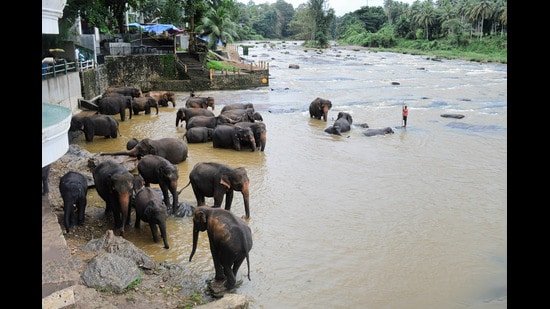
In July, while visiting Pinnawala Elephant Orphanage in Rambukkana in Sri Lanka, I was invited to the picturesque Pinnawala Elephant Dung Paper Products workshop nearby. There, on the concrete floor were piles of paper, glass-fronted cabinets of notebooks, some machinery, and people busily working at tables. It was an unexpected place to find oneself after a visit to an elephant orphanage — and an even more unexpected way to begin looking at what happens to the enormous amounts of dung produced there.
“First, I will show you the elephant poo,” said owner of the enterprise, Nimal Pilalcarathna, who explains that the dung is first dried in the sun for two or three days to get rid of the smell. What’s left behind contains “over 90 % fibre”.
This is because Asian elephants eat jackfruit, sugarcane, coconut, banana, and fishtail palm, all of which is inefficiently digested. Only about 40% of the nutrients in the feed is absorbed, leaving substantial plant material in the dung.
Next, the dried dung is put into tanks, covered with water, and boiled for a day to kill bacteria and fungi. Afterwards, it is washed, allowing the fibres to separate. At the workshop, these are either left natural or coloured using organic extracts made from barks, leaves, roots, flowers, clay, and yam. No chemicals are added.
{{/usCountry}}Next, the dried dung is put into tanks, covered with water, and boiled for a day to kill bacteria and fungi. Afterwards, it is washed, allowing the fibres to separate. At the workshop, these are either left natural or coloured using organic extracts made from barks, leaves, roots, flowers, clay, and yam. No chemicals are added.
{{/usCountry}}The fibres are then blended with water for about three hours allowing the rough material to develop into pulp, which is then poured into a framed screen. To demonstrate how it works, Nimal lifts the frame, allowing the water to drain while the fibres settled across the surface. The wet sheet is then taken out and dried in the sun. It is thick and rough. “We can’t use this paper for anything just yet,” says Nimal. It is then placed in a rolling machine that smoothens the sheet into something that’s more recognisable as paper. “We can now use this for writing, drawing and printing,” says Nirmal.
The finished material is turned into calendars, greeting cards, photo albums, frames, notebooks, and even jewellery boxes. All of this may sound unusual but it is not new. Thusitha Ranasinghe, founder of Eco Maximus, a nearly three-decade old paper-manufacturing and recycling company in Colombo, began experimenting with the material after hearing about its use in Kenya.
In the first decade of the new millennium, the company was producing around 50 boards, equivalent to 660 A4 sheets, from 10kg of elephant dung. For products intended for writing or drawing, the pulp was mixed with recycled paper offcuts in a ratio of one-third dung to two-thirds paper, as the dung fibre on its own was too coarse. That detail changes the story. Elephant dung is not a miraculous replacement for wood pulp. It is one fibre among many. In 2014, researchers Farah Nadeem, Amna Moazzam, Naila Yaqoob and Ishtiaq Rehman who, for years, have been examining non-wood fibres from rice straw, bagasse, bamboo and jute, tested elephant dung as a non-conventional raw material for paper-making. There is much potential for such products to generate revenue though, in this case, the laboratory process uses chemical pulping to obtain the best paper properties.
Nimal’s workshop treads a different path with its small-scale process based on boiling, washing, blending and drying without chemical additives.
“There’s a huge demand for elephant dung paper products in the market,” said Shirani Fairbanks, founder of Trickledown, a Sri Lankan company that works with waste fibres. “They have a unique aesthetic appeal, which many young people love.” That market gives an otherwise discarded material a price. “The interesting part is that elephant dung is not really waste in this landscape. It becomes paper, compost, a livelihood,” says Hashan Cooray, development director at Jetwing Hotels, which has pursued sustainable tourism in Sri Lanka for more than five decades.
We rarely think about what goes into a paper page. A book arrives in our hands as a finished product. We read the words without considering the surface on which they are printed. We don’t question how it was processed, how much water and energy were used to make it, and what happened to the landscape that supplied it. For Nimal, that transformation is not simply about making paper without cutting trees. “We can save trees and protect the environment,” he says, connecting the small act of making a sheet to protecting biodiversity, preserving oxygen, and allowing other forms of life to continue.
Sri Lanka’s latest nationwide elephant survey estimates that the country has 7,451 wild elephants. Research puts daily dung production at roughly 80–100 kilograms per animal. Taken together, those figures suggest that the country’s pachyderms produce about 272,000 tonnes of dung a year. Only a tiny fraction of that can realistically be collected for paper making, but the calculation illustrates the scale of the material that these giant animals return to the landscape.
Still, the future of paper is unlikely to be made entirely from elephant dung. Perhaps, what we need is not one replacement for wood but a broader understanding of the available options when it comes to raw material. At Pinnawala, the surprise element is not that elephant poop can become paper but that something that everyone imagined was waste and at the end of its useful life can actually be the start of a fresh new page.
Veidehi Gite is an independent journalist.