What makes a memoir special? The author’s personal experiences — the people they meet, the positions they hold — that allow readers a rare snapshot of a life and its times. Occasionally, an individual’s life unfolds alongside a nation’s defining moments, and their memoir transcends the personal to become a witness to history. Urdu poet, wrestler and bureaucrat Kanwar Mohinder Singh Bedi ‘Sahar’s Yaadon Ka Jashn (1983), ably translated by Kamna Prasad as A Celebration of Memories, falls squarely in this category.
A staunch supporter of the ideals enshrined in the Indian Constitution, Bedi was a secularist who penned evocative na’ats — poems in praise of Prophet Mohammad, ensured that Ramleela was held in Delhi on the very first Diwali after independence, and also ensured that the procession commemorating Guru Tegh Bahadur’s martyrdom passed through Old Delhi during namaz timings without sparking communal unrest in those fraught times. A professional administrator, he navigated the worlds of district magistrates and viceroys with fragile egos even as he rubbed shoulders with figures like Mahatma Gandhi and Jawaharlal Nehru.
For a while, it might seem like Bedi is guilty of self-aggrandizement, that his portrayal of himself is almost too good to be true: a bureaucrat who takes no bribes; a man who angers his superiors for being too fair in his dealings; a sarkaari babu who doesn’t bow down to pressure! By today’s standards, he was an absolute unicorn. Still, he chose honesty in a system that often rewards deceit and, as this memoir shows, paid dearly for it.
{{/usCountry}}For a while, it might seem like Bedi is guilty of self-aggrandizement, that his portrayal of himself is almost too good to be true: a bureaucrat who takes no bribes; a man who angers his superiors for being too fair in his dealings; a sarkaari babu who doesn’t bow down to pressure! By today’s standards, he was an absolute unicorn. Still, he chose honesty in a system that often rewards deceit and, as this memoir shows, paid dearly for it.
{{/usCountry}}Bedi often made his peers deeply uncomfortable resulting in transfers, false allegations, and attempts at character assassinations. His accounts paint him as a messiah of secularism and, at first, the contemporary reader is unsure of his claims. Who has this divine level of perfection? However, Bedi’s recounting of numerous events dispel misgivings. Eventually, one comes to the conclusion that he must have been doing something right for so many dishonest men to feel threatened by his integrity.
The contemporary reader unaware of the radically different world of pre-Independence India could possibly be taken aback that the memoirist was once in charge of a government department titled National War Front, meant to garner the support of Indians for the British during World War II. How did a pro-peace and anti-war crusader occupy such a position even if he did use most of his resources to promote Hindu-Muslim unity? Perhaps memoirs, especially those set in the not-so-distant historical past, are interesting precisely because they challenge our presentism and ideas of chronological snobbery.
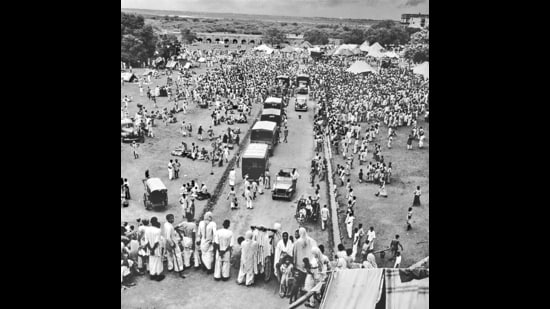
Bedi kept his passion for Urdu poetry alive even as he navigated the labyrinthine corridors of Indian bureaucracy. At mushairas, he disseminated his pro-peace, anti-war and anti-communal ideals, often soothing those looking for an escape from reality in the wake of Partition. He also writes about other prominent personalities who were part of the subcontinent’s Urdu poetry circles of the period. Faiz Ahmed ‘Faiz’ once wrote a qasida (ode) addressed to Bedi, which the latter calls a “masterpiece”. Josh Malihabadi and Sahir Hoshiarpuri are two others who are remembered fondly. A few others are not. The poet Naqshab never returned money borrowed at Bedi’s behest and how the latter chose to deal with it makes for an interesting anecdote. He reminisces too about punching a bus driver who refused to transport refugees during the Partition riots. Then, there’s the interesting chapter titled Eminent Personalities that focuses on his interactions with mid-20th century celebrities like Dilip Kumar, Sunil Dutt, Nargis, Meena Kumari, Muhammad Ali and Mohammad Rafi, to name a few.
The original book, which was published a year before the assassination of Indira Gandhi, made no mention of the 1984 anti-Sikh riots. However, in his introduction to this English translation, Bedi’s grandson Ashwajit Singh writes: “The man who had spent his entire life preaching secularism had to be ridden in the back seat of a car and smuggled out of his Greater Kailash home to safety…” He adds ironically, “Even champions of insaaniyat are not immune to humanity’s failures.” The memoir also does not mention Bedi’s wife Sohinder Kaur to whom Singh dedicates a section in the introduction, in an attempt to correct the omission. If Bedi was dreamy, transcendental in his ideas and lived in an alternate world writing shayaris and nazms, Kaur was the practical force in the marriage, taking on all its ordinary demands and responsibilities. This must have been trying at times especially as Bedi, never jealous of emerging talent and ever generous, often allowed young, aspiring poets to live in the annexe of his house. Singh describes it as ‘apprenticeship by proximity’. “That’s why I am here,” Bedi would say, “to be surpassed.”
Kamna Prasad’s translation flows with remarkable ease, preserving the lyricism, emotional sincerity, and cultural texture of the author’s voice and keeping it accessible for a contemporary readership.
This is a remarkable book not only for the insights it gives into the life of an important Urdu poet but also for the picture it provides of a young India. In the end, the reader is also left wondering how much worse the horrors of Partition might have been without individuals like Bedi who made such active efforts to foster communal harmony. If his is not a life worthy of a jashn — or perhaps several jashns — what is?
Deepansh Duggal writes on art and culture. Twitter: @Deepansh75.