
In many ways, Sonia Gandhi’s memoir, Belonging: A Journey of Love, is the story of every traditional Indian woman of a certain generation – brought up to bolster the larger patriarchy by merging faultlessly into her marital family and carrying it forward into the future. In other ways, though, the story of the Italy-born former president of the Indian National Congress, the granddaughter-in-law of independent India’s first prime minister, the daughter-in-law of another prime minister, and the wife of yet another former prime minister – the lives of the last two ended in sudden and gory death – is unique.
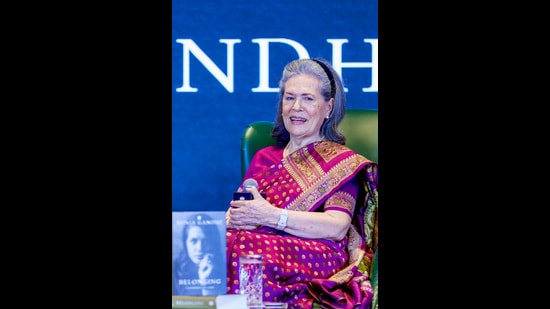
While reactions to the 525-page book, which publisher Harper Collins says sold more than 200,000 copies in the first week, have focused on the clearly political aspects of it – the position it takes against the RSS and the BJP, its excoriation of Hindutva ideologue Savarkar, and those things it doesn’t mention such as Pokhran and the Indo-US Civilian Nuclear Deal – the most interesting aspect of the volume is its presentation of the domestic sphere of India’s most prominent political family. The satisfactions, squabbles, and the compulsions of its often-recalcitrant members whose actions had a huge impact on the emerging nation. Along the way, there are some laugh-out-loud bits – Indira Gandhi saying the infant Rahul with his double chin looked like former UP chief minister Kamalapathi Tripathi, and Dhirendra Brahmachari playing “Narad Muni” between Sonia and her, to use the apt Indianism, “co-sister” Maneka.
The memoir’s form is inherently subjective and expecting the author to be impartial in her recounting of the motivations of those she held in high regard, specifically her mother-in-law, is too much to ask for. “When away from her advisers, Mrs Gandhi questioned herself about what the right course of action ought to be. A conflict was raging in her: to step down or to take the drastic action that was being advocated by many of her advisors…” Citing internal disturbances, Indira Gandhi declared Emergency on 25 June, 1975. Lasting till 21 March 1977, the period was known for several excesses, including forced sterilisation. Sonia Gandhi suggests that her brother-in-law was largely to blame: “Whatever his faults may have been, Sanjay was no coward. He was in fact without fear to the point of being reckless, and – as subsequent events showed – he had enough courage in him to face any situation and to fight his way back to political leadership. What is undeniable, however is that he had a significant role in decision-making during the Emergency period, despite lacking a constitutional locus standi for some of his political interventions.”
{{/usCountry}}The memoir’s form is inherently subjective and expecting the author to be impartial in her recounting of the motivations of those she held in high regard, specifically her mother-in-law, is too much to ask for. “When away from her advisers, Mrs Gandhi questioned herself about what the right course of action ought to be. A conflict was raging in her: to step down or to take the drastic action that was being advocated by many of her advisors…” Citing internal disturbances, Indira Gandhi declared Emergency on 25 June, 1975. Lasting till 21 March 1977, the period was known for several excesses, including forced sterilisation. Sonia Gandhi suggests that her brother-in-law was largely to blame: “Whatever his faults may have been, Sanjay was no coward. He was in fact without fear to the point of being reckless, and – as subsequent events showed – he had enough courage in him to face any situation and to fight his way back to political leadership. What is undeniable, however is that he had a significant role in decision-making during the Emergency period, despite lacking a constitutional locus standi for some of his political interventions.”
{{/usCountry}}The contemporary reader looking back at events of half-a-century ago may find it difficult to accept that the Iron Lady of India, who stood up to Nixon and Kissinger and sent troops into East Pakistan to help birth Bangladesh in 1971, was misled by her younger son, who was himself encouraged by his young wife. “The role of Maneka, too, was worrying my mother-in-law, who felt that, rather than being a sobering influence on Sanjay, she was egging him on in his activities, even interfering in them. She had said to Cabinet Secretary PN Dhar about her young daughter-in-law: Uske abhi se par nikalne lage hain” (“She has started growing wings already.”)
Rich in older historical gossip, too, the book’s accounts of unkindness towards Kamala Nehru and the simultaneous pettiness and heroism of the members of the old joint Nehru family in Allahabad’s Anand Bhavan – a hive of anticolonial activity during the Freedom Struggle – remind readers that oppressions and exclusions were invariably a part of the old undivided Hindu family.
The sections on the strains on the Feroze-Indira marriage (“He became known as a charming bon vivant who enjoyed the company of friends and women”), the dynamics of the Sanjay Gandhi-Maneka one, and Sonia’s own fairytale romance with Rajiv are absorbing in the way all Indian family dramas from The Ramayana and The Mahabharata to Kyunki Saas Bhi Kabhi Bahu Thi are.
One of the most affecting sections has to do with Rajiv Gandhi taking over the leadership mantle after his mother’s assassination:
“I felt as if a knife had been plunged right into my heart… I burst out crying, pleading, begging him with folded hands, ‘No, no, you can’t think of it. You have to stop them, you must refuse, you must say no. They will kill you… too!’ I cried out. He replied, ‘They will kill me anyway.’”
Chapter 17 on the carnage that followed the assassination – the paroxysm of violence against the Sikh community – is similarly moving though it makes no reference to Rajiv Gandhi’s widely reported early remark about the violence: “When a big tree falls, the earth shakes.”
“One thing I am certain of: Rajiv himself just and compassionate to his core, could not in any way have authorised those heinous acts on innocent men, women and children,” she writes, adding later that “Justice has been hard to come by for the victims.”
The combination of power, charisma and great tragedy embodied by the Nehru-Gandhis continues to fascinate the nation. Perhaps it was something similar that enveloped the Mughals even while the Marathas gained control of northern India. Belonging reads superbly particularly when it deals with deeply felt experiences like Rajiv Gandhi’s funeral: “Political leaders line up to be photographed by the catafalque. Priyanka glares at some of her father’s former colleagues, as if to chastise those she knew had betrayed him. What hypocrisy they display, who now sing praises of the martyr. She picks up and flings aside the wreath laid by the one who at all his election rallies had read out a number declaring that it was her father’s illegal Swiss bank account.”
And here is the author finding Rajiv’s travel bag after his ashes had been dispersed at Sangam: “I bend over it, seeking to inhale the elusive scent of my beloved, gone forever.”
Whatever one’s political sympathies it is difficult to remain unmoved by that single line soaked in sorrow. Or when Gandhi writes of turning to the Bhagavad Gita while she contemplated joining politics: “I was on my own now with my churning thoughts… Krishna has expounded the message of the Gita: Perform your dharma without regard for the fruit of your action… Something awoke in Me: I was sure. I had the answer to my own doubts and questions I had to step out and go where my duty called. And I did.”
This is powerful stuff that lingers even amid the almost humdrum tone of the later chapters – enlivened mainly by the author’s descriptions of grappling with public speaking, and her struggles with cancer. These deal with her time as leader of the opposition and the UPA years. There are anecdotes about the exuberance of Nelson Mandela, Hillary Clinton’s reaction on learning that India had many women in high office, and the royal gaucheness of Prince Edward of Britain. The vice patron of the Commonwealth Games turned to the line-up of Indian dignitaries next to Gandhi and stated, “And you lot, who are you?” A stunned silence followed, she writes. “Pranab-ji, drawing himself up to his full height of five foot three inches, said stiffly, ‘I am Pranab Mukherjee, the finance minister of India, and these are my cabinet colleagues.’ ‘Ah yes, of course,’ said Prince Edward and, not in the least embarrassed by his faux pas, turned immediately to the prime minister.” It’s evident that Sonia Gandhi has a sharp sense of humour and a capacity to pierce through appearances to arrive at reality, a quality that’s probably necessary to survive as a politician.
Early on, the poet Harivanshrai Bachchan had told her: “You must know, Sonia beti, child, that in this country it is not what you are that counts, it is what people think you to be”. To which she had wondered “Does he mean that I can never be myself? I was I, and that’s the way I was…”
In the end, as Belonging shows, the sheltered Italian girl who set out after her Indian lover has had an extraordinary life, one where the personal has been the political in ways that few would wish for themselves.
ABOUT THE AUTHOR
Manula Narayan is National Books Editor at Hindustan Times. She writes on literature and popular culture.