While reading Sudhanva Deshpande’s immersive book on his comrade and iconic street theatre artist and activist, Safdar Hashmi, I couldn’t help asking – why did we have to wait so long for a book on the deceased artist? It is public knowledge that Safdar Hashmi was brutally murdered in broad daylight by political goons who obstructed a performance of Halla Bol and attacked him with iron rods. Safdar did not survive to tell his story but Sudhanva Deshpande was present on that fateful day along with other comrades from Jana Natya Manch or Janam as it is popularly called and his book begins with a chilling recall of the events that transpired on Jan 1, 1989 which left Safdar to succumb to his injuries the following day in Delhi. Deshpande’s account begins by positing fundamental questions – why should an artist have to die for performing his art? Are artists the most vulnerable, unprotected lot? Is it a crime to be a political artist in India?
Street theatre is political. It began as a workers’ movement against capitalism. As a medium of performance, it facilitates direct conversation or confrontation with the audience or onlookers defying the restrictions and gentility of a proscenium space. It also undermines the hierarchy of the performer and the audience. Street theatre is democratic and Safdar Hashmi believed in a vision of the arts that is secular and people-oriented. He also believed in an art advocating social justice. It is therefore impossible or perhaps unpardonable to think of Safdar without his politics. His commitment to Left politics and particularly his affiliation with the CPI(M) features prominently in the book as it helps to understand his belief systems which governed the nature of his work. For readers like me, it is an advantage that Halla Bol – The Death and Life of Safdar Hashmi is written by Sudhanva Deshpande, Safdar’s long time accomplice and friend. There are insights in the book that only a friend and collaborator would have known. Biographies can be written in archives and libraries but street theatre is enlivened on the road and who better than a fellow traveller to chronicle that story? Deshpande does it with nuance, compassion, earnestness thereby privileging stories about the artist which history books might perhaps miss.
Halla Bol is not a traditional biography. It relies on personal and collective memory, interviews, Safdar’s diaries, Janam archives and other sources to construct a portrait of the artist. And that I think is a remarkable achievement. Safdar would have liked it too. The artist is thus memorialized through a source he found most nourishing – his lifelong interest in people which also defines his artistic credo. Deshpande’s memories of his friend and mentor are further supplemented with accounts of many Janam actors and associates, political activists, trade unionists, academics and several others who knew Safdar. Personal life details of the artist are minimal. There’s a brief mention about childhood, higher education and meeting with Moloyashree Roy or Mala who later became his wife and collaborator. The book locates the artist amidst his work which is used to understand his practice and the life he led. Safdar always shied away from personal fame and recognition and put forward the idea of a collective. Deshpande keeps that spirit alive in his narration. He also writes extensively about the plays that Safdar made, rehearsals, training actors, challenges faced in the process, formation of Sahmat, organizing performances, drawing youth to the movement, Safdar’s writings for children amongst other events. There is an entire section about Safdar’s collaboration with another theatre great, Habib Tanveer and the play they were making based on Premchand’s stories. The book is also a socio-historical document of the national capital in 1970s and 1980s and the movements led by Left Parties on its streets including the seven day workers’ strike in 1988 during which Jana Natya Manch performed Halla Bol.
{{/usCountry}}Halla Bol is not a traditional biography. It relies on personal and collective memory, interviews, Safdar’s diaries, Janam archives and other sources to construct a portrait of the artist. And that I think is a remarkable achievement. Safdar would have liked it too. The artist is thus memorialized through a source he found most nourishing – his lifelong interest in people which also defines his artistic credo. Deshpande’s memories of his friend and mentor are further supplemented with accounts of many Janam actors and associates, political activists, trade unionists, academics and several others who knew Safdar. Personal life details of the artist are minimal. There’s a brief mention about childhood, higher education and meeting with Moloyashree Roy or Mala who later became his wife and collaborator. The book locates the artist amidst his work which is used to understand his practice and the life he led. Safdar always shied away from personal fame and recognition and put forward the idea of a collective. Deshpande keeps that spirit alive in his narration. He also writes extensively about the plays that Safdar made, rehearsals, training actors, challenges faced in the process, formation of Sahmat, organizing performances, drawing youth to the movement, Safdar’s writings for children amongst other events. There is an entire section about Safdar’s collaboration with another theatre great, Habib Tanveer and the play they were making based on Premchand’s stories. The book is also a socio-historical document of the national capital in 1970s and 1980s and the movements led by Left Parties on its streets including the seven day workers’ strike in 1988 during which Jana Natya Manch performed Halla Bol.
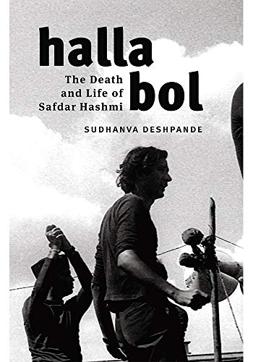
{{/usCountry}}In consonance with the overall narrative flavour, the book has the most evocative cover that I have seen in a long time. It features a black and white photograph of Safdar at a performance. His face is not visibly clear but you know that must be the man. Perhaps that’s how Safdar wanted to be remembered – through his work and action.
Kunal Ray teaches literary & cultural studies at FLAME University, Pune.