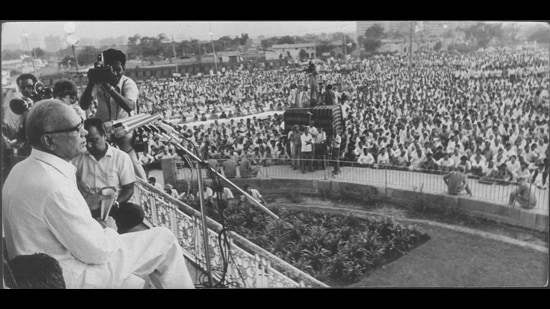
In recent times, the phrase “undeclared emergency” has been frequently invoked to explain various measures by India’s incumbent regime. It mainly alludes to the country’s political experience under Indira Gandhi’s rule between 26 June 1975 and 21 March 1977. During this period, 11 million people were sterilized, and 110,000 were locked up. In New Delhi,700,000 were displaced by the gentrification drive and 161,000 sterilized - the city had a population of roughly five million at the time. The stories of fighting back the Emergency and its excesses have been captured in numerous personal memoirs and journalistic accounts since the late 1970s. The volume under review, however, is by far the most comprehensive analysis of what led to India’s Emergency, what happened during this dark period, and also how it looks compared to the period leading to the present. In my view, this is the first major academic work that sheds light on the similarities between the excesses of the incumbent Hindu Right regime and Indira’s Emergency. And the authors conclude in the following words: “At a time when a Hindu nationalist authoritarian populism is accentuating, in the manner that the Emergency did, the illiberal aspects of Indian democracy that have been present all along, all the while conforming to the shibboleths of democratic formalism, the task of putting Indian democracy to the rights remains more pressing than ever.”
The idea for this book was revived in noted French scholar, Christophe Jaffrelot’s mind, when he accessed the papers of Granville Austin, celebrated expert of the Indian Constitution, at John Hopkins University in 2009-2010. These papers included transcripts of the Shah Commission hearings in 1977-78. A close reading of these papers led to Jaffrelot’s collaboration with his former student, Pratinav Anil and this extraordinary volume is the fruit of their endeavours.
In the wake of the dominance of the Hindu Right, a key question that scholars concerned with the future of Indian democracy are asking is: Did the decision to engage the Hindu Right in the anti-Emergency coalition led by the JP movement give it the legitimacy it sought among Indians? The research here presents valuable insights into this puzzle, which the authors recognize as “the mainstreaming” of the Hindu Right. The research raises doubts over the Hindu Right’s commitment to democracy at the time. According to the authors, “But the opposition fared no better: most of its components, including the Sangha Parivar, oscillated between resistance and capitulation, proving utterly incapable of sustained and effective mobilization.”(p.19). In hindsight, as Akeel Bilgrami reminds us, it was a blunder on the part of the JP movement to bring these forces on board. An equally pertinent question is whether there were opportunities during the post-Emergency years for India’s secular forces to neutralize whatever the Hindu Right had gained by its association with the JP movement. Interestingly, VP Singh, India’s former Prime Minister, was of the view that the Hindu Right had emerged weaker from their association with the JP Movement. It was this belief that convinced him to have the BJP on board in his anti-Rajiv campaign in 1989 and later in his short-lived government. Though the opposite happened, and the BJP electorally gained beyond anyone’s expectations. The data in the book also shows that the membership of RSS sakhas expanded in a big way.
The book comprises three main parts. The political, economic and institutional aspects of the Emergency are analyzed in its first part, which also teases out the type of authoritarianism that India experienced. In this particular context, chapter four entitled, An Era of Sultans: Sanjay’s Emergency, is particularly insightful. The other big puzzle over which there are numerous generalizations by both apologists and critics of the event is the reason for declaring Emergency. The volume’s second part, particularly chapter six, explores this in great detail. Why Indira Gandhi chose to lift the Emergency is another prominent puzzle that the authors address in the remaining section. It explores various competing explanations including foreign pressure, Indira Gandhi’s realization that Sanjay Gandhi had gone too far, and her conviction that she was invincible at the hustings.
{{/usCountry}}The book comprises three main parts. The political, economic and institutional aspects of the Emergency are analyzed in its first part, which also teases out the type of authoritarianism that India experienced. In this particular context, chapter four entitled, An Era of Sultans: Sanjay’s Emergency, is particularly insightful. The other big puzzle over which there are numerous generalizations by both apologists and critics of the event is the reason for declaring Emergency. The volume’s second part, particularly chapter six, explores this in great detail. Why Indira Gandhi chose to lift the Emergency is another prominent puzzle that the authors address in the remaining section. It explores various competing explanations including foreign pressure, Indira Gandhi’s realization that Sanjay Gandhi had gone too far, and her conviction that she was invincible at the hustings.
{{/usCountry}}Some of the authors’ findings indeed run against popular generalizations. Nonetheless, they make their claims with the required rigour and evidence. For instance, they claim that the Emergency made no fundamental difference to large swathes of society: neither to political prisoners nor the masses. They further claim that the difference between Indian authoritarianism and democracy was one of degree in most areas so far as vast sections of India’s poor were concerned. This formulation raises more questions regarding the relationship between democracy and the poor or more specifically the limits of democracy in addressing poverty. Jaffrelot and Anil fall back on Emma Tarlo’s work on the Emergency to demonstrate some of the linkages between Indira Gandhi’s charisma, state coercion, and the poor man’s way of looking at Emergency or democracy.
All in all, this is a vital piece of research that should interest scholars of comparative democracy, particularly those who are interested in exploring the relationships between political rights, authoritarianism and democracy. It will also help students of Indian politics understand why the Hindu Right is so keen to celebrate the Emergency.
Shaikh Mujibur Rehman teaches at Jamia Millia Central University, New Delhi. He is the author of forthcoming book, Shikwa-e-Hind: The Political Future of Indian Muslims from Simon and Schuster.