When a novel opens with a man nonchalantly unzipping and urinating onto the stone floor of the small house he shares with two other men, the reader tends to sit up and take notice. The first page of Ranbir Sidhu’s Night in Delhi shares much with Anubha Yadav’s The Anger of Saintly Men (2021) in that both books offer a frank, unsentimental exploration of the lives and minds of men. It is also worth comparing Sidhu’s novel in terms of how it uses its setting with Anita Desai’s In Custody (1984). While the latter depicts a decaying postcolonial capital, the decrepitude of Sidhu’s city is a consequence of neoliberal capitalism.
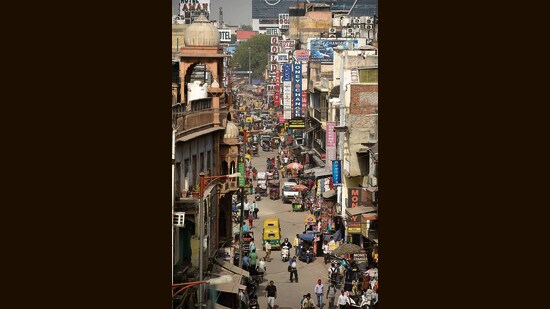
This Delhi is far removed from both the monuments of the past as well as the glitzy skylines of the future. It is a liminal, uncertain place, a shadow city; seedy, sleazy, suffocating and with widening chasms between the haves and the have-nots. Sitting near India Gate, the protagonist muses: “The sky is grey, so is the air, while the sound of construction rumbles from all sides. Everywhere, they are building something, another India rises out of the Earth around us. A new Parliament, for a newly born grey India, where the air is thicker than fog.” He is a flaneur; the city opens itself to him, especially after sunset: “I have hours on my hands and decide to walk, as I often do, until the streets become my home. The night can wrap a person as easily as a shawl, or a body. The few times I’ve felt free, if I’ve ever felt it, it’s these wanders through the city at night.”
Narrative-wise, the novel is straightforward. It follows an unnamed protagonist, a small-time hustler and thief who turns tricks from time to time. He has been with Jaggi ever since they met at a run-down underground queer club where the latter sings in drag. Jaggi becomes the protagonist’s de-facto pimp although it is not an exploitative relationship; they dream of making enough money to one day settle near a beach in south India and lead a peaceful life together. At the moment, the two of them bunk with good-for-nothing Basam in a cramped, rundown house in Paharganj. Basam lets them stay because they pay his share of the rent and the protagonist also routinely steals for him.
{{/usCountry}}Narrative-wise, the novel is straightforward. It follows an unnamed protagonist, a small-time hustler and thief who turns tricks from time to time. He has been with Jaggi ever since they met at a run-down underground queer club where the latter sings in drag. Jaggi becomes the protagonist’s de-facto pimp although it is not an exploitative relationship; they dream of making enough money to one day settle near a beach in south India and lead a peaceful life together. At the moment, the two of them bunk with good-for-nothing Basam in a cramped, rundown house in Paharganj. Basam lets them stay because they pay his share of the rent and the protagonist also routinely steals for him.
{{/usCountry}}Paharganj is popular with tourists due to the abundance of cheap hotels and its proximity to the New Delhi Railway Station but it also has an unsavoury reputation that draws the desperate and the ruthless. In one of his aimless walks in the area, the protagonist goes to a single-screen movie theatre, a relic of the past with one of those “special” matinee shows where a generic action film is cut with sequences from hardcore desi pornography. During another foray, he strikes an acquaintance with Susan, an American woman, at one of the tourist cafes. She has left the comforts of her life, and her well-educated parents, to live in Himachal at the ashram of a man who sounds more like a conman, sex pest, and cult leader than a guru. Still, she remains oblivious, and later resigned, to her exploitation.
It is clear that the protagonist is no saint – none of these characters are. He once forced a man to part with his wedding ring, the only reminder of his dead wife, when he could not pay for sex. He works for a man who runs an international scamming ring targeting old widows in the US. He grows close to the Big Man’s girl Friday — she calls herself Beatrice — since they come from similar backgrounds: “Solid, uptight family, proper Indian middle class, richer than most.” The protagonist was packed off to military school after he and a male cousin were caught sexually experimenting as teenagers. He quit at the end of the year and learned to survive on his own. Beatrice, instead of pulling it together after a wild teenage, spiralled further and turned to porn before joining the Big Man.
In the book, smell — of bodies and places — serves to set the scene just as much as any other sense. Sidhu sub-textually builds on the sociocultural, political and historical significance of smells within an Indian context where it is a marker of identity. When the protagonist is almost stopped by the guard at a posh store, he thinks: “How they see it, I don’t know. Maybe it’s smell. The odour of caste, of class, the aroma of your bank balance.” There are smells and feelings associated with the people around him too. In Basam’s case: “He smells of the street, of age and heartbreak and corruption, as if its very essence has found a home inside him.” For Jaggi: “Jaggi’s odour on the sheets is a protective cloak and I fall asleep inhaling the aching musk of his taut body.”
Not for the faint of heart, Night in Delhi is contemporary noir with no interest in sanitising the messiness of life in its exploration of desire, pleasure, queerness, power, and ambition. The opening scene sets the tone and the narrative often goes to uncomfortable and morally grey places in terms of sexual content and violence. The author also has a great way with words: peak traffic becomes “headlight-drunk streets” and someone floating in the sky in a dream sees “the planet’s curve like a man’s sensuous hip lying on a bed”. Dispensing with the usual rose-tinted glasses through which Delhi is seen in many stories set in the city, this is a gritty portrait of people just trying to survive.
Areeb Ahmad is an independent writer. He lives in New Delhi. He is @Bankrupt_Bookworm on Instagram.