Living in 2019, it can appear that mainstream acceptance of the Lesbian, Gay, Bisexual, Transgender (LGBT) community was always a given – especially in a world where Section 377 of the Indian Penal Code has been read down, where the abuse of the queer community does not have the sanction of the laws of the land and where there is no debate, at least in the mainstream media, about the rights these communities should enjoy.
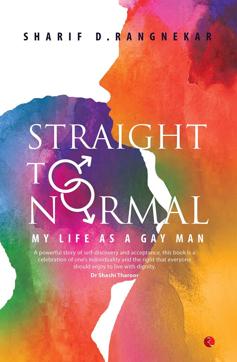
But it was not always so – and that is what Sharif Rangnekar’s book Straight to Normal is about. A slim 200-something page volume, the book narrates the journey of the author, a top journalist and public relations professional, over the course of three decades and therefore, is not just a personal memoir, but also a breezy chronicle of a slice of India’s queer rights movement.
The book begins in the author’s childhood and his explorations of sexuality through teenage and adulthood – in terms familiar to most young people stumbling through bodily changes and desires in a country where there is little acknowledgement, let alone discussion, of sexual developments. In loving detail, Rangnekar talks about his confusion as he found himself repeatedly not attracted to women – as was the norm – but in some indefinable way, to men.
His struggles with body weight and self-confidence all eminently relatable as is his hesitation in giving voice to his desire – an experience common to many queer people who grow up at a time or place where there is no one to tell them that they are not alone, or different, or wrong.
{{/usCountry}}His struggles with body weight and self-confidence all eminently relatable as is his hesitation in giving voice to his desire – an experience common to many queer people who grow up at a time or place where there is no one to tell them that they are not alone, or different, or wrong.
{{/usCountry}}In fact, loneliness is the one theme that ties the book together as the author attempts to take the reader through what it meant to be a gay man living in Delhi in the 1980s and 1990s, and through many fragments of long and short-term relationships.
A lot of the latter part of the book deals with the nascent activism that was mushrooming in Delhi around the late 90s, especially support groups run by the Naz Foundation, a leading non-governmental organisation that was the main petitioner in a case that had culminated in the Delhi high court reading down Section 377 in 2009.
It is fascinating to get a peek into the dynamics of groups of men coming together 20 years ago, the world around them completely different from what it is now, and their meetings. I had to remind myself that despite the relative invisibility of queer activism at that point, the city must have been teeming with same-sex activity and desire, of all castes, classes and regions. At one place, fittingly, Rangnekar brings up the question of security and feeling secure among gay men, wondering whether one felt secure only in the comfort of people of one’s own station.
I was slightly disappointed that the author didn’t spend more time on the meetings, the dynamics and the people. The breeziness of the book, one of its big strengths, also becomes a sticking point in some sections where maybe some pause-and-reflection at a momentous occasion, personal or professional, would be nicer.
Read more: In India I felt I had the permission to experiment: John Burbidge
My favourite sections of the book are right at the end – one where he tears apart the puerile media coverage of a 2005 murder of a gay man – and another where the author talks of himself and other queer people who had been in the city for years looking at anticipation at the Supreme Court deciding the Section 377 case. “Many of us spent a large part of our lives gathering courage to be ourselves,” exclaims one character. That one line sums up this simple, powerful story of self-discovery that doesn’t pretend to be anything else.