Rolling desert dunes could contain fish bones from a very distant, very different geographical past. Plain-looking coconut groves dotted with grazing animals could hold layers of life tracks from when coconuts were yet to be “discovered” and named by European seafarers. The ah-so-romantic past could become oh-so-problematic – depending on who is looking into it, why, and where. Though that is not how the science of archaeology was meant to be, digging into the past, rather than sparking wonder, building awareness of shared roots or cementing unity, can be used to fuel Us-Vs-Them battles. The Dig by Sowmiya Ashok highlights these and other aspects that probing into the past brings to the surface.
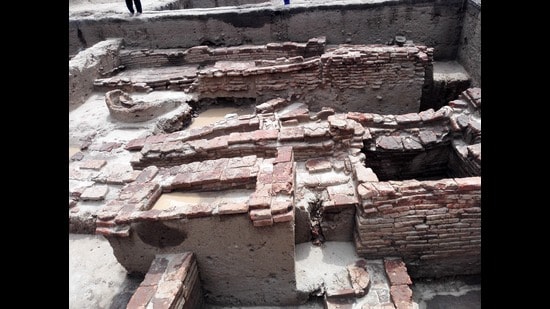
While the book is written in the context of various Indian archaeological sites and the political conversations they generated, what is in focus here is a sensational and controversial site – Keeladi (also called Keezhadi) in Tamil Nadu. By the banks of the Vaigai, near the internationally renowned city we now call Madurai, a coconut farmer’s land opened up a whole new storyline of very old times. The find was not just celebrated as proof of a highly evolved civilisation that thrived in what we now identify as Tamil Nadu – it was fought over.
As many social media users will attest, Keeladi is “reely” famous. After its discovery around 2013 and the official excavation that began in 2015, the place became more than a popular tourist spot and pre-wedding photo shoot destination. It became a battleground of questions and assertions to do with State Vs Centre, Tamil Vs Other Old Languages, and Dravidian Vs Vedic civilisation. The manner in which the author traces the events that followed the discovery of Keeladi underscores the continuum on which the past and present rest – tugging at each other with equal force.
{{/usCountry}}As many social media users will attest, Keeladi is “reely” famous. After its discovery around 2013 and the official excavation that began in 2015, the place became more than a popular tourist spot and pre-wedding photo shoot destination. It became a battleground of questions and assertions to do with State Vs Centre, Tamil Vs Other Old Languages, and Dravidian Vs Vedic civilisation. The manner in which the author traces the events that followed the discovery of Keeladi underscores the continuum on which the past and present rest – tugging at each other with equal force.
{{/usCountry}}Though the book is written in a breezy style, it is not a breezy read – packed as it is with information, research, interviews, historical dates, conversations, interviews and many details from diverse fields that intersect with archaeology. Sowmiya Ashok packs in a lot while firmly spotlighting how politics rarely steers clear of archaeological work and discoveries. Keeladi, since it was discovered, has been embroiled in so many political tussles that the report submitted on the excavations remains unpublished.
While it is impossible to take in the breadth of knowledge the book covers, the reader is struck by the passion informing those who unearthed that knowledge. The book describes not just the work of archaeologists but also of people from closely allied fields, and of those voraciously curious about the past. All of them, irrespective of their stakes in the field, are climbing hills, crawling into caves, craning their necks to read inscriptions, lingering in deep trenches, tasting ancient pottery, and walking alongside rivers. They are also engaging in debates, giving up their land for research, digging to look for potsherds, taking classes in ancient languages, going on scorching day trips to archaeological sites, trying to decipher antique scripts and participating in other such searches that seem to have no end.
The connection between ancient pottery and Sangam poetry that emerges from the book is interesting with the interweaving of poetry with the process of corroborating the past being a recurring pattern. The care and detail lavished by the ancient peoples on their own at the end of their lives, their skills in crafting jewellery, their advanced trading practices, their sense of community living, planning and architecture – all make for absorbing reading. People finding pots of gold under a fallen tree and precious beads on their land while farming or construction add to the list of routine but incredible happenings in and around Keeladi.
The author candidly anchors the book in her personal identity as a “native Tamil.” In the epilogue, she describes how people are hungry to find their origin story and like to believe that they come from a glorious past. Yet, “with the State acting as the custodian of how our past is studied and remembered over time, these stories have become political games to capture who is indigenous to this land,” she writes. The book also unflinchingly states how “archaeology played a central role” in the political projects to negate the plurality and multiculturalism at the core of India’s story and history.
Should we not be looking “to find answers for their own sake?” – to quote Nisha Yadav, a linguistic researcher whose work finds mention in the book? Why is archaeology still practised with its “colonial trappings” intact? Why can’t the science of “searching the mud” be separated from the jingoism of those who claim power over it? How can scientists across fields be enabled to work in a more objective environment? Is it even possible to not get emotional about the past? What will future generations think about and learn from these finds? These are some of the questions that The Dig brings to the fore.
Charumathi Supraja is a writer, poet and journalist based in Bengaluru.