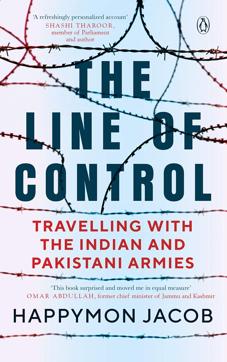
What sets Happymon Jacob’s The Line Of Control from the countless tomes written about the militaries of arch-rivals India and Pakistan over the decades is the access granted to the author to formations and personnel arrayed on both sides of the 740-km ceasefire line in Jammu and Kashmir.
Men and officers, who have spent the last few years trading heavy fire along the LoC and even possibly taking the lives of those arrayed on the other side, welcomed Jacob into their offices, messes and bunkers and allowed him to get a very special insight into what makes these people tick and why things flare up on the frontline.
The ceasefire along the LoC, put in place in November 2003, has come under increasing strain in the last few years as tensions have spiked between India and Pakistan, usually in the aftermath of attacks blamed on Pakistan-based terror groups. The LoC was also the scene of the surgical strikes carried out by India in 2016 in response to the terror attack on an army facility at Uri in Jammu and Kashmir.
Jacob’s exploration of the issues that shape and fashion military decision-making and the reasons for ceasefire violations on both sides of the LoC, thus, is timely. His work over the years in Track II efforts for India-Pakistan peace and his nuanced newspaper columns and articles are what convinced both Indian and Pakistani army commanders to give him access to both sides of the LoC.
{{/usCountry}}Jacob’s exploration of the issues that shape and fashion military decision-making and the reasons for ceasefire violations on both sides of the LoC, thus, is timely. His work over the years in Track II efforts for India-Pakistan peace and his nuanced newspaper columns and articles are what convinced both Indian and Pakistani army commanders to give him access to both sides of the LoC.
{{/usCountry}}Senior Congress leader Shashi Tharoor describes Jacob’s book as a “refreshingly personalised account”, and this is the book’s biggest strength and also its greatest weakness.
As someone who has travelled with the Indian and Pakistani armies, by road and in helicopters, on both sides of the LoC, including to bunkers and posts in Pakistan-occupied Kashmir close to the Kaman Aman Setu, this writer can appreciate the excitement in getting close to places that very few Indians can access. Or the excitement of gaining access to the General Headquarters in Rawalpindi, which this writer has visited twice. Jacob, of course, benefits from having been able to spend much more time on the ground and getting access to officers such as the Chief of General Staff.
Jacob uses an analyst’s keen eye and the skills of a dogged researcher to give us a look into the minds of officers such as Major General Azhar Abbas, the head the Pakistan Army’s 12 Infantry Division at Murree and Lieutenant General DS Hooda, the former chief of the Indian Army’s Northern Command and the man who planned and oversaw the 2016 surgical strikes.
It is rather obvious from the book that Jacob didn’t have as much access to low-ranking personnel on the Pakistani side (in itself unsurprising, as he would have been viewed by many as a person from an “enemy country”) as he did on the Indian side. Despite this shortcoming, the author offers useful nuggets of information gleaned from his numerous interactions with all the personnel.
However, Jacob’s decision to merge the interesting backstory of exactly how he managed to secure permission to visit the Pakistani side of the LoC – including the intercession on his behalf by retired Pakistani generals and diplomats he befriended on the Track II circuit – with the first few chapters recounting his travels in Pakistan tends to slow down the narrative of what is otherwise a very fast-paced book. It is almost like watching a movie with too many flashbacks that bring things to a juddering halt.
The highly personalised nature of the book also leads to over-analysis of minutiae such as whether the Pakistan Army and its intelligence wings have a file or a dossier on Jacob. This is a given for anyone allowed any sort of access to Pakistan on a regular basis, and, from this writer’s personal experience, such files, once created, have things added a regular basis.
Jacob’s tales of his travels within Pakistan are leavened with the usual elements – the problems of taking a bottle of single malt into the country and the ubiquitous minders on their rickety motorcycles – but his humorous takes on such episodes sets them apart. Like for example, the prolonged spat between the minders and a group of soldiers over whether Jacob, even when escorted by a recently retired general’s bodyguard, should be allowed into Lahore Cantonment, which is off-limits to all Indians.
Read more: The troubling rise of Indo-Pak border tensions
Possibly the most fascinating bits in the book are the explanations provided by Indian and Pakistani army officers for ceasefire violations on the LoC and the methods used to respond to such violations, which Jacob describes as the “perfect symmetry of firing”. That he also deftly captures the suffering caused by such exchanges of fire among people living along the LoC is a bonus, bringing in the terrible human costs of a volatile ceasefire line.
The Line Of Control is will clearly appeal to readers who want to expand their understanding of the militaries of India and Pakistan and the situation on the LoC, which is so closely intertwined with the current tensions between the two countries.