Book: Chander & Sudha (English translation of Dharamvir Bharat's Gunahon Ka Devta by Poonam Saxena)Publisher: Penguin VikingPages: 351Price: Rs 499
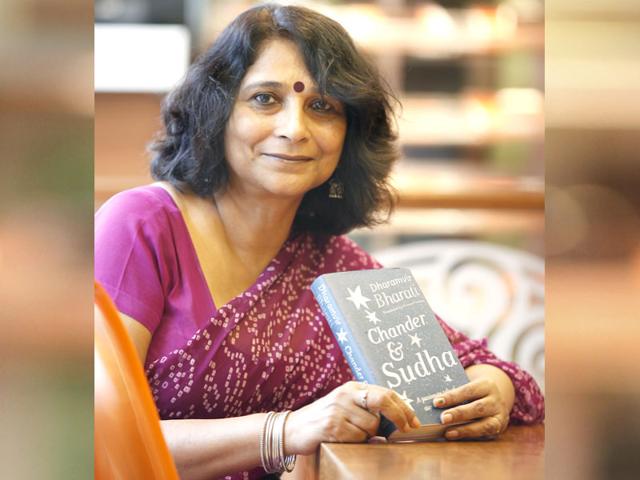
Chander Aur Sudha - the first translation of Dharamvir Bharati's iconic novel, Gunahon Ka Devta -- by editor of the weekly Brunch, journalist and writer Poonam Saxena, has caught the imagination of readers, who have lapped up the intense love story. Little wonder that Saxena's phone hasn't stopped ringing for the past several weeks, since apart from the regular readers, whosoever has read the book can't stop raving about the easy translation and the justice she has done to what can be called a classic in the popular literature category.
In 1949, Dharamvir Bharati, one of Hindi literature's best-known writers, wrote a hugely bestselling novel about a young man, Chander, and his relationships with the three women in his life: Sudha, the woman he loves but does not marry, Pammi, the woman he has an affair with and Binti, Sudha's cousin with whom he has a close but complex relationship.
The Penguin-published Chander & Sudha being the first translation of the novel, has evoked keen interest among bibliophiles. Arnab Banerjee caught up with Poonam Saxena in a candid chat.What made you choose Dharmvir Bharati's Gunahon Ka Devta for translation?This tragic love story is unconventional yet timeless, but there are two things about the novel that attracted me and they are so intertwined that one can't be separated from the other. The most compelling love stories are the tragic ones and I was haunted by the sheer emotional power of this love story which pierces through one's heart like an arrow. It's also tied up with nostalgia - 1940s India, the Ganga, the life and times in Allahabad, poetry readings... It was a great phase on the one hand and yet a very difficult time for young people to realise their aspirations since everything was so circumscribed by the times and a conservative society. It was difficult for young people, especially for girls, to realise their dreams. To bring personal happiness to fruition was very tough in that age. I was born in Kanpur and can totally identify with the ambience of the book.Has anything changed between then and now?A lot hasn't changed, even today individual aspirations are often impossible to achieve… Of course, many changes have also happened since then. For instance, when Sudha gets married, a pall of gloom and melancholy descends on the family that lasts till the time of bidaai. It's very heart-wrenching. That has changed today to a large extent -- in 2015, a girl can visit her parents after marriage whereas earlier, once a girl was married, she had to be completely cut off from her parents and her earlier life. Bidaai songs like Babul mora…are a testimony to how anguished this parting was. Imagine, young brides couldn't just visit their parents post marriage; they had to seek permission from their in-laws. These things may be alien to us in this day and age, but the conflicts and tensions in a marital relationship, between love and duty, the subject of inter-caste marriages, are still there. We may pride ourselves as being progressive, but in our pluralistic society across India, we are still grappling with sex and ideal love, religious discrimination, societal constraints, platonic relationships, helplessness, whether sex is a necessary part of love, or what ideal love is ….Therefore, tell me, has everything changed? The book is a very vital read even today.Is that why nearly all the characters have sad endings…My heart aches for all the characters because of this reason. This is why I feel very emotionally tied to the characters and their fates. One is gripped with nostalgia but when I look deep within the several layers of the lives of women of that age, I feel it must have been a very difficult time for them. Also, love was so different then: when you were parted from your loved ones, there were no mobile phones or internet to communicate with them. There was only one way to keep in touch: write letters.But in the story, it's a man struggling with his remorse-ridden heart about infidelity…Precisely. Chander is sensitive and an idealist with high notions of nobility. This is a love story without any sex between him and Sudha. He succumbs to carnal desires at a weak moment of his life and feels he has betrayed Sudha by having a physical relationship with another woman, Pammi. He is idealistic and torn between his love and his sense of duty, and though he always had Sudha on his mind, he refrained from approaching her directly. At the same time, he understands completely that he didn't have a future with Pammi. For Pammi too, who's a bold, unconventional character, it's very hard to find acceptance as an oddity, as a single independent young woman. Eventually, she decides to go back to her estranged husband since it's hard for her to live independently…Sudha remains repressed and trapped in a marriage not of her choice.
During the 1940s, Dharmvir Bharati's novel was considered courageously daring enough for it to be seen as unfit for young people and teenagers in some families.What other changes do you see between the late 1940s (the time the story is set in) and now, in 2015? Are there any major changes in our society?Yes and no. Inter-caste marriages are not a taboo anymore. At the same time, they are a taboo in many sections of society. In the present scenario, an inter- faith marriage can wreak havoc. Therefore, paradoxically speaking, a lot has changed, but may be, not that much has changed.What challenges did you face while translating the novel?The original is written so beautifully in Hindi that one cannot dream of translating the book word for word. That would have also made the language very stilted and the flow would have been lost. One would have found it difficult to read it. For a passionate and moving story like this, the nuances in Hindi are even more difficult to translate. I decided to write the novel in such a manner so as to make it read like a novel in English. I tried to retain the essence of the original by preserving the emotions and the innermost feelings of the characters.Did you also try and reinterpret some of it?Yes, one has to deduce and thus re-interpret some of it. There is a line where Binti tells Chander that "gaon ki ladkiyan to sab kuch…" It set me thinking as to what the writer means by "sab kuch"? At another point, Chander tells Sudha that it's only initially that there is some nasha in a marriage, and that gradually that nasha wears off. What exactly is he referring to? Being too elegant a person, he doesn't say anything explicitly to Sudha, but Sudha has been in a physical relationship with her husband - a thought he can't bear - and this nagging feeling weighs heavily on his heart. There are times when the characters don't say much and one needs to re-read the lines over and over again to get to the hidden meanings.The novel was written when Dharmvir Bharati was 21-22. Do you think he curbed himself while expressing himself, considering the times he lived in?On the contrary he says a lot of things without making them too obvious. I wouldn't know whether he really curbed himself or not, but the novel's contents were considered courageously daring enough for it to be seen as unfit for young people and teenagers in some families. It is also the elegance of his writing that much remains unsaid in the book; he doesn't state everything explicitly…Some of the issues raised in the book ring a bell even today…I am no scholar of Hindi to critically evaluate the greatness of his works, but I see this book as a great story told with earnestness in which delicate understated fine distinctions covering duty, friendship, platonic love, sublime love or unrequited love, marriage, relationships, inter caste marriage et al have been dealt with most sensitively. It holds a mirror to the society of India of the 40s.The fact that the novel tasted great commercial success went against it to some extent since many critics and even some of his contemporaries dubbed the book as just a novel about 'adolescent love.' Dharamvir Bharati himself believed that this was perhaps somewhat inferior to his other works like Andha Yag or Suraj Ka Satwan Ghoda. I, for one, very strongly believe that some of the issues he has raised in the book are still relevant today. Plus, I being romantic at heart, often ask myself, "Where are the great love stories being written these days?"Why doesn't Chander propose to Sudha?When one reads the book the first time one wonders why Chander holds himself back, why he doesn't propose to Sudha. Or what is it that prevents him from confessing his love for her? As one reads and rereads the novel, the whole picture emerges quite clearly. The first and foremost reason is caste. Sudha's father Professor Shukla feels love is transient. He also disapproves of inter-caste marriage. Chander has deep reverence and gratitude for him that doesn't permit him to even broach the subject of marriage to his daughter. He knows very well that Shuklaji would not be in favour of an inter-caste marriage. He also owes everything to Shuklaji. Chander is like a protector of the house, he is like a member of their family. There is so much trust Chander enjoys in the family that he finds it impossible to muster up the courage to ask for Sudha's hand for marriage and believes that he would be abusing the trust placed in him. Sudha too sacrifices her love at his urging.Why was the book titled Gunahon Ka Devta?This is very interesting. I had initially thought that the fact that Chander behaves badly with Sudha once she gets married is the reason he is called the Gunahon Ka Devta. But in a conversation with Pushpa Bharati (Dharamvir Bharat's widow), we also discussed about how he is also responsible for moulding Sudha into the woman she becomes. He influences her in every which way. He is the one who gives Sudha the idea of love, that love is always sublime, therefore when she marries Kailash she finds it difficult to accept him as her husband. Chander's gunah (crime) is: Why did he make Sudha so enamored of him or perennially dependent on him? The irony is that in reality love is not that sublime. One wonders if that kind of love is really possible to come by, though in one's heart of hearts one always yearns for inspiring, uplifting love. Chander is also full of ego and cannot bear the thought of Sudha being married to someone else, but doesn't do anything about it. Sudha tells him that he is the one responsible for her pitiable state since she and Kailash don't really have a normal marital relationship. There is this loathing inside Chander that she belongs to another man. He believes that he could have anytime made Sudha his own but refrained from doing so.Any plans of translating Dharmvir Bharati's other works too?I have read all his works and may be, some day I would like to translate some of his short stories too. As I said earlier, it is in his elegance of writing that makes his style so alluring. He doesn't state everything but one needs to read between the lines to truly comprehend the deep-rooted meanings he tries to communicate. So, it would be yet another challenge for me.
{{/usCountry}}During the 1940s, Dharmvir Bharati's novel was considered courageously daring enough for it to be seen as unfit for young people and teenagers in some families.What other changes do you see between the late 1940s (the time the story is set in) and now, in 2015? Are there any major changes in our society?Yes and no. Inter-caste marriages are not a taboo anymore. At the same time, they are a taboo in many sections of society. In the present scenario, an inter- faith marriage can wreak havoc. Therefore, paradoxically speaking, a lot has changed, but may be, not that much has changed.What challenges did you face while translating the novel?The original is written so beautifully in Hindi that one cannot dream of translating the book word for word. That would have also made the language very stilted and the flow would have been lost. One would have found it difficult to read it. For a passionate and moving story like this, the nuances in Hindi are even more difficult to translate. I decided to write the novel in such a manner so as to make it read like a novel in English. I tried to retain the essence of the original by preserving the emotions and the innermost feelings of the characters.Did you also try and reinterpret some of it?Yes, one has to deduce and thus re-interpret some of it. There is a line where Binti tells Chander that "gaon ki ladkiyan to sab kuch…" It set me thinking as to what the writer means by "sab kuch"? At another point, Chander tells Sudha that it's only initially that there is some nasha in a marriage, and that gradually that nasha wears off. What exactly is he referring to? Being too elegant a person, he doesn't say anything explicitly to Sudha, but Sudha has been in a physical relationship with her husband - a thought he can't bear - and this nagging feeling weighs heavily on his heart. There are times when the characters don't say much and one needs to re-read the lines over and over again to get to the hidden meanings.The novel was written when Dharmvir Bharati was 21-22. Do you think he curbed himself while expressing himself, considering the times he lived in?On the contrary he says a lot of things without making them too obvious. I wouldn't know whether he really curbed himself or not, but the novel's contents were considered courageously daring enough for it to be seen as unfit for young people and teenagers in some families. It is also the elegance of his writing that much remains unsaid in the book; he doesn't state everything explicitly…Some of the issues raised in the book ring a bell even today…I am no scholar of Hindi to critically evaluate the greatness of his works, but I see this book as a great story told with earnestness in which delicate understated fine distinctions covering duty, friendship, platonic love, sublime love or unrequited love, marriage, relationships, inter caste marriage et al have been dealt with most sensitively. It holds a mirror to the society of India of the 40s.The fact that the novel tasted great commercial success went against it to some extent since many critics and even some of his contemporaries dubbed the book as just a novel about 'adolescent love.' Dharamvir Bharati himself believed that this was perhaps somewhat inferior to his other works like Andha Yag or Suraj Ka Satwan Ghoda. I, for one, very strongly believe that some of the issues he has raised in the book are still relevant today. Plus, I being romantic at heart, often ask myself, "Where are the great love stories being written these days?"Why doesn't Chander propose to Sudha?When one reads the book the first time one wonders why Chander holds himself back, why he doesn't propose to Sudha. Or what is it that prevents him from confessing his love for her? As one reads and rereads the novel, the whole picture emerges quite clearly. The first and foremost reason is caste. Sudha's father Professor Shukla feels love is transient. He also disapproves of inter-caste marriage. Chander has deep reverence and gratitude for him that doesn't permit him to even broach the subject of marriage to his daughter. He knows very well that Shuklaji would not be in favour of an inter-caste marriage. He also owes everything to Shuklaji. Chander is like a protector of the house, he is like a member of their family. There is so much trust Chander enjoys in the family that he finds it impossible to muster up the courage to ask for Sudha's hand for marriage and believes that he would be abusing the trust placed in him. Sudha too sacrifices her love at his urging.Why was the book titled Gunahon Ka Devta?This is very interesting. I had initially thought that the fact that Chander behaves badly with Sudha once she gets married is the reason he is called the Gunahon Ka Devta. But in a conversation with Pushpa Bharati (Dharamvir Bharat's widow), we also discussed about how he is also responsible for moulding Sudha into the woman she becomes. He influences her in every which way. He is the one who gives Sudha the idea of love, that love is always sublime, therefore when she marries Kailash she finds it difficult to accept him as her husband. Chander's gunah (crime) is: Why did he make Sudha so enamored of him or perennially dependent on him? The irony is that in reality love is not that sublime. One wonders if that kind of love is really possible to come by, though in one's heart of hearts one always yearns for inspiring, uplifting love. Chander is also full of ego and cannot bear the thought of Sudha being married to someone else, but doesn't do anything about it. Sudha tells him that he is the one responsible for her pitiable state since she and Kailash don't really have a normal marital relationship. There is this loathing inside Chander that she belongs to another man. He believes that he could have anytime made Sudha his own but refrained from doing so.Any plans of translating Dharmvir Bharati's other works too?I have read all his works and may be, some day I would like to translate some of his short stories too. As I said earlier, it is in his elegance of writing that makes his style so alluring. He doesn't state everything but one needs to read between the lines to truly comprehend the deep-rooted meanings he tries to communicate. So, it would be yet another challenge for me.
{{/usCountry}}